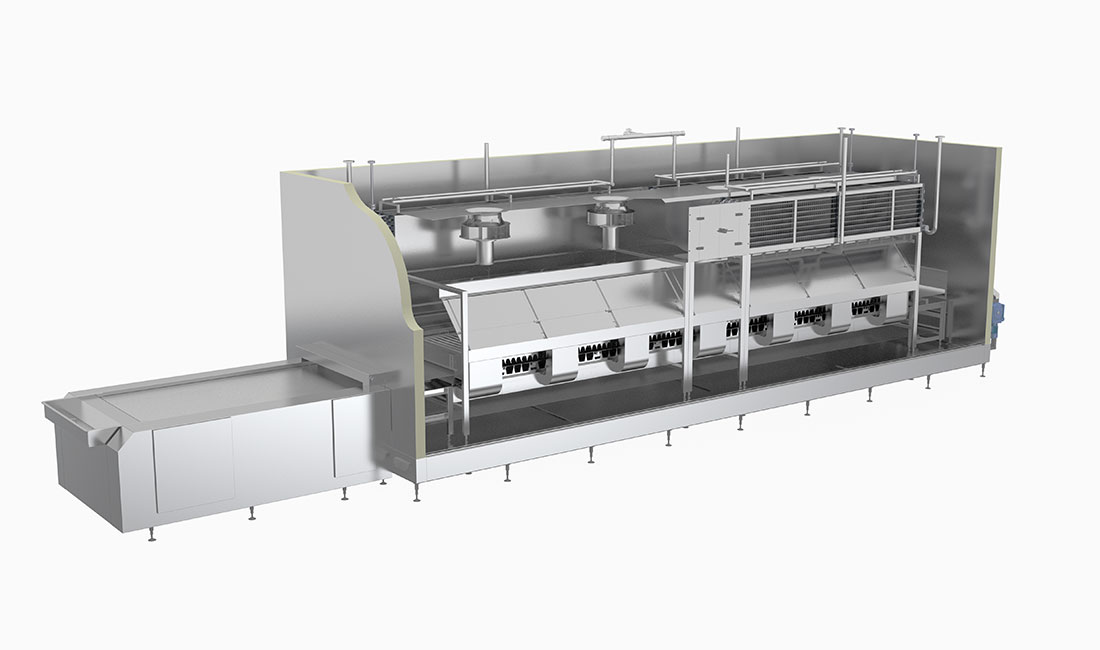
Un petit congélateur à tunnel IQF est un congélateur à bande continue destiné aux installations pilotes, aux start-ups agroalimentaires et aux petits transformateurs qui ont besoin d’une qualité IQF à un débit réduit. Il congèle les morceaux d’aliments un par un à l’aide d’air froid à grande vitesse, ce qui permet de préserver la texture, la couleur et le rendement avant le passage à une ligne de production plus importante.
S'appuyant sur notre expérience en matière d'équipements de congélation industriels et de projets d'usines pilotes, ce guide explique le fonctionnement des petits congélateurs à tunnel IQF et dans quels cas ils constituent le choix le plus approprié. Il aborde la capacité, la conception des bandes transporteuses, la circulation d’air, les fluides frigorigènes, l’hygiène, l’encombrement, les besoins en énergie, le coût, le retour sur investissement, l’installation, l’assistance technique et les erreurs d’achat courantes. Il compare également les congélateurs à tunnel aux modèles à armoire, à spirale et cryogéniques.
Qu'est-ce qu'un petit congélateur à tunnel IQF ?
Un petit congélateur à tunnel IQF est un système de congélation à bande continue dont la capacité de traitement est comprise entre 100 et 1 500 kg/h. Il congèle les produits alimentaires individuellement à l'intérieur d'un tunnel isolé à l'aide d'air froid à haute vitesse, à une température comprise entre -35 °C et -45 °C. Il est destiné aux installations pilotes et aux petits producteurs.
Comment fonctionne le procédé de surgélation IQF ?
La technologie IQF (congélation individuelle rapide) évacue rapidement la chaleur de chaque morceau d’aliment afin que sa température à cœur descende en dessous de -18 °C en moins de 30 minutes. Le produit traverse la zone de formation des cristaux de glace (de 0 °C à -5 °C) trop rapidement pour que de gros cristaux puissent se former. Les petits cristaux préservent les parois cellulaires, la couleur, la texture et le rendement après décongélation.
Quelle fourchette de débit correspond à la catégorie « petite » ?
Selon les pratiques du secteur, un débit compris entre 100 et 1 500 kg/h correspond à la catégorie des petits tunnels. En dessous de 100 kg/h, les armoires de congélation par lots constituent une solution plus économique. Au-delà de 1 500 kg/h, les systèmes industriels à bandes multiples deviennent plus rentables au kilogramme.
Quels sont les composants essentiels de ces équipements ?
Un petit tunnel IQF comprend six composants :
- Enceinte isolée — Panneaux sandwich en PIR ou en PU
- Tapis roulant — treillis en acier inoxydable ou plastique perforé
- Serpentins d'évaporateur — des échangeurs de chaleur qui absorbent la charge thermique
- Ventilateurs centrifuges — fournissent de l’air froid à grande vitesse, entre 6 et 10 m/s
- Compresseur frigorifique — utilise comme fluide frigorigène le NH₃, le CO₂ ou un HFC
- Système de commande par automate programmable (PLC) — régule la vitesse du tapis roulant et les cycles de dégivrage
À qui s'adresse un petit congélateur à tunnel IQF ?
Petits congélateurs à tunnel IQF conviennent aux installations pilotes, centres de R&D, start-ups agroalimentaires, transformateurs spécialisés et co-fabricants sous contrat. Ces utilisateurs ont besoin de performances IQF de niveau industriel avec un débit moindre, un encombrement réduit et un investissement en capital inférieur à celui requis par les lignes industrielles à grande échelle.
Les cinq profils d’acheteurs partagent trois caractéristiques opérationnelles :
- Débit inférieur à 1 500 kg/h
- Surface au sol limitée, généralement inférieure à 80 m²
- Besoin d’une qualité IQF (congélation individuelle rapide) conforme aux normes d’exportation pour plusieurs références (SKU)
Est-ce le bon choix pour une usine pilote ?
Un petit tunnel IQF constitue la plateforme pilote la plus représentative pour la mise à l'échelle industrielle. Il reproduit la géométrie du flux d'air, le temps de séjour sur la bande et la dynamique de déshydratation des lignes à grande échelle. Les congélateurs à armoire ne peuvent pas reproduire le transfert thermique en continu sur bande, de sorte que leurs données ne permettent pas de déterminer le dimensionnement industriel.
Est-ce adapté à une start-up en phase de démarrage ?
Un petit tunnel IQF convient aux start-ups qui lancent des références de produits surgelés à un volume commercial. À cette échelle, le coût d’investissement reste raisonnable. L’équipement répond aux normes d’hygiène requises pour l’exportation, et les opérateurs peuvent traiter plusieurs recettes sur un même tapis roulant en ajustant la vitesse et le temps de séjour.
Comment un petit congélateur à tunnel IQF se compare-t-il aux autres options de congélation à petite échelle ?
Un petit tunnel IQF surpasse les congélateurs à armoire en termes de débit continu, est plus économique que les systèmes cryogéniques sur le long terme et nécessite une hauteur sous plafond inférieure à celle des congélateurs à spirale. C'est le choix le plus équilibré dans la gamme de 100 à 1 500 kg/h.
Le tableau ci-dessous résume les compromis entre les différentes options de congélation à petite échelle. Les chiffres de débit correspondent aux modèles les plus compacts de chaque catégorie :
| Type | Débit | Encombrement | Idéal pour | Restriction principale |
| Armoire / lot | <100 kg/h | Le plus petit | Essais en laboratoire, micro-lots | Non continu |
| Petit tunnel IQF | 100–1 500 kg/h | Linéaire, compact | Installations pilotes, start-ups | Longueur linéaire au sol |
| Congélateur à spirale compact | 300–2 000 kg/h | Grand format vertical | Temps de séjour prolongé | Hauteur sous plafond requise |
| Cryogénique LN₂ / CO₂ | 100–500 kg/h | Le plus petit | Produits haut de gamme et collants | Coût de fonctionnement élevé lié à la consommation de gaz |
Quand un congélateur à tunnel est-il préférable à un congélateur à armoire ?
Un congélateur à tunnel est préférable dès lors que la production devient continue. Les congélateurs à armoires congèlent par lots, ce qui limite le rendement quotidien. Les tunnels permettent également d'obtenir des produits IQF s'écoulant librement ; les congélateurs par lots produisent des agglomérats qui doivent être séparés manuellement avant le conditionnement. Le compromis global entre IQF et surgélation rapide aborde en détail la qualité, le rendement et les coûts.
En quoi diffère-t-il d’un congélateur à spirale compact ?
Un petit tunnel utilise une disposition horizontale ; un congélateur à spirale utilise un empilement vertical. Les tunnels conviennent aux produits à temps de séjour court, comme les légumes et les crevettes. Les congélateurs à spirale conviennent aux produits à temps de séjour plus long, comme les raviolis, les produits de boulangerie et la viande non désossée. Les tunnels nécessitent également moins de hauteur libre.
Dans quels cas la congélation cryogénique IQF est-elle la plus indiquée ?
La congélation cryogénique IQF est indiquée pour les produits haut de gamme dont le volume quotidien est faible. L’azote liquide et le CO₂ congèlent plus rapidement que les systèmes mécaniques. En contrepartie, il faut compter avec le coût récurrent du gaz, qui dépasse généralement les coûts d’exploitation d’un tunnel mécanique en moins de 12 mois, à production constante.
Quelles sont les spécifications techniques les plus importantes à prendre en compte lors du choix d’un équipement ?
Six caractéristiques techniques influencent le plus les performances : la configuration de la bande transporteuse, la température d'évaporation, le type de fluide frigorigène, la vitesse du flux d'air, la méthode de dégivrage et la conception hygiénique. Ces paramètres déterminent le débit, la qualité du produit et les coûts d'exploitation.
Quelle configuration de bande transporteuse et de flux d’air offre les meilleures performances ?
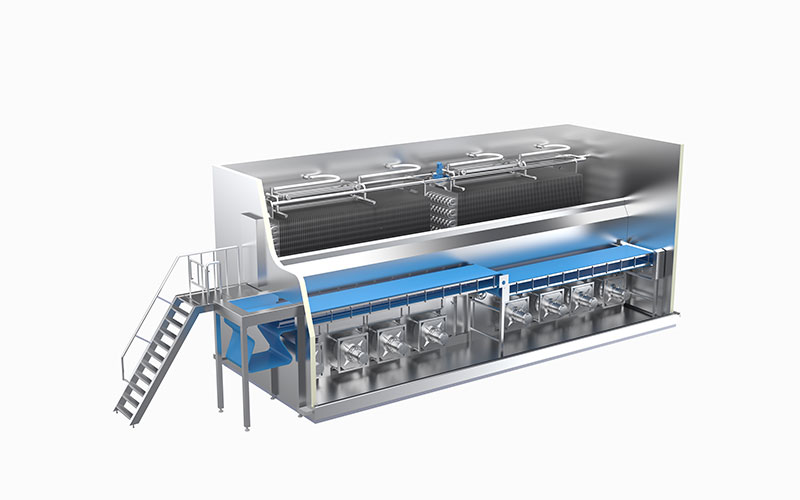
Une conception à double tapis offre de meilleures performances qu'un modèle à simple tapis pour les produits collants. Les choix de configuration varient selon le type de produit :
- Double tapis — le premier tapis congèle en surface, le second durcit ; idéal pour les produits collants comme la viande en dés
- Maille en acier inoxydable — idéal pour les produits de la mer et la viande
- Plastique perforé — idéal pour les fruits et baies délicats
- Vitesse de l'air — Une vitesse de 6 à 10 m/s avec un flux par le haut et par le bas élimine les points chauds
Quel réfrigérant est le mieux adapté à la congélation IQF à petite échelle ?
L’ammoniac (NH₃, R717) offre le meilleur rendement et le plus faible potentiel de réchauffement global (PRG) pour les installations fixes. Le CO₂ (R744) convient aux sites soumis à des restrictions de sécurité liées à l’ammoniac. Les HFC font l’objet d’une réduction progressive en vertu du règlement européen sur les gaz fluorés, ce qui réduit les quotas disponibles d’année en année.
Quelles sont les caractéristiques de conception hygiénique qui ne sont pas négociables ?
L'acier inoxydable 304 de qualité alimentaire, les joints entièrement soudés et une géométrie compatible CIP sont obligatoires. L'unité doit être conforme aux codes HACCP et aux codes d'exportation des marchés d'importation. Les équipements Square Technology sont certifiés CE (UE), ASME et PED pour la conception des récipients sous pression, U2 pour les récipients de la Section VIII Division 2, CSA pour l'Amérique du Nord et CRN pour l'enregistrement provincial canadien.
Quelles sont les exigences en matière d'encombrement, de puissance et de raccordements aux réseaux ?
Un petit tunnel IQF nécessite généralement les conditions d’installation suivantes ; les chiffres exacts dépendent de la capacité et de la configuration :
- Surface au sol — 30 à 80 m²
- Alimentation — triphasé 380–415 V
- Air comprimé — 6 bar
- Alimentation en eau — pour les cycles de dégivrage
- Hauteur libre sous plafond — 3,5 m minimum
Quel est le coût réel de possession d'un petit congélateur à tunnel IQF ?
Le coût total de possession combine l'investissement initial, la consommation d'énergie et d'eau, les recharges de fluide frigorigène, la maintenance programmée et la main-d'œuvre. Pour les opérations pilotes et de démarrage à un taux d'utilisation modéré, le délai de rentabilité se situe généralement entre 18 et 36 mois.
Quels sont les facteurs qui déterminent le coût d'investissement ?
La capacité, le type de fluide frigorigène, le niveau d’automatisation et le champ d’application de la certification déterminent le coût d’investissement. Une unité au NH₃ de 200 kg/h portant le marquage CE coûte moins cher qu’une unité au CO₂ à double bande de 1 200 kg/h accompagnée d’une documentation d’exportation complète. Les fabricants intégrés verticalement réduisent leurs dépenses d’investissement (CapEx) en produisant en interne les évaporateurs, les panneaux et les bandes transporteuses.
Quels sont les coûts d'exploitation courants ?
L'électricité représente la majeure partie des dépenses d'exploitation (OpEx), généralement entre 60 et 70 % des coûts récurrents. L'eau de dégivrage, les appoints de fluide frigorigène, les lubrifiants et le remplacement des courroies constituent le reste. Les frais d'entretien annuels se situent généralement entre 3 et 5 %, ce qui correspond aux références en matière de coûts de réfrigération industrielle.
Comment calcule-t-on un retour sur investissement réaliste ?
Le retour sur investissement (ROI) correspond au gain annuel de marge brute généré par les références surgelées, divisé par le capital investi. Le format surgelé prolonge la durée de conservation de quelques jours à 12 à 24 mois, élargissant ainsi le rayon de distribution. La plupart des opérations pilotes permettent de récupérer le capital investi en 2 à 3 ans, avec un taux d’utilisation de 50 à 70 %.
Comment un petit congélateur à tunnel IQF permet-il de passer à une production industrielle ?
Un petit tunnel IQF reproduit la géométrie du flux d’air, le temps de séjour sur le tapis roulant et le profil de déshydratation des systèmes industriels, mais avec un débit réduit. Les données issues des essais pilotes concernant les courbes de température à cœur, le rendement et la perte de poids permettent de déterminer directement le dimensionnement des lignes IQF industrielles à grande échelle.
Quelles données issues des essais pilotes doivent être enregistrées ?
Cinq ensembles de données sont nécessaires pour le dimensionnement industriel :
- Courbe de température à cœur en fonction du temps de congélation
- Temps de séjour sur le tapis à une température à cœur cible de -18 °C
- Pourcentage de perte de poids des produits
- Fréquence et durée du cycle de dégivrage
- Consommation d'énergie par kilogramme congelé
Les ingénieurs utilisent ces cinq ensembles de données pour dimensionner l'évaporateur à l'échelle industrielle, en appliquant l'équation standard de charge thermique Q = m⋅cp⋅ΔT + m⋅LQ = m \cdot c_p \cdot \Delta T + m \cdot LQ=m⋅cp⋅ΔT+m⋅L. Ce calcul permet de déterminer la puissance du compresseur et la longueur de la courroie pour la ligne à grande échelle.
Pourquoi la gamme de produits d'un fabricant est-elle importante pour la mise à l'échelle ?
Le fait qu’un seul fabricant couvre toutes les échelles, du pilote à l’échelle industrielle, évite toute divergence des spécifications lors de la montée en puissance. Square Technology produit des tunnels de petite taille, des tunnels industriels, des congélateurs à spirale et des congélateurs à double spirale sur une même plateforme d’ingénierie. Les acheteurs qui utilisent l’ensemble de sa gamme de produits évitent ainsi de devoir changer de fournisseur en cours de projet.
Quelles sont les erreurs les plus fréquentes commises par les acheteurs novices ?
Les acheteurs novices commettent cinq erreurs récurrentes lorsqu'ils cherchent à acquérir un petit congélateur à tunnel IQF.
- Sous-estimation de la capacité. Prévoir des quantités correspondant au volume actuel entraînera des goulots d'étranglement d'ici 18 mois.
- Ne pas tenir compte de la réglementation relative aux fluides frigorigènes. La réglementation européenne sur les gaz fluorés (F-Gas) et la loi américaine AIM prévoient la réduction progressive des HFC à fort potentiel de réchauffement global (GWP) d’ici 2030.
- Choisir la cryogénie uniquement en fonction du prix. Les coûts liés au gaz (LN₂ ou CO₂) dépassent souvent les coûts d'exploitation (OpEx) liés aux équipements mécaniques au bout d'un an, à production constante.
- Négligence des audits de conception hygiénique. Les joints soudés, la pente de drainage et l’accès au nettoyage en place (CIP) déterminent les résultats des audits des détaillants.
- Sélection de fournisseurs ne disposant pas de réseaux de service après-vente. Des délais de livraison des pièces détachées supérieurs à quatre semaines entraînent l'arrêt de la production sur les petites lignes.
Comment se déroulent la livraison, l'installation et l'assistance à long terme ?
Les délais de livraison pour les petits tunnels IQF sur mesure sont généralement de 12 à 20 semaines. La livraison « clé en main » comprend les essais de réception en usine, l’installation sur site, la mise en service et la formation des opérateurs. Les fabricants reconnus disposent de réseaux de service après-vente mondiaux et proposent des diagnostics à distance.
Que comprend une solution clé en main ?
Une offre clé en main standard comprend cinq éléments :
- Plans techniques et calculs de contraintes
- Essai de réception en usine
- Expédition et installation sur site
- Mise en service et formation des opérateurs
- Documentation de certification pour le marché des acheteurs
À quel service après-vente les acheteurs peuvent-ils s'attendre ?
Les acheteurs bénéficient d’une garantie de 12 mois sur les équipements, d’une assistance technique disponible 24 h/24 et 7 j/7, ainsi que de pièces de rechange disponibles en stock. Square Technology exploite un réseau mondial de service après-vente Avec plus de 200 techniciens de terrain répartis sur les marchés d'exportation, l'entreprise fabrique en interne des évaporateurs, des panneaux, des courroies et des récipients sous pression, ce qui réduit les délais de livraison des pièces.
FAQ
Quel est le plus petit tunnel de congélation IQF disponible ?
Le plus petit tunnel IQF viable traite environ 100 kg/h. En dessous de ce seuil, les congélateurs à armoire ou à choc sont plus économiques.
Combien coûte un petit congélateur à tunnel IQF ?
Le coût d’investissement varie en fonction de la capacité, du fluide frigorigène et de l’étendue de la certification. Les acheteurs doivent demander des devis spécifiques à leur site plutôt que de se fier aux prix catalogue.
Combien de temps faut-il pour congeler des aliments dans un tunnel IQF ?
La durée de congélation varie de 8 à 30 minutes. La taille du produit, sa densité et la température à cœur souhaitée déterminent le temps de séjour.
Quelle est la différence entre un tunnel IQF et un congélateur à choc ?
Un tunnel IQF congèle les morceaux individuellement sur un tapis roulant continu. Un congélateur à choc congèle les produits par lots statiques et produit des morceaux agglomérés.
Un petit tunnel IQF peut-il traiter plusieurs produits différents ?
Oui. La vitesse variable de la bande transporteuse et le débit d’air réglable permettent à un même tunnel de traiter des légumes, des fruits de mer, de la viande et des produits de boulangerie au cours de différentes équipes.
Quel est le meilleur fluide frigorigène : le NH₃, le CO₂ ou les HFC ?
Le NH₃ offre le meilleur rendement énergétique. Le CO₂ convient aux sites soumis à des restrictions concernant l’ammoniac. Les HFC font l’objet d’une réduction progressive sur les marchés de l’UE et des États-Unis.
Quelle est la consommation électrique d'un petit tunnel IQF ?
La puissance connectée varie généralement de 50 à 250 kW selon la capacité. La consommation d'énergie par kilogramme de produit congelé est comprise entre 0,15 et 0,30 kWh.
Quel est le délai de livraison pour un petit congélateur à tunnel IQF ?
Le délai de livraison est de 12 à 20 semaines pour les configurations sur mesure. Les modèles standard sont livrés plus rapidement.
Est-il possible de transformer ultérieurement un petit tunnel en un modèle de plus grande capacité ?
Les rallonges de tapis et les serpentins d'évaporateur supplémentaires peuvent augmenter le débit de 20 à 30 %. Au-delà de ce seuil, un remplacement complet s'avère plus économique.
Quelles certifications les équipements doivent-ils posséder pour être exportés ?
CE pour l’UE, ASME et PED pour les récipients sous pression, U2 pour les récipients sous pression conformes à la section VIII, division 2 de l’ASME, CSA pour l’Amérique du Nord et CRN pour le Canada. Square Technology propose ces six certifications.