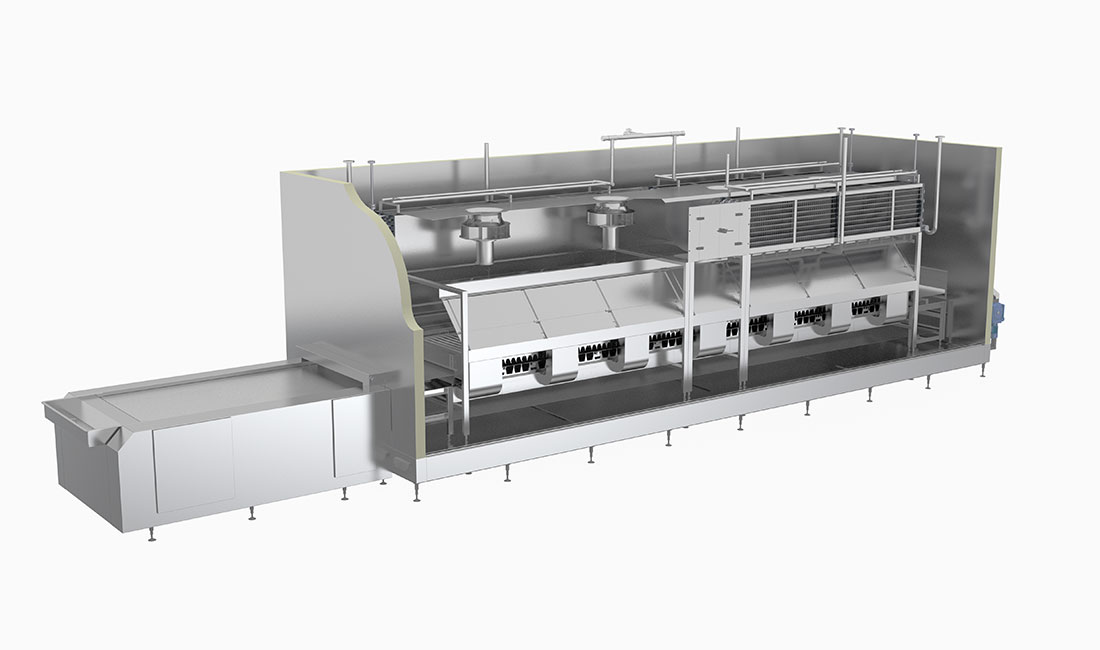
A small IQF tunnel freezer is a continuous belt freezer for pilot plants, food startups, and small processors that need IQF quality at lower output. It freezes food pieces one by one with high-speed cold air, helping protect texture, color, and yield before scale-up to a larger production line.
Based on industrial freezing equipment and pilot-plant project experience, this guide explains how small IQF tunnel freezers work and when they are the right choice. It covers capacity, belt design, airflow, refrigerants, hygiene, footprint, power needs, cost, ROI, installation, support, and common buying mistakes. It also compares tunnel freezers with cabinet, spiral, and cryogenic options.
What Is a Small IQF Tunnel Freezer?
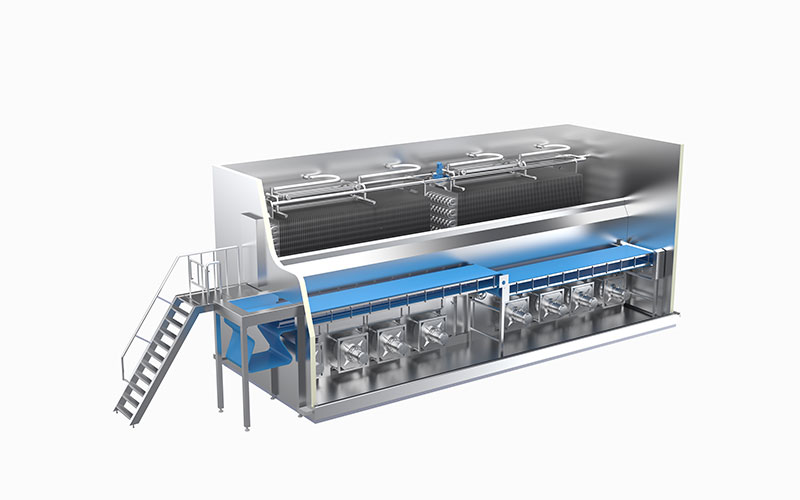
A small IQF tunnel freezer is a continuous-belt freezing system that processes 100–1,500 kg/h. It freezes food items individually inside an insulated tunnel using high-velocity cold air at -35°C to -45°C, targeting pilot plants and small-scale producers.
How Does the IQF Freezing Process Work?
IQF rapidly removes heat from each food piece so its core temperature drops below -18°C in under 30 minutes. The product crosses the ice-crystal formation zone (0°C to -5°C) too fast for large crystals to form. Small crystals preserve cell walls, color, texture, and yield after thawing.
What Throughput Range Qualifies as “Small”?
Industry practice defines throughput between 100 and 1,500 kg/h as the small-tunnel category. Below 100 kg/h, batch cabinet units make more economic sense. Above 1,500 kg/h, multi-belt industrial systems become more cost-effective per kilogram.
What Core Components Make Up the Equipment?
A small IQF tunnel contains six components:
- Insulated enclosure — PIR or PU sandwich panels
- Conveyor belt — stainless-steel mesh or perforated plastic
- Evaporator coils — heat exchangers that absorb thermal load
- Centrifugal fans — deliver high-velocity cold air at 6–10 m/s
- Refrigeration compressor — circulates NH₃, CO₂, or HFC refrigerant
- PLC control system — regulates belt speed and defrost cycles
Who Is a Small IQF Tunnel Freezer the Right Fit For?
Small IQF tunnel freezers fit pilot plants, R&D centers, food startups, specialty processors, and contract co-manufacturers. These users need industrial-grade IQF performance at lower throughput, smaller footprint, and lower capital investment than full-scale industrial lines require.
The five buyer profiles share three operational traits:
- Throughput under 1,500 kg/h
- Limited floor space, typically under 80 m²
- Need for export-grade IQF quality on multiple SKUs
Is It the Right Choice for a Pilot Plant?
A small IQF tunnel is the most predictive pilot platform for industrial scale-up. It replicates the airflow geometry, belt residence time, and dehydration dynamics of full-scale lines. Cabinet freezers cannot reproduce continuous-belt heat transfer, so their data does not translate into industrial sizing.
Is It Suitable for an Early-Stage Startup?
A small IQF tunnel suits startups launching frozen SKUs at commercial volume. Capital cost stays manageable at this scale. The equipment meets export-grade hygienic standards, and operators can run multiple recipes on one belt by adjusting speed and dwell time.
How Does a Small IQF Tunnel Freezer Compare to Other Small-Scale Freezing Options?
A small IQF tunnel outperforms cabinet batch freezers on continuous throughput, beats cryogenic systems on long-term operating cost, and needs less ceiling height than spiral freezers. It is the most balanced choice in the 100–1,500 kg/h range.
The table below summarizes trade-offs across small-scale freezing options. Throughput figures reflect the compact end of each category:
| Type | Throughput | Footprint | Best For | Key Limitation |
| Cabinet / batch | <100 kg/h | Smallest | Lab tests, micro-batches | Not continuous |
| Small tunnel IQF | 100–1,500 kg/h | Linear, compact | Pilot, startup | Linear floor length |
| Compact spiral | 300–2,000 kg/h | Tall vertical | Long retention | Needs ceiling height |
| Cryogenic LN₂ / CO₂ | 100–500 kg/h | Smallest | Premium, sticky products | High gas operating cost |
When Is a Tunnel Preferable to a Cabinet Freezer?
A tunnel freezer is preferable once production turns continuous. Cabinet units freeze in batches, which limits daily output. Tunnels also deliver free-flowing IQF products; batch freezers produce clumps that require manual breaking before packing. The full trade-off between IQF and blast freezing covers quality, yield, and cost in detail.
How Does It Compare to a Compact Spiral Freezer?
A small tunnel uses a horizontal layout; a spiral uses vertical stacking. Tunnels suit short-residence products like vegetables and shrimp. Spirals suit longer-residence products like dumplings, bakery items, and bone-in meat. Tunnels also need less ceiling clearance.
When Does Cryogenic IQF Make More Sense?
Cryogenic IQF makes sense for premium products at low daily volume. Liquid nitrogen and CO₂ freeze faster than mechanical systems. The trade-off is recurring gas cost, which usually exceeds mechanical-tunnel OpEx within 12 months at steady production.
What Technical Specifications Matter Most When Choosing One?
Six specifications most affect performance: belt configuration, evaporating temperature, refrigerant type, airflow velocity, defrost method, and hygienic construction. These parameters determine throughput, product quality, and operating cost.
What Belt and Airflow Configuration Delivers the Best Performance?
A dual-belt design outperforms single-belt for sticky products. The configuration choices break down by product type:
- Dual belt — first belt crust-freezes, second belt hardens; best for sticky products like diced meat
- Stainless-steel mesh — best for seafood and meat
- Perforated plastic — best for delicate fruits and berries
- Air velocity — 6–10 m/s with top-and-bottom flow eliminates hot spots
Which Refrigerant Is Best Suited to Small-Scale IQF?
Ammonia (NH₃, R717) delivers the highest efficiency and lowest GWP for fixed installations. CO₂ (R744) suits sites with ammonia safety restrictions. HFCs are subject to staged phase-down under EU F-Gas regulation, reducing available quota year by year.
What Hygienic-Design Features Are Non-Negotiable?
Food-grade 304 stainless steel, fully welded seams, and CIP-ready geometry are mandatory. The unit must meet HACCP and buyer-market export codes. Square Technology equipment carries CE (EU), ASME and PED for pressure vessel design, U2 for Section VIII Division 2 vessels, CSA for North America, and CRN for Canadian provincial registration.
What Footprint, Power, and Utility Requirements Apply?
A small IQF tunnel typically requires the following site conditions; exact figures depend on capacity and configuration:
- Floor space — 30–80 m²
- Power — three-phase 380–415 V
- Compressed air — 6 bar
- Water supply — for defrost cycles
- Ceiling clearance — 3.5 m minimum
What Does It Really Cost to Own a Small IQF Tunnel Freezer?
Total cost of ownership combines capital investment, energy and water use, refrigerant top-up, scheduled maintenance, and labor. For pilot and startup operations at moderate utilization, payback typically falls between 18 and 36 months.
What Drives the Capital Cost?
Capacity, refrigerant type, automation level, and certification scope drive capital cost. A 200 kg/h NH₃ unit with CE marking costs less than a 1,200 kg/h dual-belt CO₂ unit with full export documentation. Vertically integrated manufacturers reduce CapEx by producing evaporators, panels, and belts in-house.
What Ongoing Operating Costs Apply?
Electricity dominates OpEx, typically 60–70% of recurring cost. Defrost water, refrigerant top-up, lubricants, and belt replacement form the remainder. Annual maintenance commonly falls in the 3–5% range, consistent with industrial refrigeration cost benchmarks.
How Is Realistic ROI Calculated?
ROI equals annual gross margin gain from frozen SKUs divided by invested capital. The frozen format extends shelf life from days to 12–24 months, expanding distribution range. Most pilot operations recover capital within 2–3 years at 50–70% utilization.
How Does a Small IQF Tunnel Freezer Support Scaling to Industrial Production?
A small IQF tunnel reproduces the airflow geometry, belt residence time, and dehydration profile of industrial systems at lower throughput. Pilot data on core-temperature curves, yield, and weight loss directly inform sizing for full-scale industrial IQF lines.
What Pilot-Run Data Should Be Captured?
Five datasets are required for industrial sizing:
- Core-temperature curve over freezing time
- Belt residence time at target -18°C core
- Product weight-loss percentage
- Defrost cycle frequency and duration
- Energy consumption per kilogram frozen
Engineers use these five datasets to size the industrial-scale evaporator, applying the standard heat-load equation Q=m⋅cp⋅ΔT+m⋅LQ = m \cdot c_p \cdot \Delta T + m \cdot LQ=m⋅cp⋅ΔT+m⋅L. This calculation determines compressor capacity and belt length for the full-scale line.
Why Does Manufacturer Product Range Matter for Scaling?
A single manufacturer covering pilot through industrial scale prevents specification drift during scale-up. Square Technology produces small tunnels, industrial tunnels, spiral freezers, and double spiral freezers on the same engineering platform. Buyers using its full product range avoid switching vendors mid-project.
What Mistakes Do First-Time Buyers Most Often Make?
First-time buyers make five recurring mistakes when sourcing a small IQF tunnel freezer.
- Undersizing capacity. Specifying for current volume creates bottlenecks within 18 months.
- Ignoring refrigerant regulations. EU F-Gas rules and US AIM Act phase down high-GWP HFCs through 2030.
- Choosing cryogenic on price alone. LN₂ or CO₂ gas costs often exceed mechanical OpEx within one year at steady production.
- Overlooking hygienic-design audits. Welded seams, drainage slope, and CIP access determine retailer audit outcomes.
- Selecting suppliers without service networks. Spare-parts lead times above four weeks halt small-line production.
What Do Delivery, Installation, And Long-Term Support Look Like?
Lead times for small custom IQF tunnels typically run 12–20 weeks. Turnkey delivery includes factory acceptance testing, on-site installation, commissioning, and operator training. Established manufacturers provide global service networks and remote diagnostics.
What Does a Turnkey Package Include?
A standard turnkey package contains five deliverables:
- Engineering drawings and stress calculations
- Factory acceptance test
- Shipping and on-site installation
- Commissioning and operator training
- Certification documentation for the buyer’s market
What Ongoing Service Should Buyers Expect?
Buyers should expect a 12-month equipment warranty, 24/7 technical support, and stocked spare parts. Square Technology operates a global service network with 200+ field technicians across export markets, and produces evaporators, panels, belts, and pressure vessels in-house, shortening parts lead time.
FAQ
What is the smallest IQF tunnel freezer available?
The smallest viable IQF tunnel processes around 100 kg/h. Below this threshold, cabinet or blast freezers are more economical.
How much does a small IQF tunnel freezer cost?
Capital cost varies with capacity, refrigerant, and certification scope. Buyers should request site-specific quotations rather than rely on list prices.
How long does it take to freeze food in an IQF tunnel?
Freezing time ranges from 8 to 30 minutes. Product size, density, and target core temperature determine the dwell time.
What is the difference between an IQF tunnel and a blast freezer?
An IQF tunnel freezes pieces individually on a continuous belt. A blast freezer freezes products in static batches and produces clumped output.
Can one small IQF tunnel handle multiple products?
Yes. Variable belt speed and adjustable airflow allow one tunnel to run vegetables, seafood, meat, and bakery items on different shifts.
Which refrigerant is best — NH₃, CO₂, or HFC?
NH₃ delivers the best energy efficiency. CO₂ suits ammonia-restricted sites. HFCs face phase-down in EU and US markets.
How much electricity does a small IQF tunnel use?
Connected load typically runs from 50 to 250 kW depending on capacity. Energy use per kilogram frozen ranges from 0.15 to 0.30 kWh.
What is the lead time for a small IQF tunnel freezer?
Lead time runs 12–20 weeks for custom configurations. Standard models ship faster.
Can a small tunnel be upgraded to larger capacity later?
Belt extensions and additional evaporator coils can raise throughput by 20–30%. Beyond that, full replacement is more economical.
What certifications should the equipment carry for export?
CE for the EU, ASME and PED for pressure vessels, U2 for ASME Section VIII Division 2 pressure vessels, CSA for North America, and CRN for Canada. Square Technology carries all six.