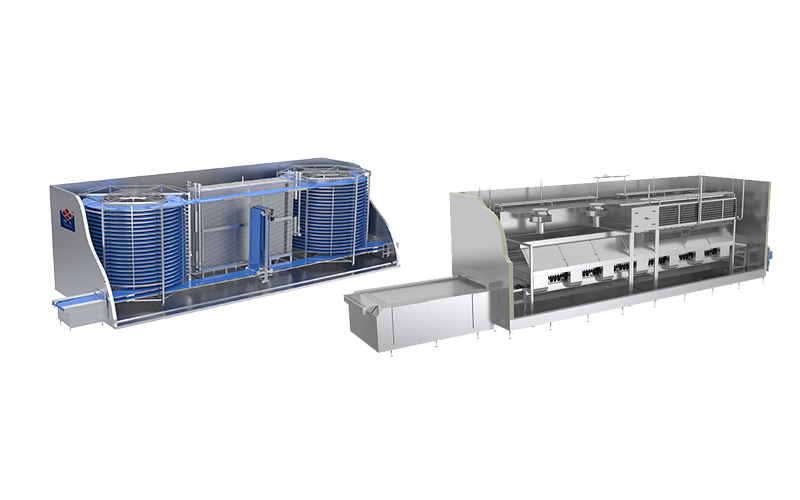
Spiral IQF freezers excel in compact footprints and delicate product handling, while tunnel IQF freezers deliver simpler operation and lower upfront cost for flat, uniform products. The right choice depends on floor space, product format, throughput, and total cost of ownership across a 10–15 year operating lifecycle.
Drawing on Square Technology Group’s 38 years of industrial freezing experience, 300+ patents, and 5,000+ installations serving processors, this guide walks through how each system works, compares them across five critical dimensions—floor space, freezing performance, energy consumption, maintenance, and cost—and identifies the specific operating scenarios where each freezer type delivers the strongest return.
What Is a Spiral IQF Freezer and How Does It Work?
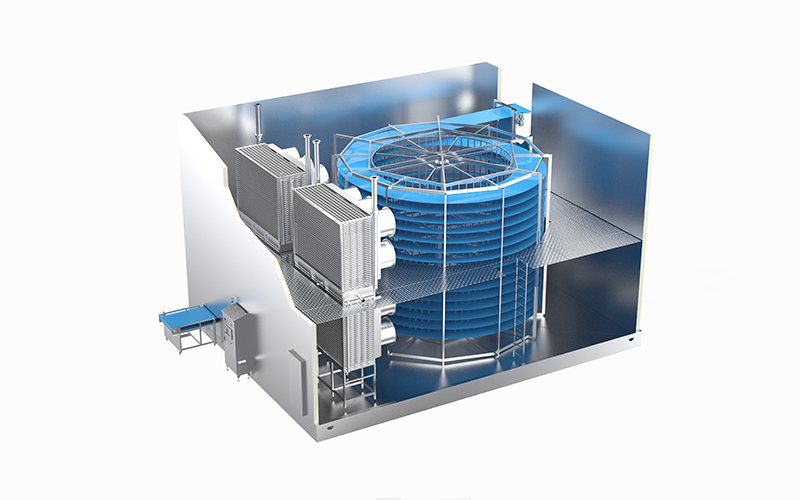
A spiral IQF freezer uses a vertical, stacked conveyor belt system to freeze individual food items quickly while occupying minimal floor space. The spiral conveyor belt moves products in a circular upward or downward path through a controlled freezing chamber.
Key components include:
- Vertical multi-tier spiral conveyor belt
- Evaporator coils that generate cold air
- High-efficiency fans for horizontal airflow distribution
- Insulated freezing chamber with sloped sanitary floor
- Drive system (either edge-driven or drum-supported, depending on design)
Les processus de congélation works through controlled airflow management. Cold air circulates around each product as it travels along the spiral conveyor. The air moves at lower velocities compared to tunnel freezers, which reduces cell damage in delicate foods.
Products enter at one end of the belt and exit at the other after completing the spiral path. Freezing time ranges from 15 to 90 minutes depending on the product type and desired temperature. The spiral path creates longer retention time without requiring extensive linear space.
What Is a Tunnel IQF Freezer and How Does It Operate?
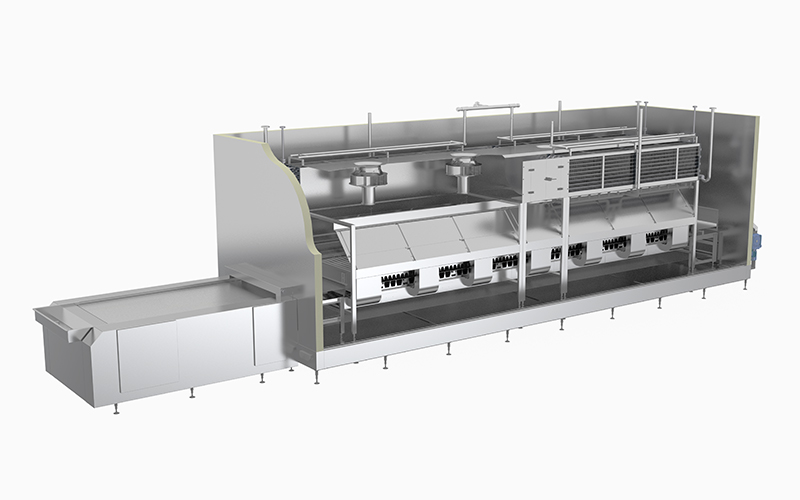
A tunnel IQF freezer uses a linear conveyor belt to move food products through a long freezing chamber where cold air rapidly freezes each item individually. The system prevents products from clumping together during the freezing process.
The freezer operates through a simple workflow:
- Products enter the tunnel on a conveyor belt
- High-velocity cold air blows across or through the belt
- Items freeze as they travel through the chamber
- Frozen products exit at the opposite end
Tunnel units rely on powerful evaporators that generate cold air at temperatures between –35°C and –40°C. The air circulates through the freezing chamber at high speeds to achieve rapid temperature reduction. Most systems reach full freezing in 3 to 20 minutes depending on product size and type.
What Are The Key Differences Between Spiral And Tunnel IQF Freezer?
Spiral and tunnel IQF freezers differ in five main areas: floor space requirements, freezing performance, energy efficiency, maintenance demands, and upfront costs. Spiral freezers use vertical spiral designs that save space while tunnel freezers require long horizontal layouts.
Floor Space and Plant Layout
Spiral freezers occupy 60–70% less floor space than tunnel freezers at the same capacity. At equivalent production capacity, spiral freezers achieve 250 kg/hr per m² of floor space, while tunnel freezers achieve only 43 kg/hr per m². For example, a 3,000 kg/hr spiral system occupies 12–16 m², whereas a tunnel system at the same capacity requires significantly more floor area due to its linear horizontal layout.
The vertical multi-tier design of spiral freezers stacks conveyor belts inside a compact cabinet, while tunnel freezers extend horizontally in a straight line. Facilities with limited floor space or flexible layout requirements benefit from spiral freezers; plants with available linear space and lower capacity needs can use tunnel freezers.
Freezing Speed and Product Quality
Spiral freezers maintain uniform temperatures through horizontal airflow that distributes evenly across every tier of the conveyor, creating consistent freezing times and preventing hot spots. Tunnel freezers use vertical airflow that can create temperature gradients along the tunnel length, causing products at the entrance to experience different freezing conditions than those at the exit.
Spiral freezers excel at IQF production because each piece freezes separately without clumping, preserving texture, color, and nutritional value through rapid, consistent freezing. Tunnel freezers can also handle IQF products but may produce less uniform results depending on product placement and airflow design.
Energy Consumption Per Kilogram
Spiral freezers consume 15–20% less energy per kilogram than tunnel freezers. The compact insulated cabinet reduces total air volume requiring cooling, while shorter airflow paths minimize energy loss and cold air escape.
Tunnel freezers require more energy to maintain temperature across longer distances. The extended conveyor length increases heat gain from the surrounding environment, demanding more refrigeration capacity to offset these losses.
Facilities with high throughput see the greatest savings: a plant freezing 50 tons per day can reduce energy costs by $15,000 to $25,000 annually by switching from tunnel to spiral systems.
Cleaning and Maintenance Complexity
Spiral freezers with edge drive designs require 30-40% less cleaning time than tunnel freezers. The open design provides easy access to all conveyor sections. Edge-driven configurations also eliminate internal drum components, reducing areas where product residue can accumulate.
Tunnel freezers have long enclosed conveyors that are harder to access for cleaning. More moving parts along the extended belt system increase maintenance requirements. The horizontal layout requires workers to clean along the entire tunnel length.
Spiral Freezer Cleaning Features:
- Stainless steel construction with sloped floors
- Direct access to all belt tiers
- Integrated drainage systems
- Typical cleaning time: 2-3 hours
Tunnel Freezer Cleaning Features:
- Extended conveyor sections to clean
- Multiple access points required
- More belt tracking adjustments needed
- Typical cleaning time: 4-5 hours
Quick freezer operations that process multiple products daily benefit from faster cleaning cycles. Reduced downtime for sanitation increases available production hours and continuous production capability.
Purchase Price and Installation Cost
Tunnel freezers cost 20-30% less than spiral freezers for initial equipment purchase. A basic tunnel freezer system starts at 150,000–300,000 for small to mid-capacity configurations, with large industrial units reaching 800,000 or more. A comparable spiral freezer ranges from 800,000 or more. A comparable spiral freezer ranges from $400,000 to $1,500,000 depending on drum size and capacity.
Installation costs favor tunnel freezers because they require simpler structural support. The horizontal design sits directly on the floor without special foundations. Spiral freezers need reinforced flooring to support the vertical weight distribution and may require ceiling height modifications.
The lower upfront cost of tunnel freezers makes them attractive for facilities with tight capital budgets. However, the total cost of ownership shifts when factoring in energy consumption, maintenance, and floor space value over 10-15 years.
| Cost Factor | Tunnel de congélation | Congélateur en spirale |
| Equipment Purchase | $150,000–$300,000 | $400,000–$700,000 |
| Installation | $20,000–$40,000 | $40,000–$70,000 |
| Annual Energy Cost (50 tons/day) | $85,000 | $65,000 |
| Annual Maintenance | $25,000 | $18,000 |
Facilities focused on maximizing processing capacity per square meter recover the higher spiral freezer investment within 3-5 years through operational savings. Plants with lower production volumes or available space may prefer the lower entry cost of tunnel systems.
When To Choose Spiral IQF Freezer?
Spiral IQF freezers fit best in operations where space, product sensitivity, and energy efficiency outweigh raw throughput. Their vertical multi-tiered belt design reduces the footprint by up to 50% compared to tunnel freezers while maintaining the same production capacity, and their gentle handling preserves the texture and flavor of delicate products like seafood, berries, and bakery items.
Spiral freezers deliver the strongest value in the following scenarios:
- Facilities with limited floor space or high space rental costs
- Processors handling delicate products requiring gentle airflow and uniform temperature
- Operations focused on reducing utility costs and carbon footprint
- Small to medium enterprises needing easy integration into existing production lines
- Production lines handling multiple product types on a single freezing system
- Businesses prioritizing consistent product quality over maximum throughput
The compact stacked design also lowers maintenance cost by providing direct access to all components, and frees valuable floor space for other production equipment or storage—translating space efficiency directly into lower operational overhead.
When To Choose Tunnel IQF Freezer?
Tunnel IQF freezers suit operations where floor space is available, product format is flat or block-shaped, and production runs favor simplicity over flexibility. Their straight-line horizontal belt processes large, uniform products evenly while keeping initial investment and maintenance access lower than multi-tier spiral systems.
Tunnel freezers deliver the best fit in the following scenarios:
| Tunnel Freezer Works Best For | Reason |
| Large slabs or blocks | Flat surface freezes evenly on horizontal belt |
| Whole fish | Size and shape suit linear processing |
| Single-product facilities | No need for multi-product flexibility |
| Long production runs | Minimal changeover requirements |
| Plants with open floor space | Linear design fits available area |
| Moderate throughput (1,200–2,000 kg/hr) | Handles volume without spiral complexity |
| Budget-conscious buyers | Lower upfront investment and simpler maintenance |
The single-tier horizontal belt also simplifies loading, unloading, and cleaning access, making tunnel freezers a practical choice for batch operations and facilities prioritizing operational simplicity over compact footprint.
FAQs
Which type of freezer is the best?
No single freezer type fits all operations. Spiral freezers suit facilities with limited floor space and delicate products like seafood or bakery items. Tunnel freezers excel at high-volume uniform production where ample linear floor space is available.
What are the disadvantages of IQF?
IQF systems require higher upfront investment, greater energy consumption, and more demanding maintenance than blast freezers. Tunnel models also need substantial linear floor space, and products with high moisture content or irregular shapes may not achieve uniform freezing results.