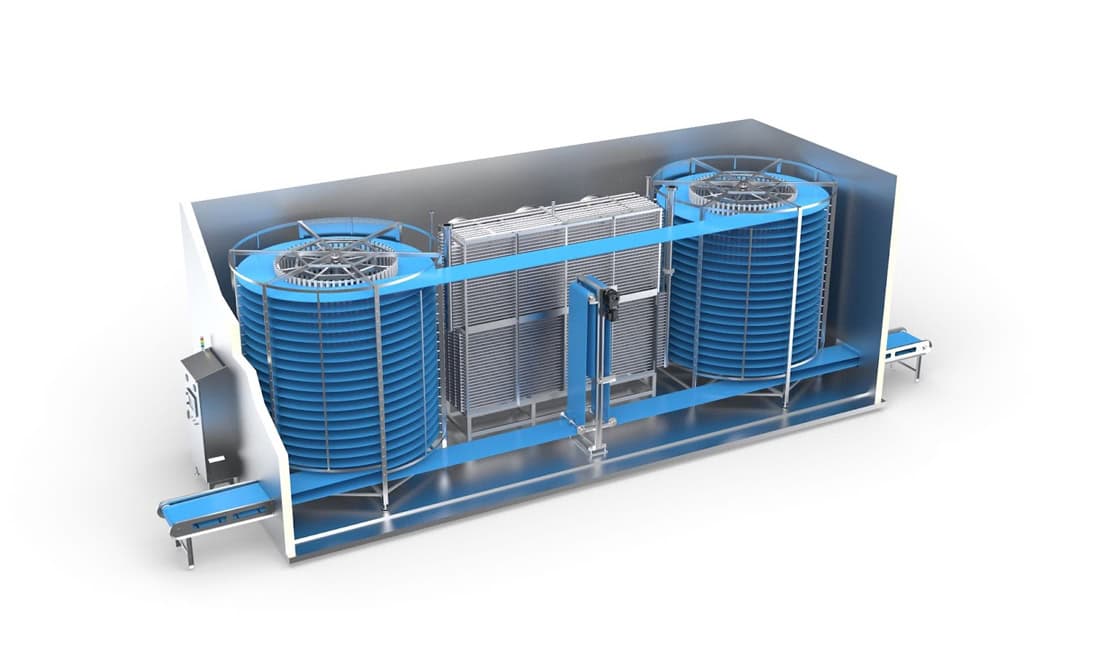
An industrial spiral freezer has no standard list price. It is engineered around a process, so the price is calculated after the design, not before it.
The final figure depends on eight inputs: the product, the hourly output, the infeed temperature, the outfeed core temperature, the allowed freezing time, the equipment structure, the refrigeration scope, and the project location. Change any one, and the machine size changes with it.
Buyers should also separate two very different numbers. A budget estimate is a rough figure used for early planning. A formal quotation is a binding offer built on complete technical data, and only the second one can be compared between suppliers.
This article covers four things: what drives equipment price, what a quote does and does not include, what the freezer costs to run over its life, and how to compare offers fairly.
How Much Does a Spiral Freezer Cost?
A spiral freezer costs whatever its duty requires. Price scales with the effective conveying area, the refrigeration load, and the supply scope, so the honest answer starts with how those three items are set.
Why Is There No Standard Spiral Freezer List Price?
There is no list price because a spiral freezer is process equipment, not a catalogue product. Two plants can order the same nominal capacity and receive machines of very different size.
The reason is heat load. Freezing 1,000 kg/hr of raw chicken wings, 1,000 kg/hr of packed ready meals, and 1,000 kg/hr of ice cream cartons are three different jobs. Each product carries a different starting temperature, a different water content, and a different allowed freezing time.
Machine size follows that heat load. A longer freezing time needs more belt tiers, a larger drum, and a bigger evaporator, and each of those items adds cost. So the same headline capacity can map to machines that differ widely in size and price.
What Changes Between a 500 kg/hr and a 5,000 kg/hr Spiral Freezer?
Almost every physical value changes, and those values are what a price is built from. The table below shows the design range that manufacturers work within for low-tension and self-stacking systems.
| Attribut | Design range |
| Capacité | 200 kg/hr to 10,000 kg/hr |
| Drum diameter | 1,620 mm to 5,800 mm |
| Belt tiers | 6 to 40 (low-tension), 16 to 50 (self-stacking) |
| Mesh belt width | 520 mm to 1,372 mm |
| Insulated panel thickness | 50 mm to 250 mm |
| Enclosure material | PIR or PU core, stainless steel skin both sides |
A small freezer may sit at the low end of every row. A high-capacity line sits near the top of most of them. Effective conveying area, which is belt width multiplied by usable belt length, is the single value that tracks price most closely.
Refrigeration load rises in step. More product per hour means more heat to remove, which means a larger evaporator, larger compressors, and heavier pipework. Buyers who know their required belt area and refrigeration load already understand most of what separates a small quote from a large one.
Equipment Price vs. Complete System Price vs. Installed Project Cost
Three different totals travel under the word “price,” and mixing them up is the most common costing error in this market.
- Equipment price covers the freezer itself: the conveyor system, the drum and drives, the insulated enclosure, the belt, the evaporator, the fans, and the agreed standard controls.
- Complete system price adds the systems that make the freezer work: the refrigeration plant, the electrical panels, the cleaning system, and the auxiliary equipment.
- Installed project cost adds everything on site: freight, insurance, duties, unloading, lifting, assembly, utility connections, commissioning, and acceptance testing.
No industry default sets which items appear in which quote. One supplier may include the evaporator only. Another may include compressors, valve stations, and refrigerant piping. A quote that looks 30% cheaper often covers 30% less work.
How Should Buyers Read an Indicative Price Range?
An indicative range is only useful when the conditions behind it are printed next to it. Without those conditions, the number is a guess dressed as data.
A usable indicative price states seven things:
- The product and its packaging state
- The hourly output
- The infeed temperature and the target outfeed core temperature
- The allowed freezing time
- The supply scope, especially whether refrigeration is included
- The currency, the quotation date, and the Incoterms
- Whether transport and installation are included
Even with all seven, the range serves budget planning only. It cannot replace a technical selection, and it should never be carried into a contract. Steel prices, refrigerant regulations, and freight rates all move, so a range quoted last year may not hold this year.
Which Factors Have the Largest Effect on Spiral Freezer Price?
Seven factors drive spiral freezer prices, and they do not carry equal weight. Freezing duty and required conveying areas usually move the number most. Refrigeration scope can change the total by a larger margin than any single mechanical choice. Controls, materials, and location adjust the result at the margins.
Product Type and Freezing Duty
Freezing duty sets the heat load, and heat load sets the machine. Manufacturers calculate the energy to be removed from the product size, the piece weight, the water content, the packaging state, and the infeed temperature.
Packaging deserves special attention. A loose chicken fillet, a tray-sealed ready meal, and a cartoned block of fish all resist heat transfer differently. Packaging acts as insulation, so a packed product needs longer in the freezer than the same food frozen loose.
The exit condition matters just as much. A target core temperature of −18 °C costs more machine than a target of −12 °C on the same product. A short allowed freezing time raises the airflow and refrigeration demand, which raises the price again.
Capacity, Dwell Time, and Conveyor Size
Conveyor size is calculated, never chosen. Four figures set it: target output per hour, product load per square metre of belt, belt speed, and dwell time inside the freezer.
Those four produce the required effective conveying area. From that area, the manufacturer fixes the belt width, the usable belt length, the number of tiers, the tier spacing, and the drum diameter. Each of those values adds steel, adds belt, and adds cost.
Tier spacing is often overlooked in price discussions. Tall products need wider gaps between tiers, so fewer tiers fit in the same height. Reaching the same output then needs a larger drum or a taller enclosure.
Spiral Configuration and Factory Layout
Configuration changes both machine size and engineering effort. Four layouts are common, and none of them is always cheaper or always better.
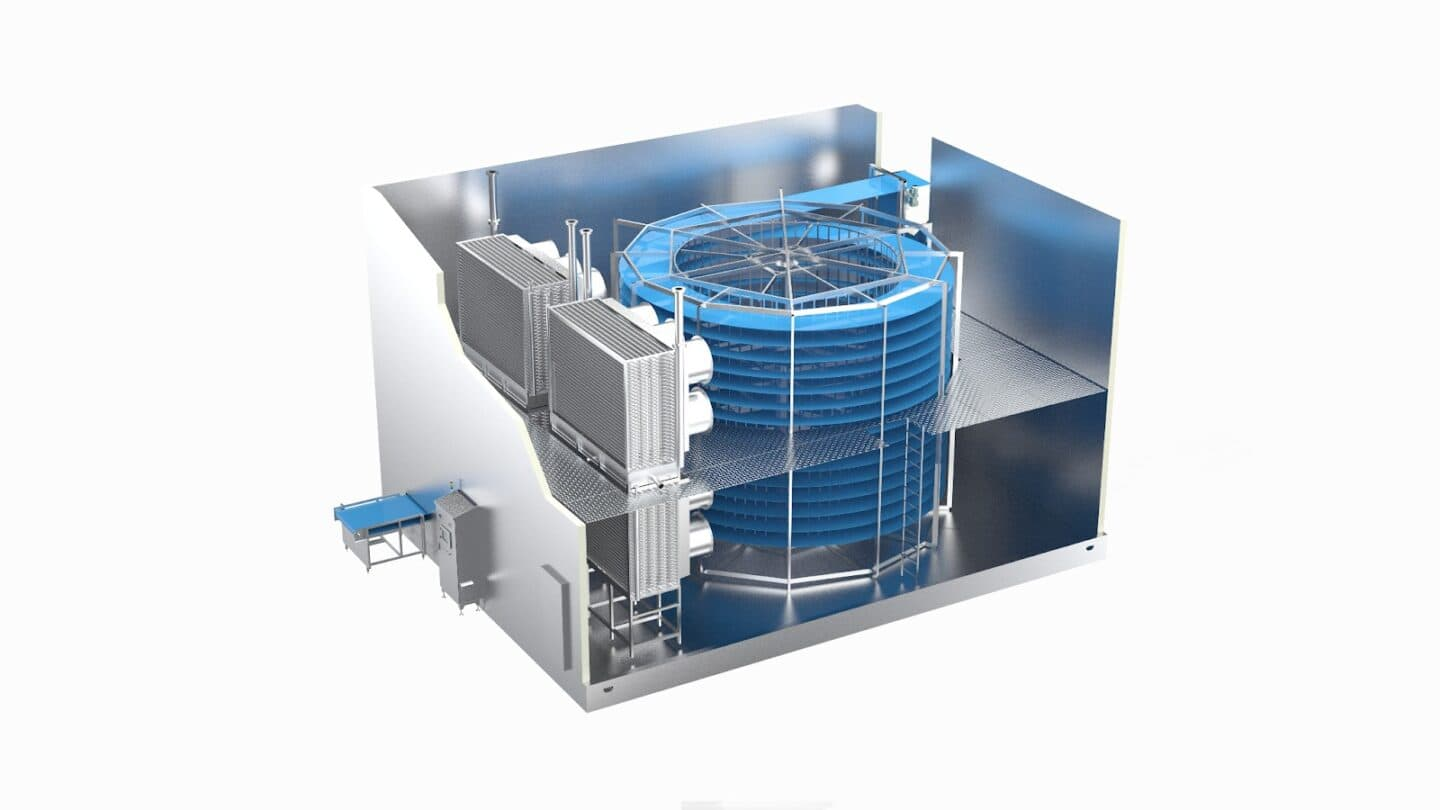
A single-drum system keeps a small footprint but discharges at a different height from the infeed. A twin-drum system adds a second drum and more floor area. In return it gives a longer belt path in the same building height, and it places both the infeed and the outfeed at a low level.
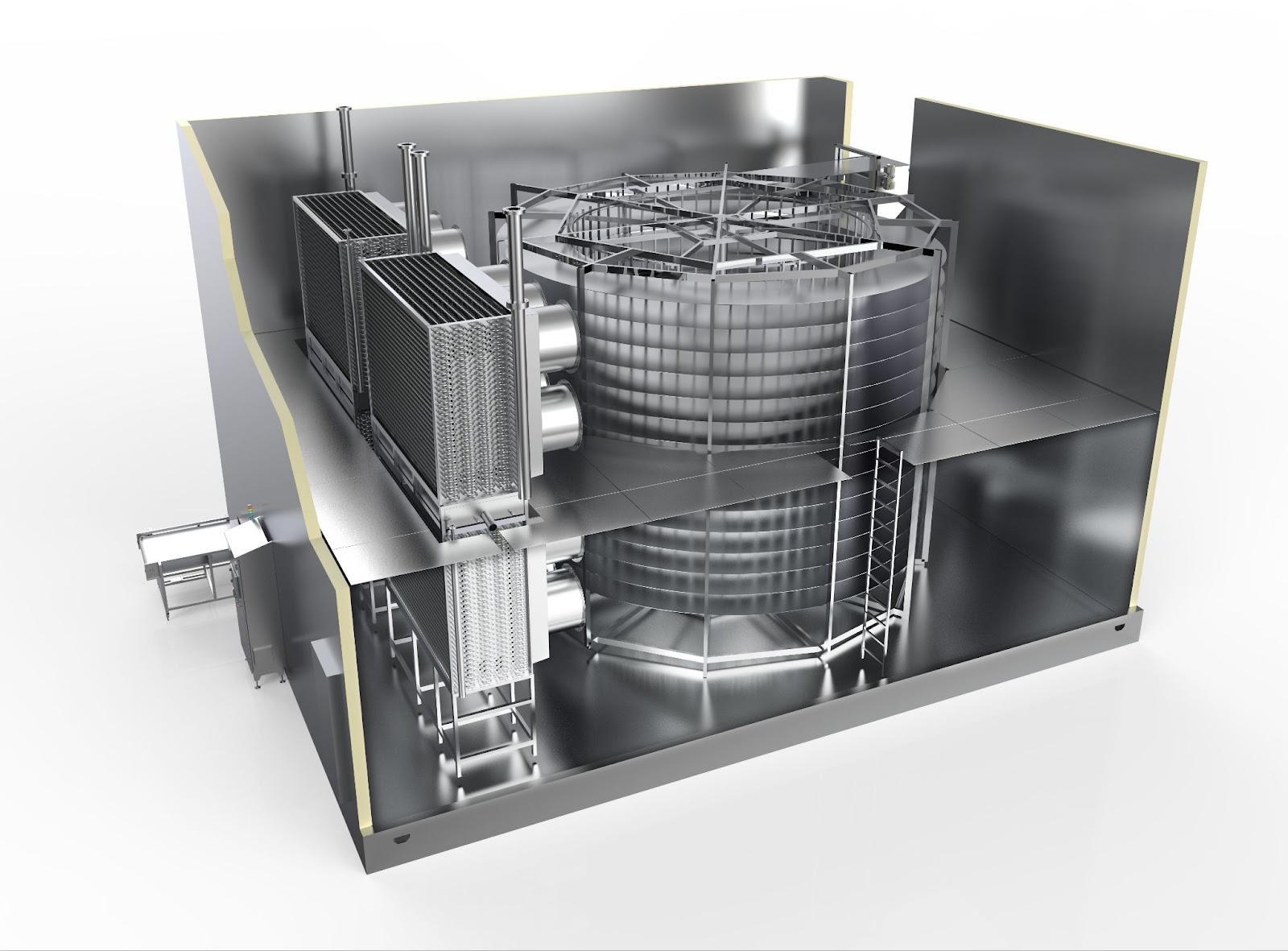
Belt support type has a similar effect. A low-tension design carries the belt on support rails. A self-stacking spiral freezer removes those rails and lets the tiers rest on each other, which fits more belt area into the same footprint. Square Technology reports up to 50% more output than a comparable low-tension design on the same floor area. The two options should therefore be compared on output per square metre, not on machine price alone.
Building constraints then add custom work. Low ceilings, fixed columns, and awkward discharge heights all push a design away from a proven configuration, and custom engineering carries a cost.
Refrigeration System and Refrigerant Scope
Refrigeration scope changes the total more than any other single line in a quote. The first question is simple: does the price cover the evaporator only, or the whole cold system?
A full refrigeration package can include valve stations, compressor units, condensers, refrigerant piping, and refrigeration controls. A quote that stops at the evaporator leaves all of that to a separate contract.
Two project types produce very different costs. Connecting to an existing central plant looks cheaper, but only if that plant has spare capacity at the required evaporating temperature. Building a new system carries a higher equipment cost and usually needs a machine room, safety systems, and extra civil work.
Refrigerant choice then shapes the design. Ammonia, CO₂, and fluorinated refrigerants each bring their own pipe sizing, safety rules, and machine room requirements. Local regulations on refrigerant use should be checked before any budget is fixed.
Hygienic Design, Cleaning, and Defrost
Hygiene specification is a real cost driver, not a finishing detail. Open frames, fully welded floors, welded stainless steel enclosures, sloped drainage, and wide access doors all cost more to build than a basic structure.
Cleaning method sets the next step in price. Manual washing needs no extra system. A belt washer adds a machine and a water circuit. A CIP system adds pumps, tanks, spray headers, and cleaning programs for foaming, rinsing, disinfecting, and belt drying. Self-stacking systems often run three cleaning modes: PZC for the product zone, PZE for the product zone and coil, and CIP for the full enclosure and structure.
Defrost method affects both price and output. Water defrost, hot gas defrost, and air defrost are the three common choices. An air defrost system blows pulses of high-speed air over the evaporator fins while production continues. By keeping frost off the coil, it can extend runtime by 150% to 200%, so a higher purchase price can return more frozen product per shift.
Controls, Automation, and Line Integration
The control package can move the price by a meaningful margin, and it is easy to under-specify. A basic PLC with a touch screen covers status display, zone temperatures, and fault alarms.
Beyond that baseline, common additions include stored freezing recipes for different products, data logging for audits, trend displays, and remote troubleshooting modules. Plants under strict food safety audits usually need the logging functions, so these are rarely optional in practice.
Line integration adds engineering hours. The freezer must exchange signals with upstream equipment such as formers, fryers, and ovens, and with downstream equipment such as weighers, metal detectors, and packing machines. Signal type, cable supply, and line-level programming should each be priced and assigned, because unassigned interface work becomes a change order later.
Materials, Compliance, and Project Location
Material and compliance choices are set by the market the plant sells into. Belt material, frame grade, panel core, panel thickness, and electrical standard all appear in the bill of materials.
Certification carries a cost of its own. Marks such as CE, ASME, PED, and CSA each require specific construction, documentation, and inspection, and they cannot be added cheaply after fabrication.
Project location then adjusts the total. Freight distance, port access, site conditions, local labour rates, and the level of service the manufacturer must provide on site all feed into the final figure. A freezer shipped to a plant with crane access and a prepared floor costs less to deliver than the same freezer going into a congested older building.
What Does a Spiral Freezer Quote Include, and What Costs Extra?
A quote is a scope document with a number at the bottom. Five blocks decide how large that number is: the equipment package, the refrigeration and electrical scope, transport and site work, commissioning, and after-sales support.
Spiral Freezer Equipment Package
The base package normally covers the conveyor system, the mesh belt, the drum, and the drive units. It also covers the insulated enclosure, the floor, the evaporator, the fans, and a basic control panel. Infeed and outfeed sections are commonly 500 mm long on low-tension designs.
Options should appear as separate priced lines, not as assumptions. The usual list includes CIP systems, belt washers, air defrost systems, belt edge guards, extended infeed and outfeed sections, and access platforms with stairs.
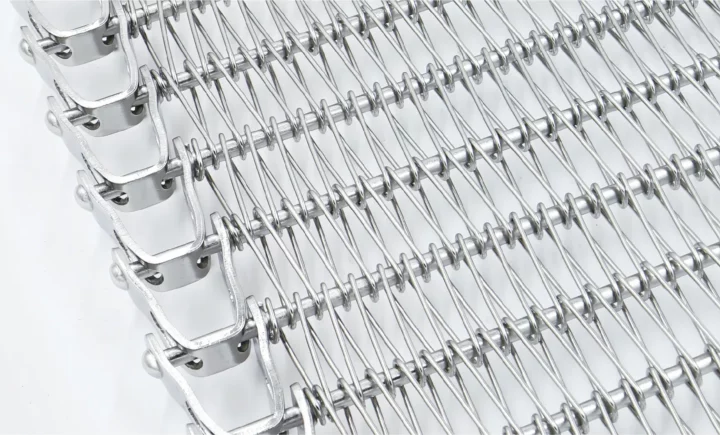
Belt specification is worth checking in detail. SUS304 food-grade spring wire with an 8 to 10 year service life is standard practice. A cheaper belt shows up again as a replacement cost within a few years.
Refrigeration, Electrical, and Control Scope
This block causes more price gaps than any other. Every item needs a clear yes or no: compressor units, valve stations, refrigerant piping, insulation of piping, electrical panels, field wiring, and interface cabling to upstream and downstream machines.
The wording matters as much as the list. “Refrigeration included” can mean the evaporator only, the evaporator plus valve station, or a complete plant. Buyers should ask for the boundary to be drawn on a drawing, not described in a sentence.
A freezer equipment price is not a freezing plant price. When the refrigeration plant and the electrical installation sit outside the quote, they can account for a large share of the money still to be spent.
Transport, Installation, and Site Work
Delivery terms change the comparable total, so Incoterms belong on every quote. The common terms shift cost and risk in a predictable order:
- EXW: the buyer arranges everything from the factory gate
- FOB: the seller delivers to the port of shipment; the buyer pays sea freight, insurance, and import costs
- CIF: the seller pays sea freight and insurance to the destination port; the buyer pays duties and inland transport
- DAP: the seller delivers to the named site; the buyer clears customs and pays duties
An EXW price and a DAP price for the same machine are not comparable numbers. Freight rates also move with season and route, so a shipping allowance quoted three months ago may need revisiting.
Site work then needs its own column. Foundations, drainage, refrigerant piping, power supply, building openings, and structural changes should each be assigned to the buyer or the supplier. Installation itself comes at four levels, and each carries a different price: supply only, installation guidance, installation supervision, and full installation.
Commissioning, Performance Testing, and Training
Commissioning runs in four stages, and a quote should say which of them it pays for. The stages are an empty run to check rotation and alarms, a trial run with product, a continuous run to prove stability, and a capacity test.
Performance testing has its own cost, especially when the test must be witnessed. Test product, test duration, and the personnel required all consume time on both sides.
Training is often trimmed to make a price look competitive, and that saving is usually false. Buyers should confirm the number of training days, whether operator and maintenance training are both included, the working language, and who pays engineer travel and accommodation.
Spare Parts, Warranty, and After-Sales Support
Warranty terms need a start date, not just a duration. A warranty that starts at shipment and one that starts at acceptance can differ by several months of real coverage on a long project.
Spare parts scope should be explicit. A recommended initial kit usually covers wear items such as belt links, drive chains and sprockets, and bearings and seals, with sensors and fan components close behind.
Support costs also need a boundary. Remote support may be free or billed, site visits may be chargeable after the warranty ends, and travel costs are often billed separately. Payment structure belongs in the same discussion. Industrial freezing equipment is commonly paid in stages, such as a deposit on order, a balance against shipping documents, and a retention released after acceptance. Exact terms are set in each contract.
What Is the Total Cost of Owning a Spiral Freezer?
Total cost of ownership adds five running costs to the purchase price: energy, cleaning, maintenance, product yield loss, and downtime. Over a ten-year life, these running costs usually outweigh the original equipment price, which is why the cheapest quote is rarely the cheapest freezer.
Refrigeration and Electrical Energy
Energy is normally the largest running cost, and it should be calculated from the plant’s own figures. The inputs are the real heat load, the annual running hours, and the air temperature in the product zone. To these the buyer adds the connected load of the fans, the conveyor drives, and the refrigeration plant.
Fan power deserves attention because it works twice. Fans draw electricity, and the motor heat they release inside the enclosure becomes an extra load for the refrigeration system to remove.
General savings claims should be treated with care. A stated percentage means nothing unless it names the product, the operating conditions, and the baseline it is measured against. Buyers should ask for the calculation, not the headline.
Water, Cleaning Chemicals, and Sanitation Labour
Cleaning cost has four parts: water, chemicals, labour hours, and lost production time. The fourth part is usually the largest and the most often forgotten.
An open structure with good access shortens the wash. An automatic CIP system shortens it further and makes the result repeatable, which matters for audits. Both cost more to buy than manual washing.
Comparison only works at equal hygiene standards. A manual wash and a CIP cycle compared against different cleanliness targets tell the buyer nothing useful.
Maintenance, Spare Parts, and Downtime
Maintenance cost follows the wear parts list, and that list is predictable on a spiral freezer. Belt links, drive chains and sprockets, and bearings and seals lead it, followed by fan motors, door gaskets, and sensors.
Planned and unplanned downtime should be counted separately. Planned stops for cleaning and defrost can be scheduled around production. Unplanned stops cost lost output, wasted product, and sometimes a full restart of the line.
Defrost strategy sits in the middle of this. Fewer full defrost stops mean more available production hours, which is a direct operating gain rather than a specification detail.
Product Yield and Dehydration
Yield loss is a running cost that never appears on an invoice. Product loses weight during freezing, and that weight was paid for as raw material.
The scale is easy to see with arithmetic. A line running 2,000 kg/hr for 16 hours a day and 300 days a year produces 9,600,000 kg per year. At 1% dehydration, the plant loses 96,000 kg of saleable product in a year. At 0.5%, it loses 48,000 kg.
Even airflow, correct dwell time, and controlled air temperature all reduce this loss. Actual figures must come from product trials or from agreed production data, because a generic percentage cannot be applied across different products.
Cost per Kilogram and Total Cost of Ownership
Cost per kilogram turns every figure above into one comparable number. The framework is straightforward:
Annual output = output per hour × running hours per day × operating days per year
Cost per kg = (annual capital charge + energy + cleaning + maintenance + yield loss) ÷ annual output
A worked example shows how it behaves. The figures below are illustrative assumptions, not a quotation.
- Output: 2,000 kg/hr, 16 hours per day, 300 days per year
- Annual output: 9,600,000 kg
- Assumed average electrical demand for the freezer and its refrigeration: 400 kW
- Assumed electricity tariff: USD 0.10 per kWh
- Annual energy: 400 kW × 16 h × 300 days = 1,920,000 kWh
- Annual energy cost: USD 192,000
- Energy cost per kg: USD 0.020
The capital charge is added the same way. Take the installed project cost, divide it by the planned service life in years, then divide by annual output. Cleaning, maintenance, spare parts, and yield loss each become another line in the same table.
Return on investment should then be calculated from the plant’s own numbers: its real output, its product value, and its operating hours. A payback period quoted by a supplier without those inputs is not a calculation.
How Should Buyers Compare Spiral Freezer Price Quotes?
Fair comparison needs three checks: the same design basis, the same declared scope, and total cost rather than headline price. Anything less compares different questions.
Use the Same Product and Design Basis
Every quote must answer the same brief. That means one product, one hourly output, one infeed temperature, one outfeed core temperature, one allowed freezing time, and one daily running schedule.
Small changes in assumption produce large changes in price. A supplier may assume a −12 °C core instead of −18 °C, or a heavier belt load per square metre. The result is a smaller, cheaper machine that will not do the job.
Buyers should send one written design basis to every supplier and ask each of them to restate it in their offer. Any supplier that changes an assumption should say so on the front page.
Compare Included and Excluded Scope
Scope should be checked on a single table with one row per item and one column per supplier. The rows that matter most are refrigeration, electrical work, cleaning systems, freight and Incoterms, installation, commissioning, training, and spare parts.
Exclusions carry the same weight as inclusions. A serious offer lists what the buyer must supply, including utilities, foundations, local labour, and lifting equipment. When an exclusion list is missing, it should be requested before any price comparison starts.
Compare Total Cost, Not Only the Headline Price
The purchase price is one line in a ten-year table. Energy, cleaning, maintenance, spare parts, downtime, and yield loss belong in the comparison alongside it.
A higher purchase price can win on total cost. Better airflow, a longer defrost interval, or faster cleaning each return value every single shift. The comparison should be run at the buyer’s own tariffs, labour rates, and operating hours, not on a supplier’s example figures.
Unverified claims should stay out of the model. A stated energy saving percentage or a fixed payback period is a marketing figure until the calculation behind it is shown.
How Can Buyers Control Spiral Freezer Project Cost?
Cost control happens during specification, not during negotiation. Five habits protect the budget without damaging the result.
Size the Freezer from Verified Product Data
Correct sizing starts with tested product data. Piece weight, piece dimensions, infeed temperature, and required core temperature should come from measurement, not from memory.
Two errors cost money in opposite directions. Sizing from an inflated nominal capacity buys steel and refrigeration that never earn anything. Cutting effective freezing area to reach a lower price produces a freezer that misses its core temperature, which is far more expensive than the saving.
Separate Required Features from Optional Features
A clean specification splits into two lists. The first covers what performance, safety, and hygiene require. The second covers upgrades that improve convenience or future flexibility.
Required items usually include the hygienic structure, the cleaning method the product demands, the defrost system, safety devices, and the control functions needed for food safety records. Optional items often include remote support modules, extra data displays, spare belt sections, and additional access platforms.
Splitting the lists lets buyers negotiate on the second list without weakening the first.
Check Existing Refrigeration and Utilities Before Reuse
Reusing an existing plant saves money only when the plant can actually carry the new load. Four checks decide it: available refrigeration capacity at the required evaporating temperature, pipe sizing, electrical supply, and control system capacity.
Water supply, drainage, and compressed air need the same review, especially when a CIP system is added. Finding a shortfall during commissioning is the most expensive time to find it, because the freezer is already on site.
Limit Unnecessary Customization
Proven configurations cost less to engineer, build, and support. Custom drum sizes, unusual belt widths, and non-standard discharge heights all add design hours and can lengthen spare parts delivery later.
Customization should be spent where the product, the layout, or the hygiene standard genuinely requires it. It should never be reversed in the wrong direction. Removing a required cleaning system, a safety device, or effective freezing area to hit a budget creates a plant problem that outlives the saving.
Plan for Future Capacity Without Oversizing the Current System
Future output should be planned in the layout, not bought in the first machine. Space for a second line, spare capacity in the refrigeration plant, and spare capacity in the electrical supply are cheap to allow for at the design stage.
Two routes then exist for growth. One is buying a larger freezer now and running it below capacity for years. The other is installing the right size now and adding equipment later. The comparison should use the plant’s real forecast, since an oversized freezer carries higher energy and cleaning costs for its whole life.
FAQs About Spiral Freezer Price
Why do spiral freezer prices vary so much?
Prices vary because the machines behind them are not the same. Effective conveying area, refrigeration load, hygienic construction, and control specification can all differ while the headline capacity stays identical.
Supply scope adds the second layer of variation. One quote may include refrigeration, freight, and installation, while another covers the freezer body alone.
Does a spiral freezer price include the refrigeration system?
Not always. Some manufacturers supply freezing equipment only, with the evaporator included and the rest of the cold system left to a separate contractor. Others supply the full package, including valve stations, compressor units, and refrigeration controls.
Square Technology supplies refrigeration systems alongside its freezing equipment, so either arrangement can be quoted. The boundary should always be confirmed in writing before prices are compared.
Is a self-stacking spiral freezer more expensive than a low-tension spiral freezer?
The two are not directly comparable on machine price. A self-stacking design removes the belt support rails, which allows more belt tiers and more output in the same footprint. The right comparison is therefore cost per kilogram of output, not cost per machine.
Other factors also shift the balance. Cleaning time, available floor space, product type, and required hygiene level all belong in the decision, and the answer changes from project to project.
Why can two quotes with the same stated capacity have different prices?
Because the assumptions behind that capacity differ, and none of them appear in the headline figure. Product type, belt load per square metre, dwell time, air temperature, and the calculation method all change the machine required.
Delivery terms widen the gap further. An EXW offer and a DAP offer for the same freezer will never show the same number, even when the equipment is identical.
Are transport and installation included in the quoted price?
Only when the quote says so. Transport cost depends on the Incoterms. Terms such as EXW, FOB, CIF, and DAP each move a different share of freight, insurance, and duty onto the buyer.
Installation is separate again. Supply only, installation guidance, installation supervision, and full installation are four different services at four different prices, and the level should be named in the offer.
What affects the lead time, and does it change the price?
Lead time depends on the engineering design, the level of customization, the fabrication schedule, and the shipping route. Highly customized systems and projects that include a new refrigeration plant take longer than standard configurations.
Schedule and price are linked in both directions. Compressed delivery may require expedited fabrication or split shipments, and freight rates change with season and route, which is why quotations carry a validity date.
Does a higher price always mean lower running cost?
No. A higher price only pays back when it buys something that works every shift, such as better airflow, a longer defrost interval, faster cleaning, or lower dehydration.
The way to test it is arithmetic, not argument. Buyers should model both offers at their own electricity tariff, labour rate, and operating hours, then compare cost per kilogram over the planned service life.
Request a Spiral Freezer Price from Square Technology
Square Technology prepares spiral freezer pricing from the design basis rather than from a catalogue. Food processors can start by sending their product specification, target hourly output, infeed and outfeed temperatures, factory layout, and refrigeration conditions.
From that data, the engineering team fixes the equipment size, defines the supply scope, and issues a budget figure that can be checked line by line. Configuration details for both system types are available on the congélateur à spirale et self-stacking spiral freezer product pages.