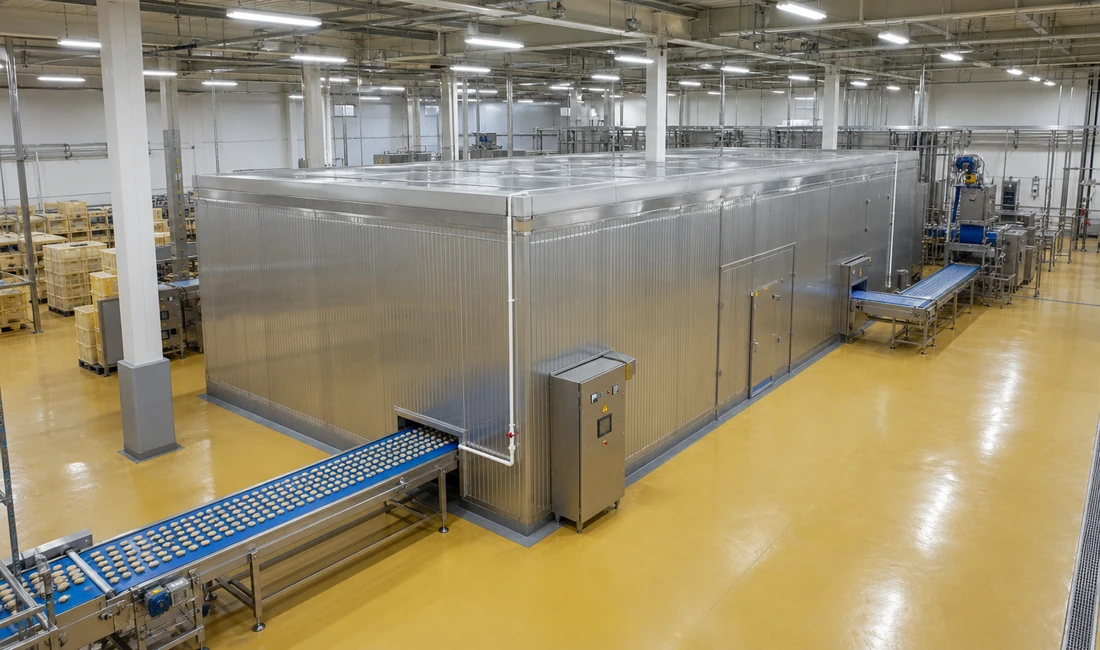
A spiral freezer may have the right capacity and freezing time, yet still be difficult to install. In many projects, the problem is not the freezer itself. It is the way the infeed and outfeed connect with the rest of the production line.
The entry and exit points affect conveyor height, product transfers, floor use, cleaning access, frost formation, and installation cost. The layout should therefore follow the full process flow rather than the freezer footprint alone.
This guide explains the main spiral freezer infeed and outfeed layouts and shows how food processors can compare them before requesting a final quotation.
What Do Spiral Freezer Infeed and Outfeed Layouts Define?
An infeed and outfeed layout describes more than the two openings in the freezer enclosure. It defines how products enter the freezing zone, move around the spiral, and continue to the next process.
Three layout details should be confirmed separately. They are related, but they are not the same.
Infeed and Outfeed Elevation
Elevation refers to the height of each conveyor above the factory floor. A freezer may have a low infeed and a high outfeed, a high infeed and a low outfeed, or both points close to floor level.
The correct elevation depends on the surrounding equipment. A high outfeed may connect with a packaging area on a mezzanine, while a low outfeed may suit floor-level inspection or packing. The choice also affects platforms, conveyor supports, access, and project cost.
Floor-Plan Orientation
Floor-plan orientation describes the direction of the infeed and outfeed when the equipment is viewed from above. Common arrangements include straight-through, 90-degree, and 180-degree layouts.
Columns, walls, aisles, drains, and existing machines often control this choice. Two freezers can have the same elevations but different floor-plan orientations.
Belt Travel Direction and Line Interfaces
The belt may travel clockwise or counterclockwise, and the infeed may approach from either side. The correct choice places each opening, drive, and service area in the right position. Conveyor width, speed, transfer height, and control signals must also match the nearby equipment.
Readers who need a broader explanation of the conveyor, airflow, and freezing process can first review Como funciona um congelador em espiral. The sections below focus on layout selection.
What Are the Main Spiral Freezer Infeed and Outfeed Elevation Layouts?
The elevation arrangement often determines whether a single-drum or twin-drum system is more practical. Each option can work well when it follows the natural product flow. Problems appear when the factory has to add several incline, decline, or transfer conveyors to make an unsuitable layout fit.
Low-In/High-Out Spiral Freezer Layout
In a low-in/high-out arrangement, products enter near floor level and travel upward through the spiral. They leave the freezing enclosure at a higher elevation.
This layout is common in single-drum systems. It uses building height while keeping the infeed easy to reach. A high outfeed can connect with an elevated inspection or packaging line, but it may require a mezzanine or a controlled decline if the next process is at floor level.
If the final destination is already at floor level, sending the product up and then back down may add cost without improving the process. It also creates more transfer points and more structures to clean.
High-In/Low-Out Spiral Freezer Layout
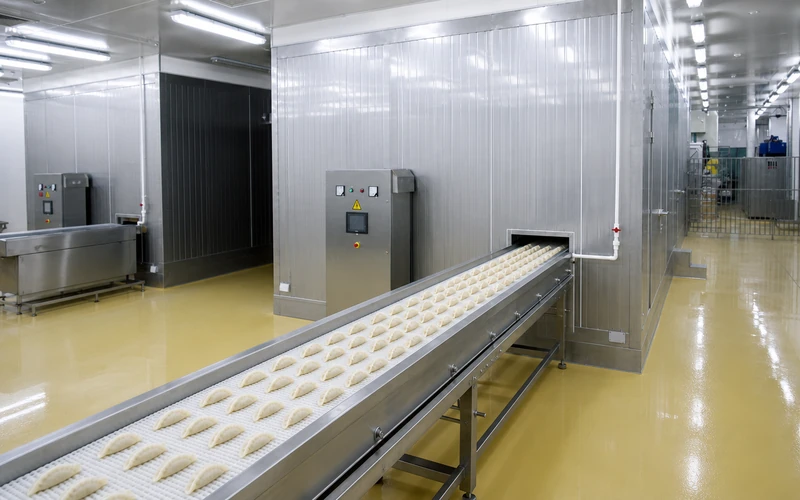
In a high-in/low-out arrangement, products enter the freezer at a raised level and travel downward. They leave near floor level.
This option fits lines where upstream equipment already has a high discharge and the frozen product must reach floor-level inspection or packaging. The approach conveyor must provide stable flow at a practical slope, with safe access for cleaning and maintenance. Delicate products also require a review of each change in belt angle and speed.
Low-In/Low-Out Spiral Freezer Layout
A low-in/low-out arrangement keeps both connections close to the production floor. It is often achieved with a twin-drum spiral. The belt rises around the first drum, passes through a transfer section, and descends around the second drum before leaving the enclosure.
This arrangement suits many single-floor factories because it connects floor-level equipment without a tall external decline. The trade-off is horizontal space: a twin-drum freezer is usually wider or longer and has a more complex belt path. Floor area, ceiling height, dwell time, product load, and service access must all be checked.
| Layout | Typical arrangement | Often fits | Main point to check |
| Low-in/high-out | Single drum, upward travel | Floor-level upstream process with an elevated downstream line | Cost and access at the high outfeed |
| High-in/low-out | Single drum, downward travel | Elevated upstream discharge with floor-level packing | Product handling and access at the high infeed |
| Low-in/low-out | Often a twin-drum system | Single-floor production lines | Larger horizontal footprint and internal transfer design |
The table provides an initial comparison, not a final selection rule. Special drum, edge-drive, or multi-belt designs can offer other arrangements. The supplier should confirm what is available for the selected freezer type.
What Are the Main Spiral Freezer Floor-Plan Orientations?
After the elevations are chosen, the next step is to decide where each conveyor points on the factory floor. This is where the layout must work around the building and the rest of the line.
Straight-Through Spiral Freezer Layout
In a straight-through layout, the infeed and outfeed generally continue along the same production axis. This is often the simplest arrangement for a new line with enough clear space.
It can reduce external curves and simplify conveyor supports. However, columns, cross aisles, or fixed equipment may force the line to use long external conveyors, so the full route still needs review.
90-Degree L-Shaped Spiral Freezer Layout
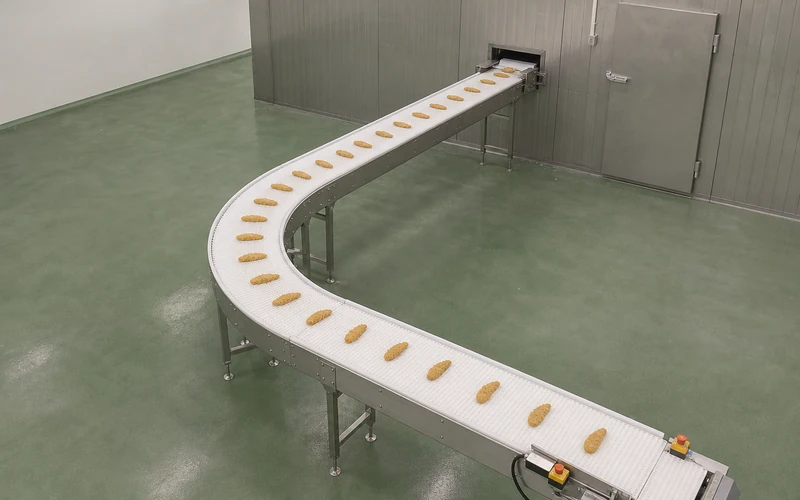
A 90-degree layout places the infeed and outfeed on adjacent sides of the freezer. It can turn the product flow around a column, wall, or other machine without adding a large external curve.
This arrangement works when upstream and downstream sections run in different directions or when the outfeed must reach another room. Enough corner space is still needed for the opening, transfer conveyor, guarding, access door, and operator path.
180-Degree U-Shaped Spiral Freezer Layout
In a 180-degree or U-shaped arrangement, products leave in the opposite direction from which they entered. The two connections may be on the same side or return toward the same part of the factory.
This layout can loop the line back in a short, wide building and keep operator areas closer. The main risk is congestion. Warm and frozen product flow, staff, forklifts, packaging materials, and sanitation zones must remain safely separated.
Clockwise vs. Counterclockwise Belt Travel
Clockwise and counterclockwise travel can change which side of the freezer contains the entry, exit, drive, and service points. This choice is often called the hand of the spiral.
The direction should be fixed early and shown on both plan and elevation drawings. A mirrored layout may fail once access doors, pipes, and conveyor connections are added.
How Should a Spiral Freezer Layout Match the Production Line?
The freezer is only one stage in a continuous process. Its layout should support the equipment before and after it without creating a new bottleneck. This requires more than matching two conveyor centerlines.
Connect the Infeed to Ovens, Fryers, Proofers, and Forming Lines
The upstream process sets the infeed temperature, product condition, spacing, and rate. Hot products may need more cooling load, while some items need time to drain, set, or pre-cool. The approach conveyor must support these needs and maintain an even belt load rather than simply follow the shortest route.
Connect the Outfeed to Glazing, Inspection, Weighing, and Packaging
The outfeed must deliver frozen products in a form that glazing, inspection, weighing, or packaging equipment can accept. Its height and direction should come from that next process. Transfer plates, drops, turns, and guides must also suit the frozen product, which may be harder, more brittle, or more likely to slide.
Minimize Elevation Changes and Product Transfers
Every extra transfer creates a possible jam, drop, or alignment problem. It also adds motors, sensors, guards, supports, cleaning work, and spare parts.
The best layout reaches the required process height with the fewest practical transfers. A controlled incline may be reasonable, but products should not move up, down, and sideways without a process reason. This is especially important for soft, coated, or oriented products.
Balance Spiral Freezer and Production Line Speeds
Freezer belt speed is linked to dwell time, while nearby machines may follow different rules. The layout needs room for spreading, merging, aligning, or buffering, and the controls must exchange run, stop, and fault signals. If packaging stops, the line may need accumulation or product diversion at the outfeed.
Which Plant Constraints Affect Spiral Freezer Layout Selection?
Once the preferred process flow is clear, the plant survey determines what is physically possible. A reliable proposal should use measured site data rather than an estimated open area on a simple floor plan.
Map Floor Space, Ceiling Height, Columns, and Doorways
The survey should record floor area, clear height, beams, columns, walls, doors, pipe routes, and the equipment delivery path. The footprint must include conveyor extensions, panels, platforms, stairs, connections, access doors, and service space—not only the insulated enclosure.
Check Conveyor Heights, Slopes, and Product Stability
All conveyor heights should use the same floor reference. There is also no universal slope for every product; the limit depends on the belt, shape, packaging, speed, moisture, and spacing. Suppliers may need samples, videos, or handling data for inclines, declines, and sharp turns.
Reserve Space for Cleaning, Drainage, Maintenance, and Safety
A compact layout becomes costly if staff cannot clean or service it. Doors need room to open, components need inspection space, and drains must remove wash water. Platforms, emergency routes, operator aisles, and hygiene zones should therefore be fixed before the footprint is approved.
Confirm Structural, Refrigeration, and Utility Interfaces
The structure must support the freezer, product, platforms, and operating loads. Pipes, drains, water, air, and cables also need accessible routes. Refrigeration sizing should include product heat, equipment loads, enclosure heat gain, and air entering through the openings—not only rated throughput.
How Do Spiral Freezer Infeed and Outfeed Layouts Affect Operation and Cost?
Two layouts with the same freezing capacity can have different lifetime costs. The difference often comes from external conveyors, product loss, frost, cleaning time, and future changes rather than from the freezer price alone.
Protect Products at Infeed and Outfeed Transfer Points
Transfer points need aligned heights, suitable gaps, matched speeds, and stable guides. Large drops can damage products, while poor alignment can cause jams and belt wear. The design should be checked with the actual product, especially when it is small, soft, sticky, or irregular.
Control Warm-Air Infiltration, Condensation, and Frost
Warm, moist air can enter near each opening and freeze on surfaces, belts, or coils. Openings should provide safe product clearance without being larger than needed. Room humidity, air pressure, doors, and wash areas may call for seals, controlled room air, dry-air treatment, or another site-specific solution.
Reduce Auxiliary Conveyors, Platforms, and Civil Work
A low purchase price may become less attractive after conveyors, platforms, stairs, guards, and building work are added. A twin-drum freezer may reduce external elevation changes, while a single-drum system may suit an existing elevated line. Cost comparisons should cover the installed system, not only the enclosure.
Allow for Future Capacity and Product Changes
New products may need different spacing, dwell time, packaging, or downstream routes. The layout should leave access for belt work, added inspection equipment, or future conveyors and avoid placing fixed services where an expansion connection may be needed.
How Should Buyers Review a Spiral Freezer Layout Proposal?
A supplier proposal should make the product path and responsibility boundaries clear. A capacity figure and an overall box size are not enough for installation planning.
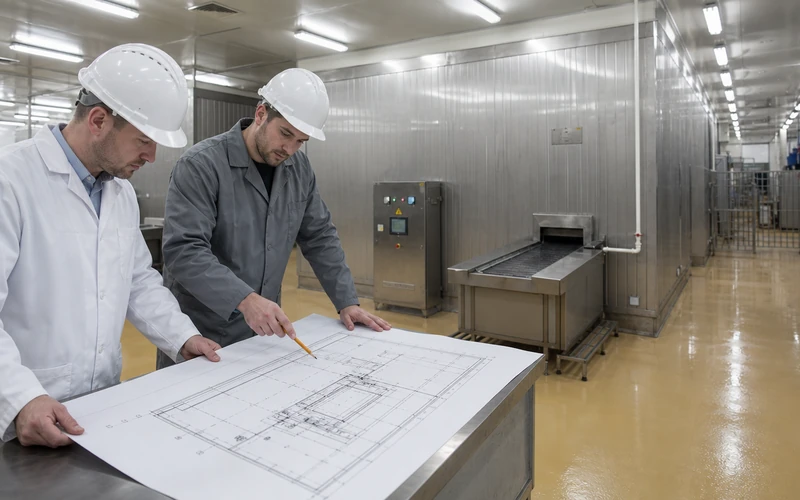
Request Plan and Elevation Drawings With Belt Direction
The general arrangement drawing should include both a top view and side elevations. It should show:
- Product travel direction
- Infeed and outfeed heights
- Conveyor centerlines and widths
- Spiral rotation and belt hand
- Enclosure and overall system dimensions
- Access doors, panels, platforms, and stairs
- Maintenance and cleaning clearances
- Main utility and refrigeration connection points
The drawing should use a confirmed plant reference point. This makes it easier to coordinate the freezer with the building and other equipment.
Verify Transfer Points, Opening Sizes, and Access Clearances
Each transfer should show belt heights, direction, gap, width, speed, and expected product condition. Openings should fit the largest product without allowing excess air entry. Clearances should confirm that doors can open and parts can be removed after nearby equipment is installed.
Define the Supply Boundary for Conveyors, Controls, and Utilities
Quotations may use different supply limits. One supplier may include infeed and outfeed extensions, while another may stop at the enclosure wall. The same issue applies to platforms, guards, belt washers, control panels, field wiring, refrigeration valves, piping, drains, and insulation.
The proposal should state who supplies and installs each interface. It should also explain who controls the upstream and downstream conveyors and how the equipment will exchange signals.
| Item to confirm | Questions for the proposal review |
| Product data | Are size, weight, spacing, load, and infeed condition defined? |
| Performance | Are throughput, dwell time, infeed temperature, and target outfeed temperature stated? |
| Layout | Are elevations, direction, rotation, openings, and clearances shown? |
| Conveyor scope | Are extensions, transfers, curves, inclines, and guards included? |
| Utilities | Are power, refrigeration, water, drains, air, and cleaning connections listed? |
| Controlos | Are line interlocks, sensors, fault signals, and speed control included? |
| Instalação | Are foundations, lifting, assembly, insulation, testing, and training assigned? |
Confirm Installation, Commissioning, and Performance Testing
The proposal should define delivery access, lifting space, foundation readiness, and work by other contractors. Commissioning should run the full line with the intended product and state the rate, temperatures, dwell time, loading pattern, and settings. For several products, the team should identify both the highest heat load and the hardest item to handle.
What Spiral Freezer Layout Mistakes Cause Expensive Rework?
Most layout problems can be found before equipment is built. The following mistakes often lead to extra conveyors, delays, or difficult daily operation.
Selecting the Spiral Freezer Before Mapping the Full Production Line
A freezer should not be selected from capacity and footprint alone. The upstream discharge, downstream infeed, product path, hygiene zones, and service routes need to be mapped first. Otherwise, the plant may buy a suitable freezer in the wrong configuration.
Reducing Footprint but Blocking Cleaning or Maintenance Access
Using every available square meter may look efficient on a drawing. In practice, blocked doors, narrow aisles, and inaccessible drives increase cleaning and repair time. Service space is part of the required footprint.
Adding Too Many Transfers for Delicate Products
Several short conveyors may solve a geometric problem but create a product-handling problem. Each added transfer should have a clear reason. Where transfers cannot be avoided, their design should be tested with the real product.
Ignoring Moisture Loads and Downstream Bottlenecks
A well-sized freezer can still lose production time if its openings collect ice or if the packaging line cannot accept the discharge rate. Layout review must include room humidity, air movement, defrost needs, downstream capacity, and line-stop behavior.
FAQs About Spiral Freezer Infeed and Outfeed Layouts
The questions below cover project situations that are not solved by choosing a standard layout alone.
Can an Existing Spiral Freezer Be Reconfigured After Installation?
Some systems can be modified, but the enclosure openings, belt hand, drum rotation, drive, controls, and airflow may also need changes. The original manufacturer should review the machine drawings and proposed layout before a used purchase or plant modification.
Can One Spiral Freezer Serve More Than One Production Line?
It may be possible to merge upstream lines, divide the outfeed, or use a custom multi-belt system. The design must address product separation, loading, sanitation, accumulation, and line stops. A shared freezer saves space but creates a common point of failure.
Can the Infeed and Outfeed Pass Through Different Hygiene Zones?
Yes, when the enclosure, wall penetrations, conveyors, and room controls are designed for it. The project team must review product and staff flow, air pressure, condensation, cleaning, seals, the plant food safety plan, and local requirements.
Conclusion: Choosing the Right Spiral Freezer Infeed and Outfeed Layout
The right layout follows the production process. It connects the required infeed and outfeed heights with a practical floor-plan direction, stable product handling, safe access, and clear installation boundaries.
Low-in/high-out and high-in/low-out systems use building height, while low-in/low-out systems can simplify a single-floor line. Straight-through, L-shaped, and U-shaped options then adapt the freezer to the floor plan. Buyers should compare the complete installed system rather than the enclosure alone.
Square Technology can configure an industrial congelador em espiral around the product, capacity, factory layout, and surrounding processing equipment. Supplying accurate line drawings and process data at the quotation stage allows the engineering team to develop a more practical layout and a clearer project scope.