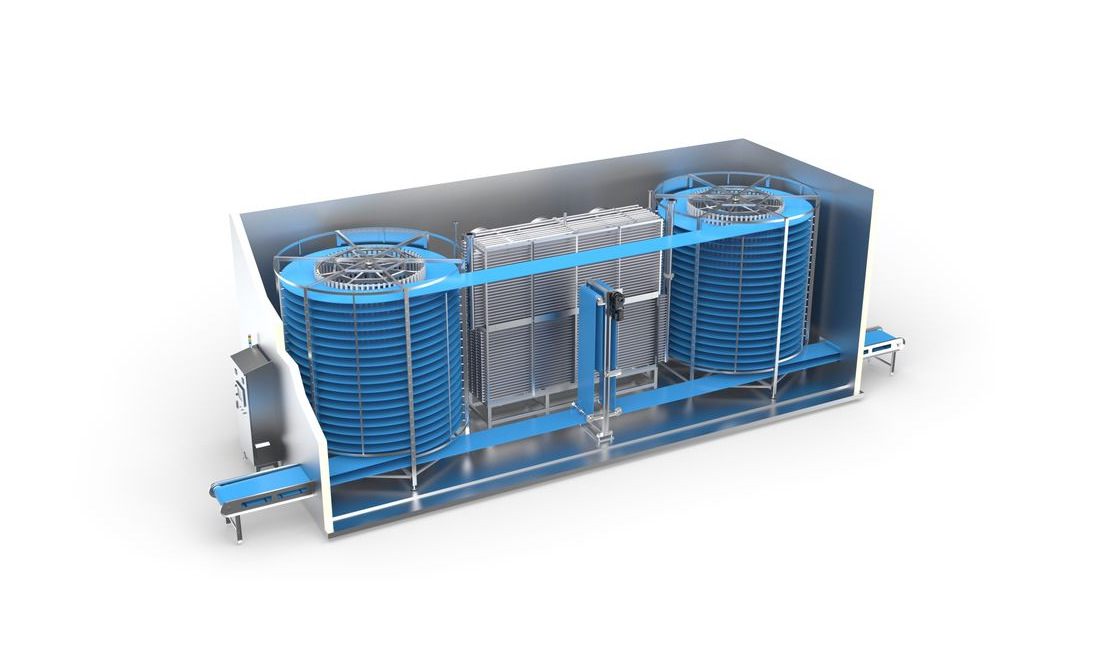
A spiral freezer is a long-term capital asset in a food plant, not a catalogue purchase. Buyers should not select one by brand name or rated capacity alone. Two freezers both rated at 2,000 kg/hr can give very different results on the same product.
Manufacturers differ in four areas: system design, engineering capability, supply scope, and site service. Some supply the freezer body only. Others supply the refrigeration plant, the control system, and the site installation as well. These gaps change the true cost of a project and the work the buyer must carry alone.
This article does not rank manufacturer brands. It explains the spiral system types on the market, the engineering work behind a proper design, and the project stages a manufacturer may or may not cover.It also lists the data a food processor should prepare before asking for a quote. With complete data, every supplier quotes on the same basis, and the proposals become comparable.
What Spiral Freezer Systems Do Manufacturers Offer?
Manufacturers offer four main spiral configurations: low-tension systems, self-stacking systems, single-drum systems, and twin-drum systems. The first two describe how the belt is carried. The last two describe the shape of the belt path. The same spiral frame is also built for cooling, chilling, and proofing duty.
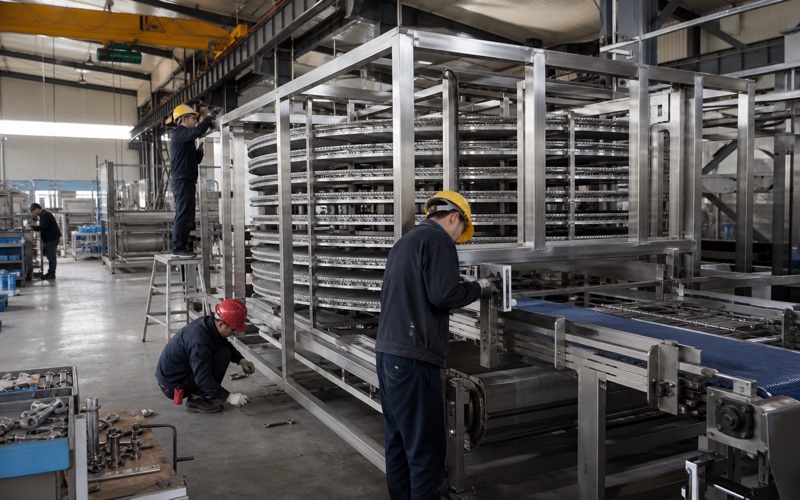
Low-Tension Spiral Freezer Systems
A low-tension spiral freezer wraps its belt around a rotating drum, and the drum pulls the belt along. Because the drum does the work, the belt stays under low tension. Low tension means less stretch, less deformation, and a longer belt life.
Typical build values for this system include:
- Drum diameter: 1,620 mm to 5,800 mm
- Belt tiers: 6 to 40
- Mesh belt width: 520 mm to 1,372 mm
- Belt material: SUS304 food-grade spring wire, with an 8 to 10 year service life
- Capacity: 200 kg/hr to 10,000 kg/hr
Support rails hold the belt on each tier. Those rails add parts inside the freezer, so washing takes more care than in an open frame.
Belt support, product load per square metre, travel path, and free plant space all have to be fixed project by project. A layout that suits a new 12 m high building will not fit an older room with a 6 m ceiling and fixed columns.
Self-Stacking Spiral Freezer Systems
A self-stacking spiral freezer builds its own tower, because each belt tier rests on the side links of the tier below. The design removes the support rails and the drum cage.
Removing those parts frees space inside the enclosure. More tiers fit into the same floor area, and Square Technology reports up to 50% more output than a comparable low-tension design on the same footprint. The self-stacking spiral freezer range covers 300 kg/hr to 5,000 kg/hr, with 16 to 50 belt tiers and belt widths of 420, 660, 760, 860, and 1,060 mm.
The open frame also shortens washing. With no rails and no cage, the conveyor is almost fully reachable, so food scraps have fewer places to collect. Automatic cleaning normally runs in three modes: PZC cleans the product zone only, PZE cleans the product zone and the coil, and CIP cleans the product zone, the coil, the enclosure, and the structure.
Belt choice still matters. The belt must suit the piece size, the piece weight, and the way the product sits on the surface. Fried foods, ready meals, and pastries are common duties for this system.
Single-Drum and Twin-Drum Configurations
Single-drum and twin-drum systems differ in belt path length, dwell time, discharge height, and floor space. A single-drum system uses one drum, so the product enters at one level and leaves at another. Infeed and outfeed sit at different heights, and the machine keeps a small footprint.
A twin-drum system, also called a double-drum system, uses two drums. The belt climbs the first drum and comes down the second. This gives a longer belt path inside the same building height, which supports longer dwell time and higher output. It also places both the infeed and the outfeed at a low level, which suits operators and matches many existing conveyor lines. Infeed and outfeed sections are commonly 500 mm long on both designs.
The trade-off is floor area. A twin-drum machine needs more space than a single-drum machine of similar output. Configuration should follow the target capacity, the product type, and the direction of the existing line, not a general habit.
Freezing, Cooling, Chilling, and Proofing Systems
Spiral systems handle far more than freezing. The same conveying principle is used for cooling, chilling, and proofing, because a spiral simply holds product in a controlled airstream for a set time.
Real duties show the range clearly:
- Freezing: raw chicken parts, whole fish, and dumplings taken to a core temperature of −18 °C
- Cooling: baked bread, buns, and croissants brought down to ambient temperature before packing
- Chilling: cooked meals, sauces, and sliced meats brought to a safe holding temperature
- Proofing: raw dough held in warm, moist air before baking
What changes between these duties is the process condition, not the frame. Operating temperature, humidity, airflow, and dwell time are each reset for the job. A ready meal can go from cooked temperature to −18 °C in under 1.5 hours. Ice cream hardening in boxes runs from −4 °C down to −18 °C.
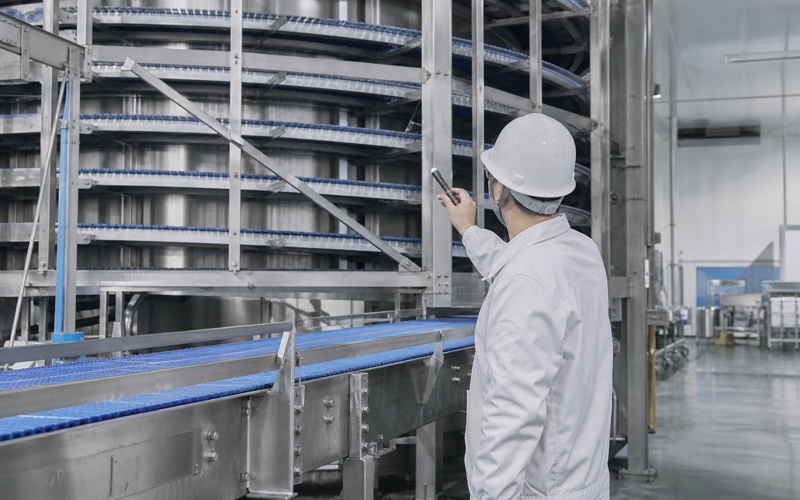
Some manufacturers cover this full range and also build the matching spiral ovens, continuous ovens, and continuous proofers. Others build freezing equipment only. Processors planning a complete line should confirm this point early.
What Are the Core Capabilities of Spiral Freezer Manufacturers?
A capable manufacturer works through six engineering steps before it issues a price: product analysis, capacity calculation, airflow design, hygienic design, refrigeration integration, and control integration. A quote produced without these steps is a guess.
Product and Process Analysis
Product analysis is the first step, because the food decides the machine. Engineers should review the product type, the piece size, the piece weight, the shape, the moisture content, the packaging state, and the heat load to be removed.
These details set the freezing time and the safe belt loading. A 120 g chicken fillet and a 350 g packed ready meal do not freeze at the same speed, even in the same airstream. Soft or sticky items need extra handling so they hold their shape on the belt.
Different food groups lead to different designs. Poultry, meat products, and ready meals need high airflow and strong hygiene control. Bakery goods, raw dough, and proofed products need gentle handling and tight humidity control. Seafood such as shrimp, fish fillets, and shellfish needs fast surface freezing to limit drip loss.
Capacity, Belt Loading, and Dwell Time Calculation
Equipment size comes from four linked figures: target output per hour, product load per square metre of belt, belt speed, and dwell time inside the freezer. Change one, and the others must move too.
Overloading the belt is the most common design error. If pieces overlap, air cannot reach every surface, and the core temperature is missed. If dwell time is too short, the surface freezes hard while the centre stays warm, and the product softens again in the carton.
For this reason, a rated capacity means nothing on its own. A figure such as 3,000 kg/hr should always carry three conditions with it: the named product, the infeed temperature, and the target core temperature at outfeed. Ranges quoted on product pages work the same way. A stated span of 300 kg/hr to 3,000 kg/hr for Chinese pastries covers many different machine sizes.
Airflow and Temperature Control
Airflow decides freezing speed far more than machine size does. A manufacturer should be able to state five values: airflow direction, air speed across the belt, evaporating temperature, air temperature in the product zone, and target core temperature.
Freezing duty often calls for an evaporating temperature between −35 °C and −45 °C. Air baffles guide the cold air evenly through the product area, and air shrouds at the infeed and outfeed limit cold loss to the room. Even airflow keeps weight loss low and gives a uniform result across the full belt width.
Two freezers with similar outside dimensions can still perform differently. Drum diameter and belt area are easy to compare on paper. The air system is what turns that belt area into real freezing capacity, so it deserves the same attention.
Hygienic Design, Cleaning, and Defrost
Hygienic design covers access, internal structure, drainage, belt washing, and defrost. Good practice includes stainless steel frames and panels, easy-access doors and liftable covers, a fully welded leak-proof floor, and a sloped floor that drains through corner outlets.
Cleaning runs at three levels. Manual washing suits low-risk products. A belt washer handles daily production cleaning. A CIP system runs automatic recipes for foaming, rinsing, disinfectant spraying, and belt drying. CIP is normal for cooked and ready-to-eat products, where food safety rules are strictest.
Defrost also belongs in the design stage. The three common methods are water defrost, hot gas defrost, and air defrost. An air defrost system blows pulses of high-speed air over the evaporator fins while production continues. By keeping frost off the coil, it can extend runtime by 150% to 200%. Longer runtime means fewer stops, more stable freezer temperature, and higher daily output.
Refrigeration System Integration
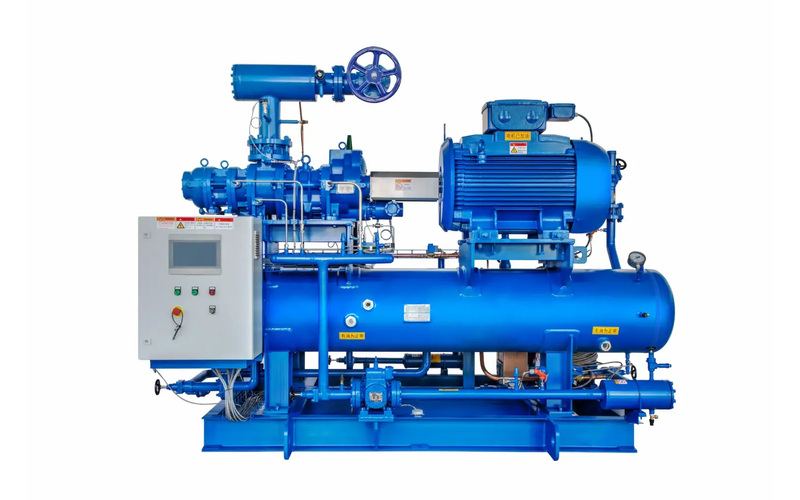
The freezer is one part of a cold system, so the refrigeration side has to match it. The refrigerant, the evaporator, the valve station, the compressor package, and the total plant load all work together, and a weak link caps the whole line.
Three refrigerants dominate spiral freezing: ammonia, CO₂, and fluorinated refrigerants. Each one changes pipe sizing, safety rules, and machine room design. Evaporator build also matters. Stainless steel or aluminium tubes with aluminium fins are standard, and a variable fin pitch delays frost buildup on the coil face.
Supply scope varies more here than anywhere else. Some manufacturers supply freezing equipment only and expect a separate refrigeration contractor. Others design and supply the full system, including evaporators, valve stations, and compressor units. Buyers should settle this boundary before they compare any prices.
PLC and Production Line Integration
A spiral freezer runs on a PLC with a touch screen, and that panel is the operator’s only view of the process. Standard functions include real-time status display, zone-by-zone temperature readings, fault alarms, stored freezing programs for different products, and data logging. Remote troubleshooting modules are widely offered as an option.
The freezer also has to work with the rest of the line. Upstream equipment such as formers, fryers, and ovens sets the feed rate. Downstream equipment such as weighers, metal detectors, and packing machines sets the discharge rate. Belt speeds, start and stop signals, and emergency stop circuits all need to be linked.
Interface details should be written into the contract. Signal type, cable supply, and the party that programs the line-level control are three of the most common gaps in a spiral freezer project.
What Is Included in a Spiral Freezer Manufacturer’s Project Scope?
Project scope covers five blocks: the freezer equipment package, the refrigeration and auxiliary systems, transport and installation, commissioning and acceptance, and after-sales support. Two quotes can differ by a wide margin simply because they cover different blocks.
Spiral Freezer Equipment Package
The equipment package normally covers the conveyor system, the drive units, the insulated enclosure, the floor, the mesh belt, the evaporator, and the fans. Access doors, air baffles, and the PLC control panel are usually included as well.
Enclosure specification should appear in writing. PIR or PU panels of 50 mm to 250 mm thickness are standard, with stainless steel skin on both sides. A fully welded stainless steel enclosure is available as an option.
Standard scope is not the same for every supplier. Belt edge guards, extended infeed and outfeed sections, and access platforms with stairs may be standard for one manufacturer and priced as extras by another. A written equipment list with quantities, materials, and marked options removes the doubt.
Refrigeration, Controls, and Auxiliary Systems
Auxiliary scope decides whether a quote is for a machine or for a working freezing plant. A complete project may need compressor units, valve stations, refrigerant piping, electrical panels, cleaning systems, defrost systems, and water supply and drainage work.
A price for the spiral freezer body is not a price for a finished installation. When the refrigeration plant, the power supply, and the cleaning system sit outside the quote, the excluded work can equal a large share of the total project budget. Buyers should read every quote as a scope document first and a price second.
Transport, Installation, and Site Responsibilities
Site responsibility must be assigned item by item. That list includes packing, freight, customs clearance, unloading, lifting, site assembly, refrigerant piping, electrical work, pipe insulation, and civil work such as foundations and floor openings.
Four service levels exist, and the wording matters:
- Supply only: the equipment arrives at the agreed point and nothing more
- Installation guidance: drawings and remote support are provided
- Installation supervision: the manufacturer sends engineers to direct a local crew
- Full installation: the manufacturer performs the assembly work
Each level carries a different price and a different workload for the buyer. The chosen level should appear in the contract, not in an email.
Commissioning and Performance Acceptance
Commissioning runs in four stages: an empty run, a trial run with product, a continuous run, and a capacity test. The empty run checks rotation, alarms, and safety devices. The trial run confirms product handling. The continuous run proves stability, and the capacity test proves output.
Performance acceptance must rest on conditions agreed in advance. Five values belong in that agreement: the named test product, the hourly output, the infeed temperature, the outfeed core temperature, and the ambient and refrigerant supply conditions during the test.
Without those agreed values, a performance dispute has no reference point, and both sides argue from different assumptions.
Training, Spare Parts, and Technical Support
Support after start-up should cover operator training, maintenance training, an initial spare parts kit, remote support, and site service visits. These items are cheap at the contract stage and expensive later.
Wear parts on a spiral freezer are predictable. Belt links, drive chains and sprockets, and bearings and seals top the list, followed by fan motors and door gaskets. A recommended spare parts list with part numbers lets the plant hold its own stock and avoid long stoppages.
Project location shapes this support. Spare parts delivery time and site visit response time are not the same in every region, so buyers should ask how the manufacturer serves their country.
What Information Do Manufacturers Need to Develop a Spiral Freezer Proposal?
Manufacturers need six data sets to size a spiral freezer: product data, capacity and temperature data, layout data, refrigeration and utility data, cleaning requirements, and project location and schedule. A proposal is only as accurate as this input.
Product Size, Weight, and Packaging
Product data comes first. Manufacturers need the product name, the size of a single piece, the piece weight, and the shape. They also need any recipe feature that changes freezing behaviour, such as high fat content, high moisture content, or a filled centre.
Packaging state must be stated too. Loose pieces, tray-packed meals, and bagged or cartoned goods each freeze at different speeds, because packaging adds a layer of insulation between the air and the food.
Buyers should also flag difficult behaviour. Products that stick to the belt, lose their shape, break easily, or lose weight during freezing all need design attention. Photos or physical samples help when the product is unusual.
Required Capacity and Temperature Conditions
Capacity and temperature must be given together, because neither one sizes a freezer alone. Manufacturers need the target output per hour, the infeed temperature, the required outfeed temperature, and the freezing time the process allows.
Core temperature and surface temperature should be listed separately. A piece can show a hard surface at −18 °C while its core sits at −6 °C, and those two cases lead to very different machine sizes.
Daily running hours and shift pattern belong here as well. They set the windows available for defrost and cleaning, which in turn affect the real output over a week.
Factory Layout and Production Line Direction
Layout data decides whether a design will physically fit. Manufacturers need the available floor area and the clear height under beams and services. They also need the required infeed and outfeed heights and the position of the machines before and after the freezer.
Line direction is equally important. The freezer must accept product from the correct side and discharge it towards the next machine. A simple dimensioned drawing, marked with column positions, door widths, and ceiling services, prevents most layout problems later.
Refrigeration and Utility Conditions
Utility data sets the operating limits of the design. Useful inputs include the refrigerant type, the capacity of any existing refrigeration plant, the electrical supply and voltage, the water supply, the drainage, and the compressed air supply.
Buyers should state clearly whether the freezer connects to an existing refrigeration system or whether a new system forms part of the project. When an existing plant is used, its spare capacity at the required evaporating temperature must be confirmed, not assumed.
Cleaning and Food-Safety Requirements
Cleaning requirements shape the hygienic design, so they cannot wait until commissioning. Manufacturers need the planned cleaning frequency, the need for CIP, the preferred defrost method, and the plant’s internal hygiene standard.
Food-safety and compliance rules for the project country should be added at the same time. Equipment certificates such as CE, ASME, PED, and CSA apply in different markets, and each one affects construction, marking, and documentation. Building these rules into the original design costs far less than retrofitting them.
Installation Location and Project Schedule
Location and schedule affect both the design and the shipping plan. Manufacturers need the project country or region, the site access conditions, and the planned start-up date.
Site access has real design consequences. Crane availability, door widths, and free assembly space decide how far the freezer can be pre-assembled in the factory and how it must be split for transport.
Buyers should also state the support they expect. Site installation, commissioning, and long-term technical service can come from the manufacturer, from a local contractor, or from a mix of both.
How Should Buyers Compare Proposals from Spiral Freezer Manufacturers?
Comparison works only when every supplier answers the same question. Seven checks turn a stack of quotes into a fair comparison.
Confirm the Same Design Basis
The design basis must match across every proposal. That means the same product, the same hourly output, the same infeed temperature, the same outfeed core temperature, and the same daily running hours.
Small changes in assumption produce large changes in price. A supplier that assumes a −12 °C core instead of −18 °C, or a heavier belt load per square metre, will quote a smaller and cheaper machine. Until the basis is aligned, capacity and performance figures cannot be compared at all.
Compare System Design and Performance Data
Once the basis matches, the technical data can sit side by side. Six items carry most of the weight:
- System type, single or twin drum, and number of belt tiers
- Belt width and total effective conveying area
- Product load per square metre and dwell time
- Air temperature in the product zone and evaporating temperature
- Airflow direction and product handling on the belt
- The production changes the design can absorb
That last point is often missed. A plant that plans to add new products within three years should ask what else the freezer can handle beyond today’s recipe.
Check the Included and Excluded Project Scope
Scope should be checked line by line, not summarised. Refrigeration, electrical work, cleaning systems, freight, installation, commissioning, and site engineering each need a clear yes or no.
A serious proposal lists its exclusions openly. Buyers should ask for a written list of everything they must supply themselves, including utilities, foundations, local labour, and lifting equipment.
Review Energy and Utility Conditions
Energy figures are comparable only when the boundary is stated. Fans, conveyor drives, control systems, refrigeration, and defrost all draw power, and some quotes count only the freezer motors.
The same rule applies to water and compressed air. Cleaning cycles and defrost cycles consume both, and consumption depends on the cleaning mode selected. Numbers gathered under different operating conditions or different supply scopes tell the buyer nothing.
Review Performance Test and Acceptance Conditions
Test conditions should be written into the contract before the order. The document needs the test product, the output to be demonstrated, the required core temperature, and the length of the continuous run.
The proposal should also explain the remedy if the test fails. A clear correction process, with named responsibilities and a time limit, protects the buyer and the manufacturer equally.
Evaluate Cleaning, Maintenance, and Technical Support
Daily operating cost lives in these details. Five points make a practical comparison: hours needed for a full clean, reach into internal parts, wear parts list, maintenance interval, and spare parts supply route.
Support should be described in real terms, not adjectives. Buyers should confirm the number of training days, the working language, the response time for remote support, and who pays travel costs for a site visit.
Identify Common Gaps in Manufacturer Proposals
Gaps follow a pattern, so they are easy to hunt for. The frequent ones are missing auxiliary equipment, unassigned site work, undefined interfaces with upstream and downstream machines, and vague performance test conditions.
Three areas deserve extra attention: the basis behind the stated capacity, the exact limit of the refrigeration scope, and the responsibility for installation. Loose wording in these three places causes most disputes in spiral freezer projects.
FAQs About Spiral Freezer Manufacturers
What types of spiral freezer systems do manufacturers provide?
Manufacturers provide four main types: low-tension systems, self-stacking systems, single-drum systems, and twin-drum systems. Low-tension and self-stacking describe how the belt is carried, while single-drum and twin-drum describe the shape of the belt path.
Many manufacturers also build spiral systems for other duties. Cooling, chilling, and proofing systems use the same conveying principle at different temperatures, humidity levels, and dwell times.
Do all spiral freezer manufacturers provide refrigeration systems?
No. Supply scope differs across the market, and this is the largest single difference between quotes. Some companies supply freezing equipment only and leave the refrigeration plant to a separate contractor.
Others integrate the refrigeration system, the electrical controls, and the auxiliary equipment into one package. Square Technology supplies refrigeration systems alongside its freezing equipment, so either arrangement is possible. The boundary should always be confirmed in writing before prices are compared.
Can manufacturers customize the belt and equipment layout?
Yes. Customization is normal rather than exceptional in this equipment class. Common custom items include belt width, number of belt tiers, tier spacing, and drum diameter. Buyers can also specify infeed and outfeed heights, conveying direction, enclosure material and thickness, refrigerant type, defrost method, and cleaning system.
The range of options depends on the product data and the building. Accurate product specifications and a dimensioned layout drawing open up far more choices than a general description does.
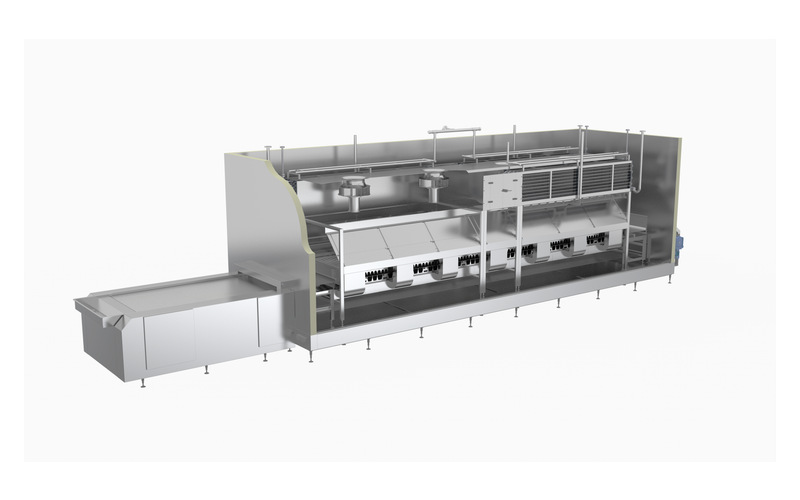
Can a spiral freezer be integrated into an existing production line?
Yes, and retrofit projects are common. Five checks decide whether it will work: free floor space, clear height, required output, conveying heights at both ends, and control interfaces with the machines before and after the freezer.
The existing refrigeration system needs a separate review. Its spare capacity at the required evaporating temperature determines whether new compressors or evaporators are needed.
Why can proposals with the same stated capacity be different?
Because the assumptions behind that number differ. Product type, belt load per square metre, freezing time, air temperature, and calculation method all shift the result, and none of them appear in the headline figure.
Supply scope and acceptance conditions widen the gap further. One proposal may include refrigeration, installation, and a witnessed capacity test, while another covers the freezer body alone, even though both state 2,000 kg/hr.
What information is needed for an accurate spiral freezer proposal?
Six data sets are needed: product details, target output, infeed and outfeed temperatures, factory layout and line direction, refrigeration and utility conditions, and cleaning requirements. Project location and target start-up date complete the picture.
The more complete this information is, the more accurate the equipment design and the quotation will be. Missing data forces the manufacturer to add safety margins, which raises the price.
How long does a spiral freezer project take?
Project duration depends on the engineering design, the equipment configuration, the level of customization, the shipping route, and the site conditions. A standard configuration going into a prepared building is not comparable with a custom system that includes a new refrigeration plant.
A fixed lead time quoted before the design basis is agreed is not reliable. A realistic schedule can be issued once the product data, the layout, and the supply scope are settled.
How much does an industrial spiral freezer cost?
No fixed price range applies without design conditions. Cost is driven by required output, equipment size, system type, effective belt area, refrigeration scope, control system, cleaning and defrost systems, and installation requirements.
A machine for 300 kg/hr of pastries and a machine for 5,000 kg/hr of raw poultry sit in completely different cost brackets. The only meaningful figure is one calculated for a named product, a defined output, and an agreed supply scope.
Discuss Your Spiral Freezer Project with Square Technology
Square Technology Group designs spiral freezing solutions around the product, the target output, the temperature conditions, and the plant layout. The company has built freezing systems for more than 30 years from its base in Nantong, China. It can also supply the matching refrigeration system, PLC controls, and cleaning systems within a single scope.
Food processors planning a new line or an upgrade can start a design review at any time. The starting data set is the product specification, required capacity, infeed and outfeed temperatures, site layout, and refrigeration conditions. Full configuration details are available on the спиральный морозильный шкаф и self-stacking spiral freezer product pages.