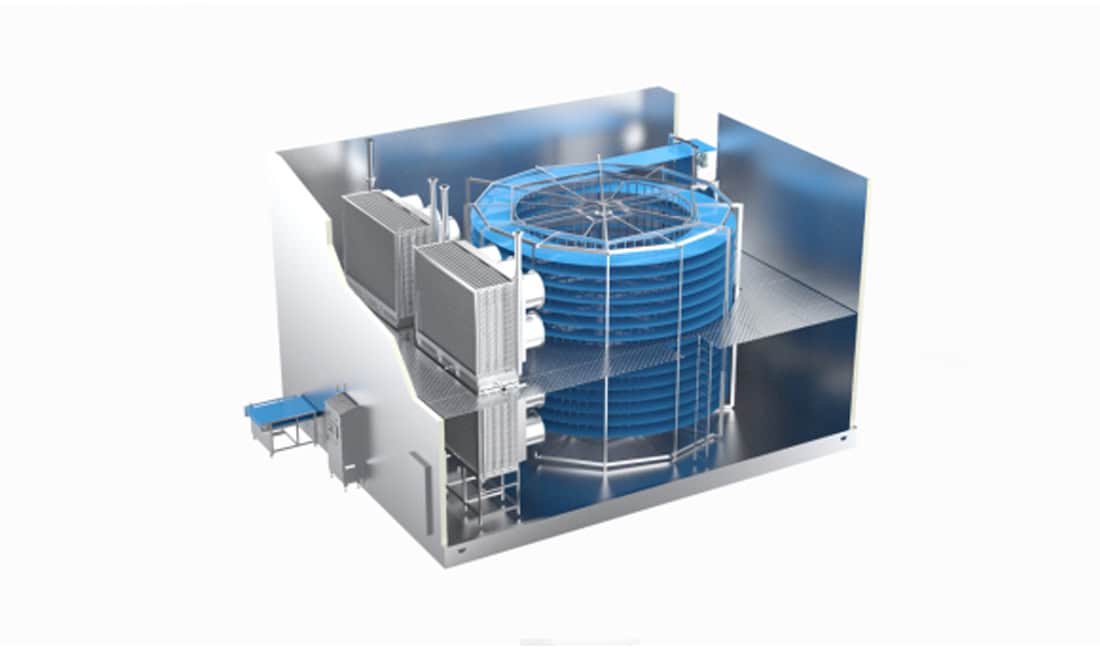
A spiral freezer freezes food as it moves through an insulated cabinet. The product rides on a conveyor belt that climbs or drops along many stacked tiers. Fans push very cold air across the food. Heat leaves the food, passes into the air, and moves to the evaporator. The refrigeration system then carries that heat outside the machine.
Several settings work together to control the result. Belt speed, dwell time, airflow, air temperature, and product load all shape the final core temperature of the food. This article explains how an industrial spiral freezer works when it uses a mechanical refrigeration system.
What Is a Spiral Freezer?
A spiral freezer is a continuous industrial freezer. It chills or freezes food without stopping to load and unload in batches. The belt is arranged in a spiral, so it stacks the freezing path upward instead of stretching it across the floor. This design uses vertical space to hold a long belt path in a small footprint.
Food cools or freezes while it keeps moving through the cabinet. Because the flow is continuous, the line does not need to pause between loads. This differs from a batch freezer, which freezes one full load at a time before the next load goes in. This section only sets the basic idea. The full benefits and uses come later.
How Does a Spiral Freezer Work Step by Step?
The freezing job can be broken into eight clear steps. Each step hands off to the next, from the moment the food enters to the moment it leaves. The steps below follow the food through the machine in order.
Step 1: Products Enter Through the Spiral Freezer Infeed
Products arrive from the upstream line and move onto the conveyor belt. Depending on the machine design, the food may sit directly on the mesh belt. It may also travel on trays, in packaging, or on other carriers.
Product size, weight, spacing, packaging, and inlet temperature should match the design conditions. When products overlap or the load is uneven, they can block airflow. Good spacing at the infeed helps the cold air reach every surface.
Step 2: The Conveyor Moves Products Along a Spiral Path
A motor and drive system move the belt around the spiral structure. Depending on the line layout, products can travel upward or downward through the tiers. The stacked spiral path gives a long, useful belt length inside a small floor area.
Not every freezer uses the same drum, rail, or drive design. Some machines rely on a drum and support rails. Others use a self-stacking belt. The layout depends on the type of spiral system.
Step 3: Spiral Freezer Belt Speed Creates the Required Dwell Time
Dwell time is how long the food stays inside the freezer. It comes from the useful belt length and the real belt speed working together. A slower belt speed usually gives the food more time inside the machine.
Some products need more heat removed than others. Thick, heavy, or warmer products often need longer inside the freezer. Belt speed should be set from both the target output and the target core temperature of the food. The two goals must be balanced.
Step 4: Fans Circulate Cold Air Across the Product
Fans push cold air between the evaporator, the air ducts, and the product area. On Square Technology’s spiral freezers, air baffles guide the cold, high-speed air evenly through the product zone. This helps the air reach different tiers and the exposed surfaces of the food.
Different machines use different airflow designs. Some use horizontal airflow, and some use vertical airflow. The right airflow direction and speed depend on the product and the machine structure. Good airflow keeps freezing even and helps limit product drying.
Step 5: Heat Moves from the Product to the Air
Heat leaves the food surface through forced convection. This means moving air pulls heat away from the surface. Inside the food, heat keeps traveling from the warm center toward the surface.
The surface cools first. The center temperature drops later, after the surface. For this reason, three values are not the same: the air temperature in the cabinet, the surface temperature of the food, and the core temperature of the food. They should never be treated as one number.
Step 6: The Evaporator Transfers Heat to the Refrigerant
After the air picks up heat from the food, it returns to the evaporator. The evaporator passes that heat from the air into the refrigerant. The now-colder air is sent back to the product area by the fans.
This cycle repeats without stopping. In a mechanical spiral freezer, the refrigerant flows inside a closed circuit. It does not touch the food directly. The circulating air is the only medium that moves between the product and the evaporator.
Step 7: The Refrigeration System Removes Heat from the Spiral Freezer
The refrigeration system moves the heat from the evaporator to a place outside the freezer. It does this through a cycle with four main actions: compression, condensation, throttling, and evaporation. The compressor raises the pressure of the refrigerant. The condenser releases heat outside. A valve drops the pressure again, and the refrigerant evaporates in the coil to absorb more heat.
This section does not cover full refrigeration design or load math. A complete system must be sized for the real job. Readers who want more detail can look at the системы охлаждения page.
Step 8: Frozen Products Leave Through the Discharge
After the set dwell time, the products reach the outfeed and leave the freezer. From there they may go to packaging, to more processing, or into frozen storage. The step depends on the line.
Acceptance testing should check the real core temperature of the food, the real output, and steady running conditions. Measuring only the air temperature inside the cabinet does not prove the food reached its target frozen state. The core temperature is the true test.
What Components Make a Spiral Freezer Work?
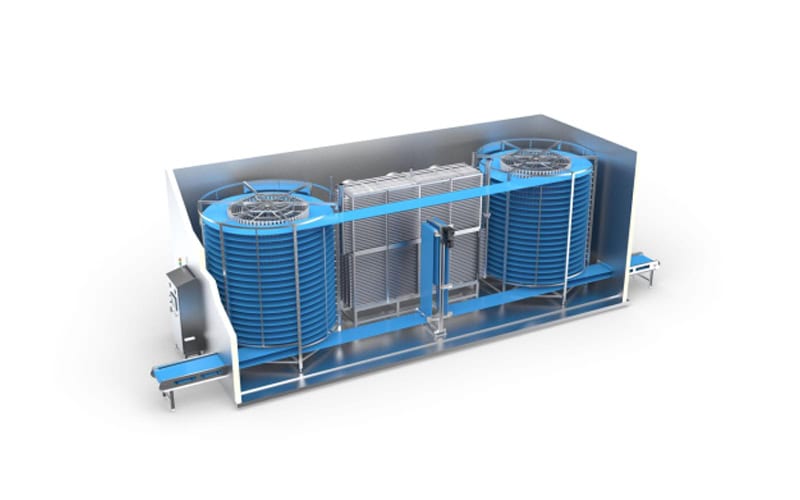
A spiral freezer is a set of parts that work as one system. Some parts move the food, some move the air, and some remove the heat. The main groups are covered below.
Spiral Belt, Drum, Support Structure, and Drive System
The conveyor belt carries the product and runs along the spiral path without stopping. Support rails, the drum, the drive unit, and the tensioning parts help keep the belt steady. On Square Technology machines, the belt is made from SUS304 food-grade spring wire for high strength and a long service life.
The exact structure depends on the design. A low-tension system and a self-stacking system are not built the same way. The parts are chosen to match the chosen spiral type.
Evaporator, Fans, Ducts, and Air Baffles
The evaporator handles the heat exchange between the air and the refrigerant. The fans move the air in a steady loop. The ducts and air baffles control the air path and spread the air across the tiers.
These parts must work as a team. When they are matched well, they reduce the airflow difference between one tier and another. Even airflow leads to more even freezing.
Insulated Enclosure, Infeed, and Discharge Openings
The insulated cabinet keeps outside heat and moist air from entering. Square Technology builds these enclosures from PIR panels, with thicknesses from 50mm to 250mm, and offers a fully welded stainless steel option.
The infeed and outfeed openings must stay open so product can pass through. Because of this, the cabinet cannot be sealed completely. The size, position, and airflow control at these openings affect cold loss and frost load. Air shrouds can help limit cold loss at the openings.
Refrigeration System and Refrigerant Circuit
The refrigeration unit, valve stations, pipes, and evaporator form the heat-removal system. This system must handle several heat loads at once. These loads include the product, the fans, the drive, air that leaks in, and other sources.
The freezer body and the full refrigeration system are not always quoted together. Buyers should check the exact scope of supply before they order. This avoids gaps between the freezer and the cooling system.
PLC, Sensors, Alarms, and Safety Interlocks
The PLC control system coordinates the belt, fans, temperature, defrost, and alarms. On Square Technology’s freezers, a PLC touch screen shows the running status, the temperature of each area, and fault alarms in real time. Sensors watch air temperature, belt status, and fault signals.
Safety interlocks can stop or limit the machine when something goes wrong. Still, the control system does not measure the food core temperature by itself. That value must be checked with a method both sides agree on.
How Do the Cold-Air and Refrigerant Loops Work in a Spiral Freezer?
A spiral freezer runs two linked loops at once. One moves cold air, and one moves refrigerant. They meet only at the evaporator. The two loops are explained below, followed by the full heat path.
The Cold-Air Loop Inside the Spiral Freezer
Cold air flows from the evaporator to the product area. It passes over the food surface and picks up heat. The warmer air then returns to the evaporator, where it is cooled again.
This air loop mostly stays inside the insulated cabinet. It is a closed path of moving air. The air is the working medium that carries heat from the food to the evaporator.
The Refrigerant Loop in the Spiral Freezer System
The refrigerant flows through the evaporator, the compressor, the condenser, and the connecting pipes. In the evaporator, the refrigerant absorbs heat from the air. That heat is then released through the condenser or another heat-rejection system.
The refrigerant loop and the cold-air loop are two separate loops. They are linked, but they are not the same. They meet only at the evaporator, where heat passes from one to the other.
The Complete Spiral Freezer Heat-Removal Path
The full heat path can be shown in a clear order: Product core → Product surface → Moving air → Evaporator → Refrigerant → Heat-rejection system
Heat starts at the center of the food and ends outside the machine. A simple two-loop diagram helps show this path clearly. The key point is that the cold air and the refrigerant are two different media. They should not be described as the same thing.
What Controls Spiral Freezer Dwell Time and Product Exit Temperature?
No single setting controls the result. Several factors work together to set the dwell time and the final core temperature. The main ones are the product, the target temperatures, the belt, the air, the load, and the cooling power. Each factor is covered below.
Product Size, Thickness, Composition, and Packaging
Product thickness, weight, shape, and water content all affect how fast heat can leave the food. Fat, sugar, recipe, and packaging change the freezing process too. For example, a thick meat cut freezes slower than a thin one.
Because of this, no single freezing time fits every food. The freezer does not offer a fixed time apart from the real product specification. Each product needs its own settings.
Product Inlet and Target Core Temperatures
The inlet temperature sets how much heat the machine must remove at the start. A warm product carries more heat than a cold one. The target core temperature at the outfeed should be set from the process and the cold-chain need that follows.
Four values must be kept apart: air temperature, evaporating temperature, surface temperature, and product core temperature. Mixing them leads to wrong conclusions. Clear targets keep the freezing job correct.
Spiral Freezer Belt Speed, Effective Belt Length, and Dwell Time
The useful belt length and the belt speed set the theoretical dwell time. A longer belt or a slower speed gives more time inside. Real running also depends on how the belt is loaded, the line pace, and the conveyor controls.
These factors work together, not alone. Readers who want the math can look at a spiral freezer capacity or dwell time guide for the full method.
Spiral Freezer Air Temperature, Velocity, and Distribution
Air temperature sets the gap between the food and the air. A larger gap moves heat faster. Air speed and air spread control how well heat leaves the food surface.
A lower set temperature does not always give a more even or faster result. The airflow path, the heat-exchange area, and the cooling power matter just as much. All of these must be balanced together.
Spiral Freezer Belt Loading and Product Spacing
When products overlap or sit too close, less surface is exposed to the air. A load that is too heavy can block the cold air from flowing. Both problems slow the freezing.
The right belt load should be confirmed with product testing and the machine design. It is not a guess. Good loading keeps airflow and freezing even.
Spiral Freezer Refrigeration Capacity and Frost Condition
The refrigeration system must keep handling the real running heat load. If the system cannot keep up, the freezing suffers. Frost on the evaporator adds air resistance and can lower the heat-exchange ability.
During long continuous runs, the frost rate and the defrost plan both matter. Square Technology uses variable fin pitch on its evaporators to delay frost buildup and give a longer frosting interval. This helps the freezer run longer between defrosts.
Do All Spiral Freezer Systems Work the Same Way?
The basic idea is the same across machines, but the designs are not. Freezers differ in their cooling method, belt type, drum count, and run direction. These differences are compared below.
Mechanical vs. Cryogenic Spiral Freezer Systems
A mechanical system cools the circulating air with an evaporator and a closed refrigeration loop. Square Technology builds mechanical spiral freezers of this type. A cryogenic system is different. It may use liquid nitrogen or carbon dioxide sprayed directly onto the food.
The two systems differ in structure, ventilation, safety needs, and running cost. Their temperature, energy use, and running data should not be mixed. Each type is judged on its own numbers.
Low-Tension vs. Self-Stacking Spiral Freezer Systems
A low-tension system runs the belt with support rails, a drum, and a drive. A self-stacking spiral freezer works another way. Its belt stacks on the side links of the tier below, so it needs no support rails. The belt is not under tension while it runs, so it is less likely to stretch or deform.
The two structures differ in belt support, drive method, cleaning, and layout. They suit different lines. The choice depends on the product and the plant.
Single-Drum vs. Double-Drum Spiral Freezer Layouts
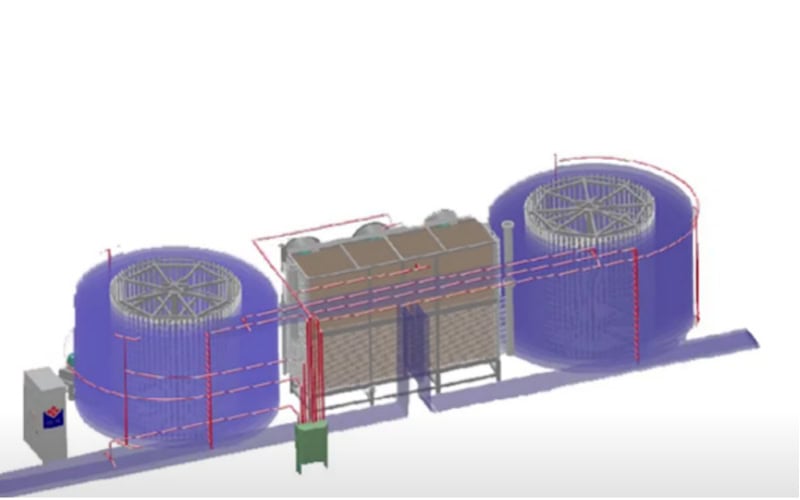
The number of drums affects the belt path, the machine size, and where the infeed and outfeed sit. A double-drum layout can meet certain dwell time or line layout needs. Square Technology’s double-drum design places the infeed and outfeed low, which is easy to operate and matches many customer lines.
No layout is faster or lower in energy use for every job. The best layout depends on the product and the space.
Upward, Downward, and Line-Direction Spiral Freezer Arrangements
Products can move upward or downward along the spiral path. The infeed and outfeed height and direction depend on the plant layout and the machines before and after the freezer. The run direction is chosen to fit the line.
The direction does not change the basic idea. Cold air still carries heat away from the food in the same way. The physics stays the same.
How Does a Spiral Freezer Maintain Stable Continuous Operation?
Steady output depends on more than good freezing. The machine must manage frost, watch its own running conditions, and stay clean between runs. These three tasks are covered below.
Spiral Freezer Frost Formation and Defrost
Water from the product and moist air that enters at the openings slowly forms frost on the evaporator. A frost layer can limit airflow and lower the heat-exchange ability. So the freezer needs a defrost plan that fits its running conditions.
Square Technology offers water defrost, hot gas defrost, and an air defrost (ADF) system. The ADF blows pulses of high-speed air over the fins while the products keep running. This keeps the inside temperature more stable and extends the runtime. These systems manage frost. They do not stop frost from ever forming.
Spiral Freezer Temperature, Airflow, and Belt Monitoring
The control system watches air temperature, fan status, belt speed, and running faults. When a value moves out of its set range, the system can raise an alarm or trigger an interlock. This helps catch problems early.
Still, automatic monitoring does not replace regular checks. The core temperature and the output should be verified on a set schedule. Both the machine and the product need checking.
Spiral Freezer Cleaning and Inspection Between Production Runs
Between runs, the belt, support structure, cabinet, and hygiene areas should be cleaned on a schedule. Staff should also inspect the belt, drive system, fans, evaporator, and safety devices. Square Technology’s open structure design gives full access for easy cleaning and maintenance.
Whether a CIP system is fitted, and which areas it can reach, depends on the machine design. Square Technology offers an optional automatic CIP with tailored recipes for different products. Good cleaning supports food safety and steady output.
What Causes Uneven or Incomplete Freezing in a Spiral Freezer?
When freezing goes wrong, the cause is usually one of a few common problems. Most trace back to loading, belt speed, airflow, product changes, cooling power, or weak testing. Each cause is explained below.
Uneven Product Loading or Overlapping
When products overlap, cold air cannot reach part of the surface. That part freezes slower than the rest. Uneven loading can also give products in different spots a different heat load, so results vary across the belt.
Spiral Freezer Belt Speed Is Too High
When the belt runs too fast, the dwell time gets too short. The surface of the food may already look frozen. But the core temperature can still be above the target. A surface check alone can hide this.
Uneven Spiral Freezer Airflow or Blocked Air Paths
Stacked products, evaporator frost, or a blocked channel can change how the air spreads. A fault in the fans, ducts, or baffles can also change the heat exchange between tiers. The result is uneven freezing from one area to another.
Variable Product Inlet Conditions
When product size, weight, spacing, or inlet temperature change, the heat load changes too. Settings that worked for the old product may no longer fit the new one. New conditions may call for new settings.
Insufficient Spiral Freezer Refrigeration Capacity
When the cooling power is too low, the real air temperature can slowly rise. A low set temperature does not fix this on its own. The system must be able to remove the full heat load, run after run.
Incomplete Spiral Freezer Performance Verification
Measuring only the air temperature does not prove the food is fully frozen. The core temperature should be checked at the agreed output and under steady running. The acceptance terms should also list the test product, the inlet state, the run time, and the temperature method. Clear terms prevent disputes.
FAQs About How a Spiral Freezer Works
The questions below cover the points buyers ask most often about how these machines work.
При какой температуре работает спиральный морозильник?
There is no single operating temperature for every machine. The right value depends on the product and the goal. It also helps to keep three values apart: the air temperature in the cabinet, the evaporating temperature of the refrigerant, and the core temperature of the food. They are related but not equal.
How long does food stay inside a spiral freezer?
The dwell time depends on several things together. These include the product features, the useful belt length, the belt speed, the inlet and target temperatures, and the airflow. Each product has its own time. As one example, a ready meal can go from cooked temperature to -18°C in under 1.5 hours on a Square Technology spiral freezer.
Does food move upward or downward in a spiral freezer?
It can move either way. The direction depends on the machine design and the line layout. Both upward and downward arrangements are common.
Does spiral freezer refrigerant come into direct contact with food?
In a mechanical spiral freezer, the refrigerant stays inside a closed system. It does not touch the food. The circulating air is the medium that moves heat between the food and the evaporator.
Is every spiral freezer an IQF freezer?
No. A spiral freezer can handle single loose pieces, but it can also freeze trays, packages, and shaped products. Whether it gives an individually quick frozen (IQF) result depends on the product state, the spacing, and the process conditions.
Can a spiral freezer also be used for cooling or chilling?
Yes. The spiral conveyor design can also be used for cooling or chilling. But the temperature, airflow, cooling power, and controls for cooling may differ from a freezing setup. A machine built for one job is tuned for that job.
Can a spiral freezer run continuously?
The product flow can run without stopping. Yet the real continuous run time still depends on frost, defrost, cleaning, maintenance, and product changes. These needs set how long a run can go before a pause.
How is spiral freezer capacity determined?
Capacity comes from several inputs. The main ones are the product heat load, the useful belt area, the dwell time, the belt load, the airflow, and the cooling power. A full capacity method uses all of these together.
Discuss Your Spiral Freezer Process with Square Technology
To scope a project, a buyer should share the product name, size, weight, and packaging state, plus the target output, the inlet temperature, and the target core temperature. It also helps to send the plant layout, the available height, the upstream and downstream connections, and the current refrigeration setup.
With this information, Square Technology’s engineers can set the belt speed, dwell time, airflow, cooling load, and machine structure to fit the line. To start, buyers can explore the Спиральный морозильный аппарат и Спиральная морозильная камера с самонесущей лентой product pages, then request a quote.