Commercial refrigeration is used in stores, restaurants, hotels, and other customer-facing spaces. Industrial refrigeration is used in food plants, cold storage warehouses, and factories that need large-scale cooling or deep freezing.
The main difference is size, temperature range, system design, duty cycle, and cost. Commercial systems usually keep food cold at about 0°C to 5°C. Industrial systems can run all day and may freeze products at -25°C to -40°C or lower.
This guide explains the key differences in simple terms. It covers refrigerants, equipment layout, maintenance, energy use, cost, and selection criteria. Readers will learn which system fits their business, product, and facility needs.
What Is Commercial Refrigeration?
Commercial refrigeration means standard cooling equipment used in stores, restaurants, cafés, and hotels. Examples include display cases, reach-in coolers, and walk-in units.
These systems keep food and drinks cold, usually between 0°C and 5°C. They also make products easy to see and reach. Most units are self-contained, with the compressor, condenser, and evaporator built into one cabinet. This makes installation and relocation easier.
The following types of businesses commonly rely on commercial refrigeration:
- Supermarkets and grocery stores — open-front display coolers, deli cases, and frozen food islands.
- Restaurants and cafés — under-counter refrigerators, prep tables, and bar coolers.
- Convenience stores — glass-door reach-in merchandisers for beverages.
- Hotels and catering — walk-in coolers for bulk ingredient storage.
- Pharmacies — vaccine and medication cold storage at controlled temperatures.
In these settings, refrigeration has two jobs: keeping products cold and displaying them clearly. Since doors are opened often during the day, the unit must recover temperature quickly and use energy efficiently.
What Is Industrial Refrigeration?
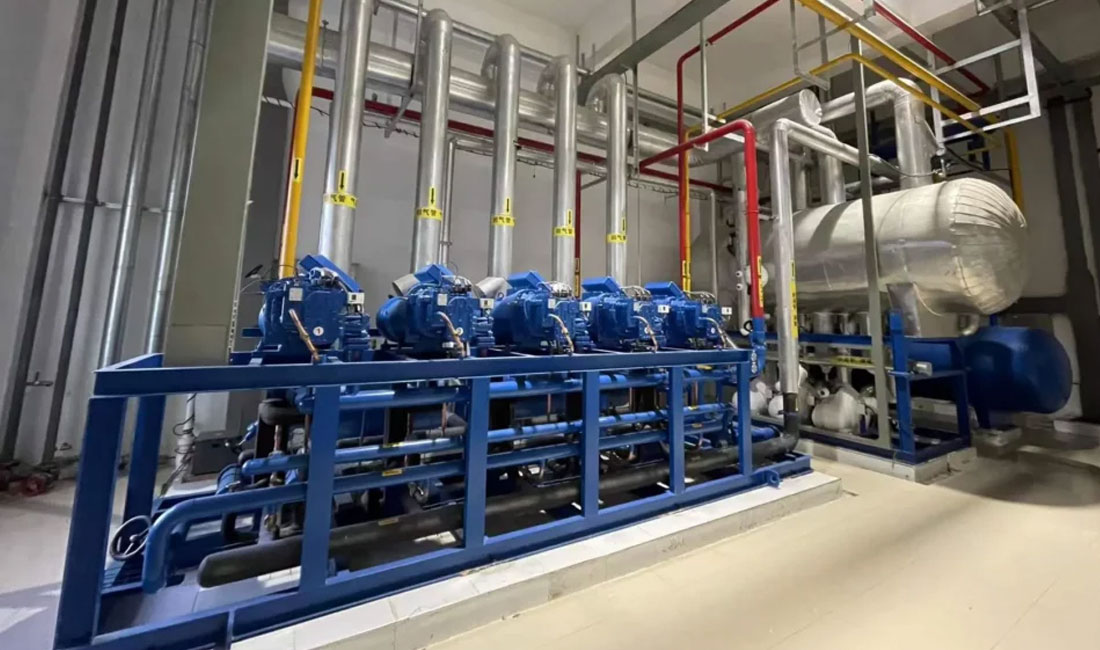
Industrial refrigeration means large cooling systems built for heavy use. Examples include IQF freezers, spiral freezers, blast freezers, and central ammonia systems.
These systems are used in food processing plants,cold storage warehousing, and pharmaceutical factories. They often run for long hours or even 24/7. Some can reach -40°C or lower.
Unlike commercial units, they are not made for customer display. They are built for production, storage, and process control. A single industrial freezing line can take up a large part of a factory floor.
Industrial refrigeration serves a broad range of sectors beyond food. The following industries depend heavily on industrial-grade cooling:
- Food processing — seafood, meat and poultry, bakery, fruit and vegetable IQF lines, dairy, and prepared meals.
- Cold chain logistics — large-scale refrigerated warehouses and distribution centers.
- Pharmaceutical manufacturing — controlled-environment storage for vaccines, biologics, and active ingredients.
- Chemical processing — reactor cooling, solvent recovery, and process chilling.
- Ice production — commercial ice plants and indoor ice rinks.
Companies such as Square Technology, also known as NTSquare, work in this field. The company has made spiral freezers, tunnel freezers, IQF freezers, and complete refrigeration systems for many years. Its systems are used in many countries. This type of large-scale production and engineering shows how industrial refrigeration differs from commercial refrigeration.
How Do Temperature Ranges Compare Between Commercial and Industrial Systems?
Commercial units usually keep fresh food at 0°C to 5°C. Industrial systems often work at -25°C to -40°C for deep freezing. Some ultra-low systems can reach -60°C. This temperature difference affects the system design, refrigerant choice, and energy use.
The table below summarizes temperature differences across key parameters:
| Parâmetro | Commercial Refrigeration | Refrigeração industrial |
| Typical operating range | 0 °C to 5 °C (chilling) | −25 °C to −40 °C (deep freezing) |
| Extreme low end | −18 °C (standard freezer) | −60 °C (ultra-low applications) |
| Temperature precision | ±2 °C acceptable | ±0.5 °C or tighter required |
| Pull-down speed | Moderate (hours) | Rapid (minutes for IQF) |
| Typical product dwell time | Days to weeks | Seconds to minutes on the freezing line |
Rapid freezing at very low temperatures forms smaller ice crystals inside food. Smaller ice crystals help protect the product’s structure, texture, and quality. This is why IQF, or Congelação rápida individual, is widely used for high-value foods such as shrimp, berries, and bakery products.
What Refrigerants Are Used in Commercial vs. Industrial Systems?
Commercial systems often use refrigerants such as R-134a, R-404A, or R-290. These are usually used in smaller, self-contained units.
Industrial systems often use ammonia, also called NH₃, or CO₂-based systems. These refrigerants can work well for large cooling loads. They are common in food plants, cold storage, and deep-freezing systems.
Ammonia is widely used in industrial refrigeration because it is very efficient. It has zero ozone depletion potential and zero global warming potential. However, ammonia can be dangerous at high levels. For this reason, facilities must follow strict safety rules, such as ASHRAE 15, EN 378, and OSHA PSM.
CO₂ systems and NH₃/CO₂ cascade systems are also becoming more common. They can reduce ammonia charge and improve safety in some projects. They are useful in regions with stricter environmental rules.
Some manufacturers design systems that can work with ammonia or cascade setups. This gives plant operators more flexibility when meeting local safety and compliance needs.
How Does System Architecture Differ?
Commercial refrigeration uses factory-assembled, plug-and-play units with built-in compressors. Industrial refrigeration requires custom-designed centralized engine rooms with separate evaporators, condensers, piping networks, and automated control systems engineered for each facility.
This architectural divide is one of the starkest differences between the two categories. A commercial reach-in cooler arrives on a pallet, gets plugged into a wall outlet, and begins operating. An industrial refrigeration plant, by contrast, involves months of engineering design, fabrication, on-site installation, and commissioning.
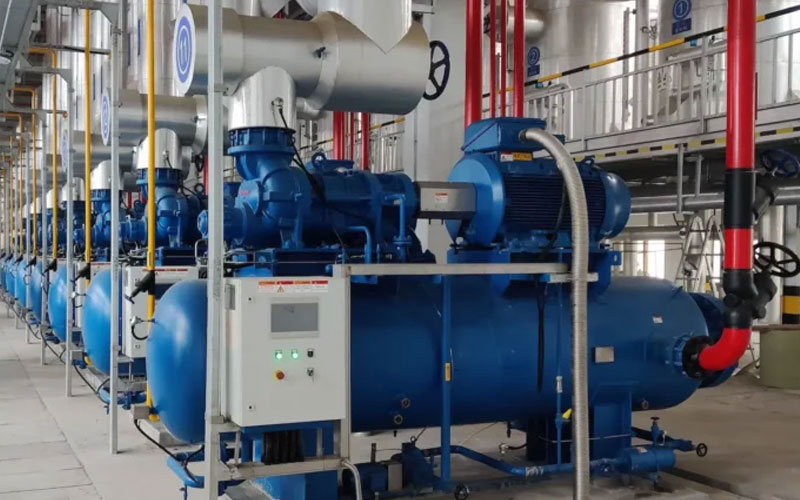
Ocore components of a typical industrial refrigeration system include:
- Centralized compressor rack or screw compressor packages housed in a dedicated engine room.
- Evaporators and unit coolers distributed throughout processing areas, cold rooms, and freezing tunnels.
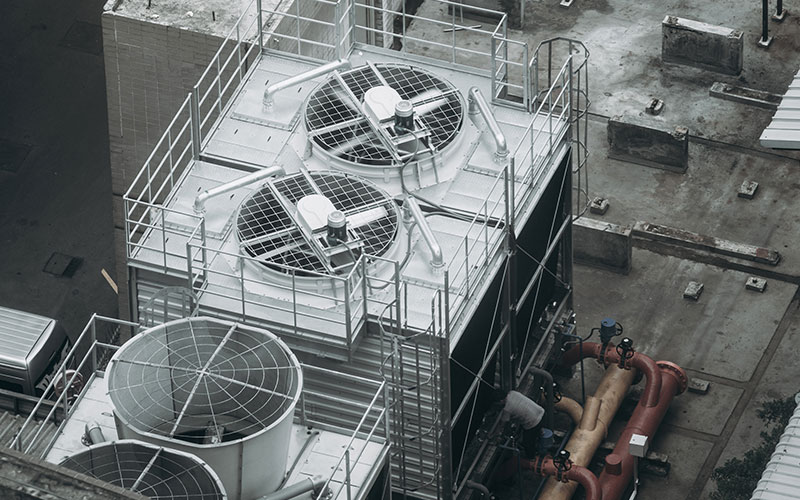
- Condensadores — evaporative, air-cooled, or water-cooled — mounted externally.
- Custom piping networks carrying refrigerant between components across large distances.
- PLC-based control and monitoring systems for automated temperature management and alarm handling.
NTSquare produces many key parts in-house. These may include evaporators, PIR insulation panels, conveyor belts, steel structures, and pressure vessels.
This setup can help improve quality control and shorten lead times. It also gives buyers one main supplier for the project.
For custom refrigeration systems, a turnkey supplier can support several stages. These may include facility design, equipment selection, installation, commissioning, and after-sales service.
How Do Maintenance and Operating Costs Compare?
Commercial units usually need basic cleaning and regular part replacement. Their maintenance cost is often moderate. Industrial systems need more specialized care. They may require trained engineers, planned shutdowns, ammonia leak checks, and pressure vessel inspections. These systems often cost more to operate and maintain. However, they can also last more than 20 years when properly maintained.
The following table outlines cost differences across both categories:
| Fator de custo | Commercial | Industrial |
| Initial investment (CAPEX) | $1,000 – $30,000 per unit | $50,000 – $1,000,000+ per system |
| Consumo de energia | Lower absolute kWh | Significantly higher, but better kWh-per-ton efficiency |
| Maintenance model | In-house or third-party service calls | Dedicated on-site engineering team |
| Typical lifespan | 8 – 12 years | 20 – 30 years |
| Downtime cost | Moderate (spoilage of retail stock) | Severe (entire production line halts) |
When choosing industrial refrigeration, total cost of ownership, or TCO, is more useful than the first purchase price. TCO includes energy use, maintenance, downtime, spare parts, and service life.
For example, one system may cost 15% more at the start. But if it uses 20% less energy over 25 years, it may save more money in the long run.
This is why manufacturer experience matters. A good supplier should understand equipment design, refrigerant efficiency, and facility layout. These factors all affect long-term cost.
How Do You Choose Between Commercial and Industrial Refrigeration?
The choice depends on four main factors: daily production volume, target product temperature, available floor space, and safety rules.
If a business processes more than 500 kg per hour, it often needs an industrial system. If the product must be frozen below -18°C, an industrial system is usually the better choice.
The following decision checklist helps narrow the choice:
- Rendimento: Is the facility processing or storing more than 500 kg of product per hour? → Industrial.
- Temperatura: Does the product require freezing at −25 °C or below? → Industrial.
- Duty cycle: Will the system run continuously (20+ hours/day)? → Industrial.
- Access pattern: Is the unit opened and closed frequently by staff or customers? → Commercial.
- Personalização: Does the facility require bespoke layout, piping, or integration with processing lines? → Industrial.
- Compliance: Are ammonia safety regulations (PSM/RMP) applicable? → Industrial with specialized engineering.
One common mistake is buying a system that is too large or too complex. Some buyers choose industrial equipment when a commercial system would be enough. This can waste money, take up extra floor space, and make maintenance harder.
The opposite mistake is also risky. Using commercial equipment for heavy production can overload the system. This may cause early failure, unstable temperatures, and food safety risks.
The line between commercial and industrial refrigeration is also becoming less clear. Central kitchens, ghost kitchens, and large meal-prep businesses often need stronger systems than standard restaurants. Some manufacturers now offer scalable systems for these mid-size operations. These systems combine industrial-level control with layouts that fit smaller facilities.
Businesses with special cooling needs should compare their product type, capacity, temperature target, floor space, and long-term operating cost before choosing a system.
FAQs
Can commercial refrigeration equipment be used in a food processing plant?
It is usually not recommended. Commercial units are not built for heavy, continuous production. They may also lack deep-freezing power and high throughput. If the system is too small, it can cause unstable temperatures, more breakdowns, and possible food safety issues.
What is the lifespan of an industrial refrigeration system compared to a commercial one?
Commercial refrigeration units often last about 8 to 12 years with normal maintenance. Industrial systems can last 20 to 30 years when properly maintained. They are built for longer run times and heavier use.
Is ammonia refrigeration dangerous?
Ammonia can be dangerous at high concentrations. Facilities that use ammonia need strict safety controls. These may include leak detection, ventilation, and PSM or RMP compliance.
Even with these safety needs, ammonia is still widely used in large industrial systems. It is energy efficient and has zero ODP and zero GWP.
What is the difference between a blast freezer and an IQF freezer?
A blast freezer uses strong cold air to freeze products in batches. It is often used for bulk freezing.
An IQF freezer freezes individual pieces separately. Products move on a belt or through a spiral system. This helps prevent clumping and helps protect product shape, texture, and weight.
Do I need a custom-designed system or can I buy it off the shelf?
Commercial businesses can often use standard units. These include reach-in coolers, display cases, and walk-in units.
Industrial applications often need custom design. This is especially true for food processing lines with specific capacity, product type, temperature, and layout needs.
What is the most energy-efficient refrigerant for industrial use?
Ammonia, or NH₃, is one of the most energy-efficient refrigerants for large industrial systems. CO₂ transcritical and NH₃/CO₂ cascade systems are also becoming more common. They can reduce refrigerant charge and improve safety in some facilities.