
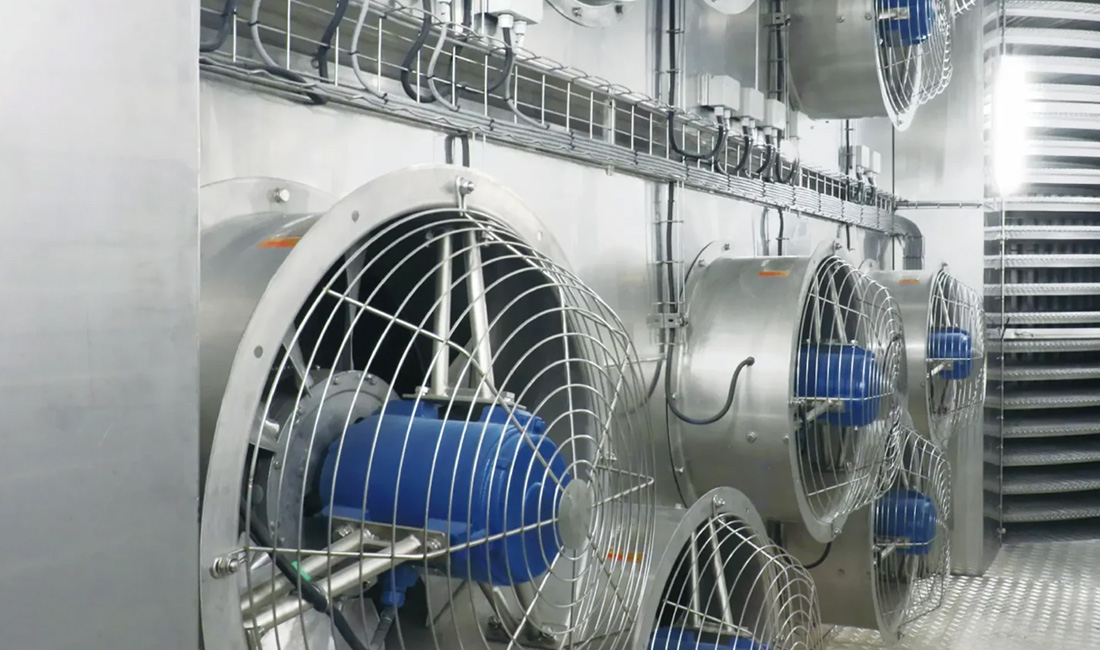
A capacidade correta do congelador em espiral é fundamental para um funcionamento suave e eficiente. É necessário saber quanto tempo os produtos permanecem no interior, qual a capacidade da correia e se o ar frio chega a cada peça. A capacidade depende do tempo de permanência, da carga da correia e do fluxo de ar que trabalham em conjunto.
Se o fizer de forma incorrecta - tempo de permanência demasiado curto ou fluxo de ar irregular - os produtos podem congelar mal, a energia é desperdiçada e a produção abranda. Os cálculos corretos ajudam a equilibrar a utilização de energia, a consistência da congelação e a qualidade dos alimentos.
Este guia mostra como calcular a capacidade do congelador em espiral passo a passo, com fórmulas e um exemplo do mundo real, tornando a conceção e otimização do congelador muito mais fácil.
Quais são os princípios-chave no cálculo da capacidade do congelador em espiral?
A capacidade do congelador em espiral é determinada por três elementos simples: o produto a congelar, o espaço disponível na esteira e as condições de funcionamento do congelador.
Eis os princípios fundamentais:
- Caraterísticas do produto: Como é que o tamanho e a temperatura do produto afectam o tempo de congelação.
- Dimensões da esteira e do congelador: A quantidade de produto que o tapete pode conter fisicamente.
- Condições de funcionamento: Como o caudal de ar, a temperatura e a velocidade da correia influenciam a eficiência da congelação.
Caraterísticas do produto
O tamanho, a forma e a espessura dos alimentos determinam a rapidez com que congelam e a quantidade que pode colocar no tapete. Cortes grossos, como bifes ou pedaços grandes de frango, precisam de mais tempo do que itens pequenos, como ervilhas ou bagas.
A temperatura de alimentação e a temperatura central pretendida também afectam taxas de carregamento. Os produtos mais frios permitem um processamento mais rápido, enquanto os alimentos mais quentes ou húmidos tornam a linha mais lenta e podem exigir cargas de correia mais baixas.
A densidade do produto e o teor de humidade determinam a energia de refrigeração necessária. As especificações consistentes dos produtos tornam o desempenho do congelador mais fácil de prever.
Dimensões da esteira e do congelador
A largura da correia, o comprimento do percurso e o número de níveis determinam a quantidade de produto que pode carregar. Correias mais largas, camadas extra ou um percurso em espiral mais longo aumentam a capacidade e afectam o tempo de espera.
A disposição das correias também afecta o fluxo de ar. Um espaçamento uniforme ajuda os produtos a congelarem uniformemente de cima para baixo.
Se estes elementos forem corretos, o congelador pode atingir a capacidade pretendida sem estrangulamentos ou problemas de qualidade.
Condições de funcionamento
Velocidade da correia, temperatura do ar e padrão de fluxo de ar controlar a remoção de calor. As correias mais lentas aumentam o tempo de permanência e qualidade do congelamento mas reduzem a capacidade horária; as correias mais rápidas aumentam a produção, mas correm o risco de subcongelar.
A temperatura e a velocidade do ar afectam a rapidez com que os produtos arrefecem. Um maior caudal de ar acelera a congelação, mas pode desperdiçar energia se for excessivo.
O desempenho do evaporador também é fundamental. Um evaporador forte e com boa manutenção mantém as temperaturas estáveis e a descongelação regular garante que o fluxo de ar se mantém consistente. As definições necessitam frequentemente de ser ajustadas com base no produto e na carga.
Como funciona a fórmula da capacidade básica?
A fórmula da capacidade central num congelador em espiral funciona através da combinação da área da correia, da carga do produto e do tempo de permanência para calcular quantos quilogramas por hora o sistema pode congelar.
Eis os pontos essenciais:
- Tempo de espera: Tempo de permanência do produto na zona fria, definido pelo comprimento do trajeto da correia e pela velocidade da correia.
- Impacto do tempo de espera na qualidade: Porque é que um tempo de permanência correto evita a subcongelação, a sobrecongelação e a perda de qualidade.
- Otimização do tempo de espera: Como diferentes alimentos e designs de fluxo de ar requerem tempos de permanência ajustados para obter os melhores resultados.
O que é o tempo de espera nos congeladores em espiral?
O tempo de permanência é o tempo que um produto permanece no ar de congelação, calculado dividindo o comprimento do percurso do tapete por velocidade da correia. Caminhos mais longos ou correias mais lentas aumentam o tempo de permanência, proporcionando uma congelação mais profunda e uniforme.
A espessura e a densidade do produto afectam o tempo de permanência. Os artigos grossos demoram mais tempo do que os finos. A velocidade da correia é escolhida para equilibrar o congelamento completo com a taxa de produção. Demasiado rápida → subcongelação; demasiado lenta → desperdício de energia.
O controlo do tempo de permanência é mais fácil com sensores de temperatura e accionamentos programáveis, mantendo a velocidade da correia consistente ao longo de um turno.
Impacto do tempo de permanência na qualidade e no rendimento do produto
O tempo de permanência correto é crucial para a textura, humidade e aparência. Demasiado curto → gelado por fora, mole por dentro; demasiado longo → produtos secos ou gelados. O tempo de espera correto mantém os cristais de gelo pequenos e preserva a qualidade após a descongelação.
Um tempo de espera adequado também melhora o rendimento, fixando a humidade e reduzindo a perda por gotejamento. Um tempo de espera inconsistente entre camadas provoca uma congelação desigual e ciclos mais longos. A maioria das equipas monitoriza as temperaturas de saída para garantir que o tempo de espera é eficaz.
Como otimizar o tempo de permanência para diferentes produtos alimentares?
Os diferentes alimentos necessitam de tempos de permanência próprios com base na sua composição e espessura. Os alimentos com elevado teor de água - marisco, fruta - precisam de mais tempo porque a água congela a uma temperatura constante. Os alimentos gordos, como as salsichas, normalmente congelam mais depressa.
Agrupar os produtos por tipo e testar o melhor tempo de permanência é uma boa ideia.
A conceção do equipamento também tem um impacto. Os sistemas de caudal de ar verticais podem reduzir o tempo de paragem, uma vez que fazem passar melhor o ar frio pela pilha. Os horizontais podem necessitar de correias mais lentas para atingir o mesmo congelamento. Normalmente, os operadores ajustam o caudal de ar e a velocidade da correia em conjunto, procurando o ponto ideal entre a utilização de energia e a qualidade do produto.
Como é que se calcula a capacidade do congelador em espiral passo a passo?
O cálculo da capacidade do congelador em espiral, passo a passo, significa confirmar o objetivo de congelação, determinar o tempo de permanência, calcular a carga de produto por área da correia, utilizar a área da correia para calcular a produção horária e, finalmente, verificar o fluxo de ar, a capacidade do evaporador e os factores de correção.
- Passo 1: Identificar a informação sobre o produto: Enumerar o tipo de produto, a forma, o peso, o teor de humidade e as temperaturas-alvo do núcleo/superfície, que servem de entrada para todos os cálculos seguintes.
- Passo 2: Determinar a curva de arrefecimento e os objectivos: Utilizar as propriedades do produto ou os dados de ensaio para identificar a curva de arrefecimento e a remoção total de calor necessária (calor sensível e latente) desde a temperatura inicial até à temperatura de congelação pretendida.
- Passo 3: Calcular o tempo de espera: Com base na curva de arrefecimento e nos requisitos de qualidade/segurança, determinar o número de minutos que o produto deve permanecer na zona fria (um tempo de permanência mais curto aumenta a capacidade potencial, mas deve continuar a atingir a temperatura-alvo).
- Passo 4: Determinar a carga do produto (L): Calcular quantos quilogramas de produto podem ser colocados por metro quadrado de correia (kg/m²), considerando a cobertura do produto, o espaçamento e a altura de empilhamento.
- Passo 5: Calcular a área efectiva da cintura (A): Multiplicar a largura útil do tapete pelo comprimento efetivo do tapete dentro da zona de congelação para obter a área efectiva de congelação (m²).
- Passo 6: Aplicar a fórmula da taxa de transferência: Utilizar a fórmula C = (A × L) ÷ T × 60, em que A = área do tapete (m²), L = kg/m², T = tempo de espera (minutos) e C = débito (kg/h).
- Exemplo: A = 15 m², L = 10 kg/m², T = 30 min → A×L = 150 kg; 150 ÷ 30 = 5; 5 × 60 = 300 kg/hr.
- Passo 7: Estimar a carga térmica e verificar a capacidade de refrigeração: Converta a remoção de calor necessária por hora (sensível + latente) em capacidade de arrefecimento (kW ou TR) e verifique se o evaporador/compressor consegue satisfazer a carga.
- Etapa 8: Verificar e validar a distribuição do fluxo de ar: Avalie a velocidade, o volume e a distribuição do ar para garantir um fluxo de ar uniforme; uma má distribuição provoca uma congelação desigual e reduz a capacidade real.
- Passo 9: Aplicar os factores de correção: Introduzir factores de correção para o espaçamento dos produtos, o empilhamento, as folgas das correias, a perda de humidade e os efeitos da abertura da porta ou da carga para ajustar a capacidade teórica às condições reais de funcionamento.
- Passo 10: Efetuar a validação e o ajustamento no local: Durante os testes, meça o rendimento real, as temperaturas do núcleo do produto e a qualidade do congelamento; ajuste o tempo de espera, a velocidade da correia ou a carga conforme necessário e repita os passos 6-9 até que a capacidade e a qualidade satisfaçam os requisitos.
Que factores reduzem a capacidade real de congelação?
Muitas peculiaridades de funcionamento e de conceção podem reduzir o rendimento real de um congelador em espiral. Mesmo que a capacidade nominal do sistema pareça boa no papel, a realidade confusa no chão diz frequentemente o contrário.
1. O empilhamento ou agrupamento de produtos limita o fluxo de ar sobre as superfícies. Quando os itens se tocam ou se sobrepõem, o ar frio não consegue chegar a todo o lado, pelo que a congelação se torna irregular e os tempos de espera prolongam-se. É melhor manter os produtos espaçados na correia, mas isso nem sempre é fácil na prática.
2. A espessura do produto muda tudo. Os produtos mais espessos ou mais densos mantêm o calor durante mais tempo, pelo que é necessário mais tempo para os arrefecer até ao núcleo. Se colocar uma mistura de tamanhos na correia sem ajustar a velocidade, a produção diminui.
3. O fluxo de ar irregular no interior da espiral é outro ponto problemático. A má conceção das condutas, os bloqueios ou a falta de deflectores significam que algumas áreas são inundadas de ar enquanto outras ficam paradas. Quando o fluxo de ar é equilibrado, a congelação é mais consistente e obtém-se uma melhor utilização da capacidade do congelador.
4. A acumulação de gelo nas bobinas ou nas paredes prejudica o movimento do ar e o isolamento. A descongelação regular ajuda a manter as coisas em movimento e a troca de calor a funcionar corretamente.
5. A baixa capacidade do evaporador ou o fraco desempenho da refrigeração faz baixar a temperatura do ar e atrasa a remoção do calor. Talvez a carga de refrigerante seja baixa, as serpentinas estejam sujas ou o compressor não esteja a acompanhar o ritmo.
6. A variabilidade na alimentação - como o carregamento irregular ou a entrada de produtos a diferentes temperaturas - significa que os tempos de espera são muito variáveis. Por vezes, os operadores têm de abrandar o tapete só para o acompanhar, reduzindo ainda mais o rendimento.
Perguntas frequentes
Que factores determinam o tempo de permanência num congelador em espiral?
O tempo de espera depende principalmente do tamanho, peso, espessura do produto e da temperatura final pretendida. Os produtos maiores ou mais densos demoram mais tempo a congelar até ao fim.
A velocidade da correia e o número de camadas também são importantes - controlam o tempo que o produto permanece no interior. A temperatura do ar e a taxa de fluxo de ar também desempenham um papel importante, uma vez que influenciam a rapidez com que o calor deixa o produto. Se os ajustar, pode congelar eficientemente sem arrastar as coisas.
Como é que a carga da correia afecta a eficiência de um congelador em espiral?
A carga da correia é a quantidade de produto que coloca no transportador de uma só vez. Se colocar demasiado, o fluxo de ar fica bloqueado, a transferência de calor abranda e a congelação demora mais tempo.
Manter a carga da correia equilibrada significa melhor circulação de ar em todas as superfícies do produto. Se mantiver as coisas estáveis e não sobrecarregadas, o congelador funciona a temperaturas mais estáveis e gasta menos energia. É simples, mas surpreendentemente fácil de ignorar.
É possível aumentar a capacidade de um congelador em espiral sem alterar o seu tamanho?
É claro que pode aumentar a capacidade ajustando a velocidade do ar, a configuração da correia e a temperatura de funcionamento, em vez de apenas aumentar o congelador. Quando se aumenta a velocidade do ar em ambos os lados do produto, este arrefece mais rapidamente e não precisa de ficar tanto tempo no interior.
Se utilizar camadas mais finas ou brincar com o espaçamento da correia, pode fazer passar mais produto sem necessitar de espaço extra. E, honestamente, o simples facto de manter a limpeza e a manutenção em dia faz a diferença - o gelo pode aparecer sorrateiramente, bloquear o fluxo de ar e diminuir silenciosamente a sua capacidade, se o permitir.