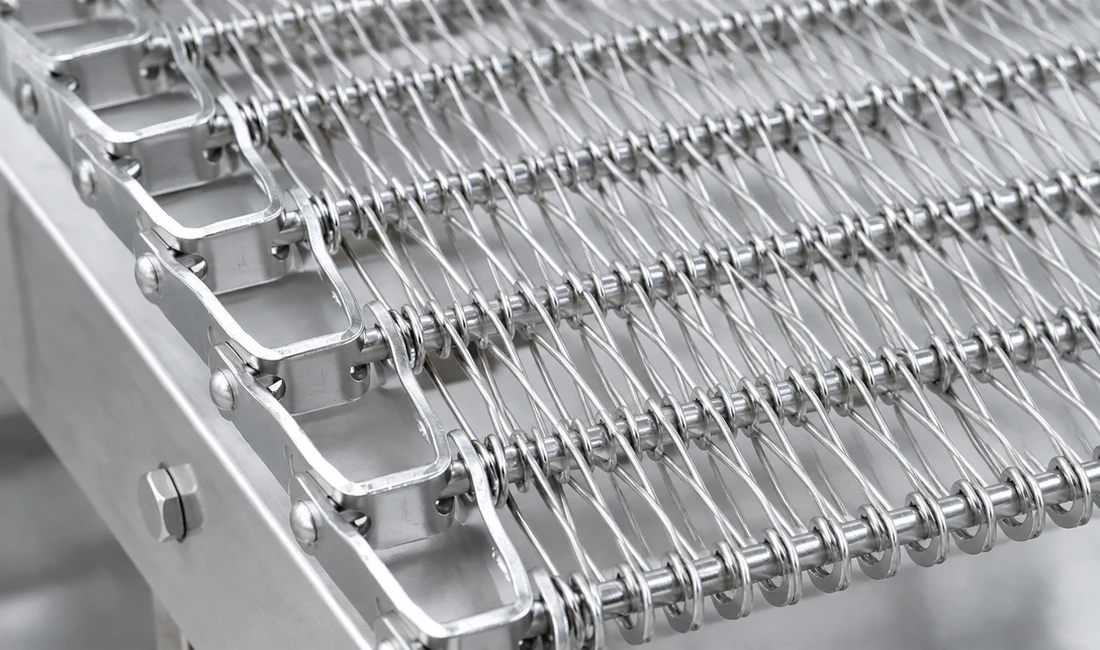
A stainless steel mesh belt for a spiral freezer must support the food, turn smoothly, and fit the drive system. A belt that matches the width but not the machine can cause poor transfers, early wear, and unplanned stops. The right choice starts with the product and the complete freezer design.
This guide covers system fit, steel grades, mesh openings, load limits, and cleaning needs. It also explains how to assess belt wear and prepare the details needed for a clear, accurate quotation.
Why Use Stainless Steel Mesh Belts in Spiral Freezers?
Stainless steel mesh belts provide food support while allowing air to pass through the belt. Their open structure also gives cleaning water access to the mesh. Grade 304 retains good toughness at low temperatures and suits many food-processing environments.
For example, Square Technology’s congeladores en espiral use SUS304 stainless steel mesh belts. The open belt structure provides cleaning access, while optional edge guards help prevent products from falling off the sides.
These features do not make every stainless steel belt suitable for every product. Small pieces need enough support to stay on the mesh. Soft foods need a surface that limits marking. Both needs must be balanced against the space available for airflow.
Match the Belt to the Spiral Freezer System
The belt must match both the drive method and the support structure. Width and length alone cannot confirm that it will run correctly.
Drive and Support Compatibility
The drive method determines how force reaches the belt. A friction drive relies on contact with a drum. A positive drive uses mechanical engagement, such as sprockets that engage the belt or its side chains. The belt must suit the system’s actual drive points.
The support structure is a separate concern. In a rail-supported spiral, the belt travels on supporting rails or wear strips. In a self-stacking system, side links support the tiers above.
La tecnología Square self-stacking spiral freezer uses a chain-driven, self-stacking belt. Its stacked side links remove the need for belt-supporting rails. This design shows why a self-stacking belt cannot be treated as a simple substitute for a rail-supported belt.
Turning Radius, Belt Width, and Transfer Points
The belt’s turning limit must suit the freezer’s tightest curve. For side-flexing belts, the inner edge must close up enough to follow the turn without forcing the structure out of shape.
Some suppliers state a turn ratio based on inside radius divided by belt width. For illustration, a 1.6:1 ratio with a 1,000 mm belt gives a 1,600 mm minimum inside radius. This is an example, not a universal belt rating. The supplier must confirm the ratio and measurement points for the selected design.
Usable width also needs a separate check. Side links, edge guards, and clearances may reduce the area available for food. A belt can fit the machine yet offer less loading space than expected.
At the infeed and outfeed, the review should cover transfer gaps and the belt’s approved bending limits. A smaller end roller may reduce a gap, but it must still suit the belt. Trials should include the smallest and most fragile products planned for the line.
Which Stainless Steel Mesh Belt Specifications Matter?
The main checks are material grade, food support, and mechanical limits. These should appear as measurable details on the approved drawing and specification sheet.
304 vs. 316 Stainless Steel
Grade 304 suits many food-processing applications. Grade 316 offers greater resistance to certain forms of corrosion, especially pitting caused by chlorides. Its added molybdenum helps provide this protection.
The choice should reflect the full exposure cycle, not just the freezer temperature. Salted food, wash water, and cleaning chemicals all need review. Warm cleaning conditions may pose a different corrosion risk from cold production conditions.
Grade 316 is not immune to corrosion. It is also not an automatic upgrade in belt strength or freezing performance. Material selection and mechanical design remain separate checks. Any alternative grade should be confirmed for the proposed belt, rather than assumed to be available for every freezer model.
Mesh Openings, Open Area, and Product Support
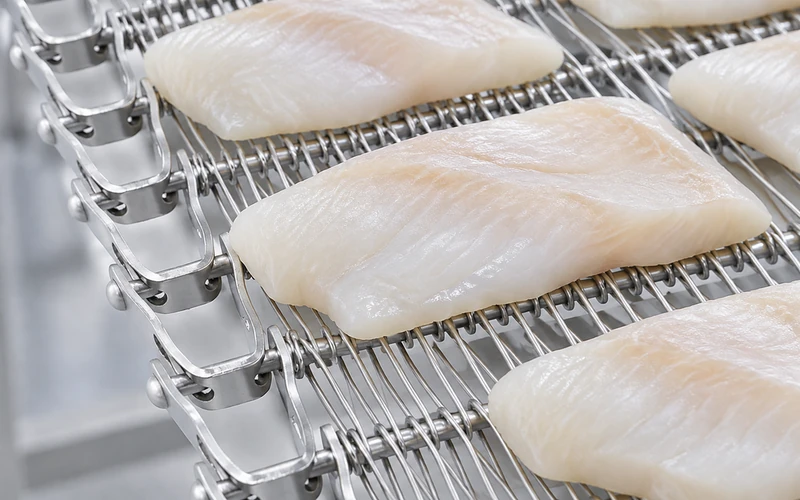
Mesh openings must support the smallest product, while the open area must suit the airflow needs. The best choice is a balance, not simply the most open or most tightly woven mesh.
A small piece of diced food may need closer support than a large fillet. A soft patty may stay on an open belt but still pick up unwanted mesh marks. Product trials help assess retention, surface marks, and release under the planned process conditions.
Open area describes the share of a surface left open rather than filled with metal. It does not state how much air will reach the food in a loaded freezer. Product coverage and the rest of the airflow path still matter. Suppliers may also distinguish between surface openings and openings through the full belt structure, so the measurement basis needs to be clear.
A useful specification separates the following details:
| Detail | What the supplier should state | Main purpose |
| Clear mesh opening | Gap dimensions in millimeters | Checks support for small pieces |
| Open area | Percentage and measurement basis | Helps assess the open flow path |
| Wire and rod dimensions | Diameters and spacing in millimeters | Defines the mesh and support structure |
| Usable carrying width | Food-loading width in millimeters | Confirms the available product space |
Rod Size, Belt Load, and Allowable Tension
Product load and belt tension are different measures. Product load describes how much food the belt carries. Tension is the pulling force within the belt. Both must stay within the limits of the selected system.
For a simple loading example, a belt with 0.8 m of usable width carrying 10 kg of food per square meter holds 8 kg per running meter. These are illustrative values, not a load rating. The figure excludes the belt’s own weight and does not determine the required belt tension.
The manufacturer still needs the support layout, load pattern, and drive conditions to assess the forces. A heavier rod alone does not prove that the full belt can carry more tension. Edge links, joints, and welds also need review.
The specification should state allowable running tension for the intended conditions. A breaking-strength value is not a substitute for an operating limit. Ratings for straight travel and turns may also differ, so the relevant rating must be identified.
What Makes a Spiral Freezer Belt Easy to Clean?
An easy-to-clean belt gives access to its mesh, joints, and contact areas. It must also suit the plant’s cleaning method and the food residues involved.
Mesh, Joints, and Cleaning Access
The mesh surface is only one part of the hygiene review. Residue can collect around rods, edge links, belt joints, and supporting parts. Cleaning access therefore needs checking from both above and below the belt.
Smooth, burr-free surfaces and well-made joints help reduce places where residue can remain. Buyers should review close-up images or samples of the belt surface, edge structure, and joining section. The focus should be on the finished parts, not just the name of the welding process.
The freezer layout matters too. An open belt is less useful for cleaning if nearby structures block access. Belt and machine design should therefore be reviewed together.
Cleaning Chemicals, Rinsing, and Drying
Cleaning conditions must suit both the belt material and the soil being removed. Chemical concentration, contact time, and temperature should follow the agreed equipment and chemical-supplier guidance.
Stronger solutions are not automatically more effective or safer for the belt. Chlorine-based chemicals can attack stainless steel under unsuitable conditions. Their use needs a specific compatibility check, including exposure time and rinsing requirements.
The cleaning plan should cover detergent removal, sanitizer use, drainage, and drying before restart. Sanitizers must follow their own use instructions; they should not be treated as if they all require the same rinse step. Residual water also needs attention before the belt returns to freezing conditions.
How Can Belt Wear and Downtime Be Reduced?
Wear control starts with correct drive settings, clean support surfaces, and regular checks. The inspection plan should match the freezer design rather than apply one checklist to every system.
Inspection and Condition Monitoring
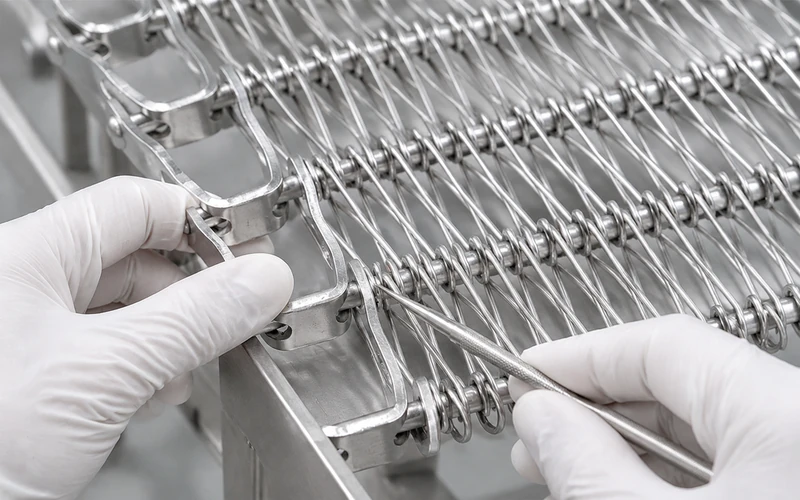
Routine checks should cover damaged mesh, bent rods, worn edge links, and cracked joints. The team should also inspect the belt’s supporting and driving parts, including wear strips, bearings, and sprockets where fitted.
On friction-driven spirals, the drum-to-belt speed relationship needs checking under the manufacturer’s procedure. Where a take-up mechanism is fitted, its position can provide clues about changing belt conditions. New rubbing, jerking, or unusual noise also warrants investigation.
Where suitable sensors are installed, teams can track belt tension, drive power, and temperature over time. Readings are most useful when compared under similar speeds and loads. An unexplained rise can prompt an inspection before a breakdown. Monitoring does not replace physical checks or prove that the belt itself is at fault.
Hands-on inspection requires the equipment to be stopped and safely isolated under the site’s procedure.

Repair or Replacement: What to Check First
The first decision is whether damage is local or part of wider wear. The manufacturer should confirm whether repair is suitable and which joining method is approved. Repeated cracking, distorted links, or damage across several areas calls for a broader assessment.
The old belt can help reveal the cause. For example, heavy wear along one edge should prompt checks of guides, clearances, and alignment. Replacing the belt without correcting a worn drive part or a contact point may repeat the same damage.
After repair or replacement, the team should check alignment, remove loose wire pieces, and follow the approved test procedure before returning to production. Records should capture both the damage and the corrective work.
What to Check Before Ordering a Stainless Steel Mesh Belt for a Spiral Freezer
A clear order defines the food, the machine, and the supply scope. It should give both parties a shared basis for checking fit, performance, and delivery.
Specifications and Documents for an RFQ
A request for quotation, or RFQ, should contain enough detail to assess the application rather than price an estimated length of mesh. The following checklist provides a practical starting point.
- Product and output: Food type, size range, piece weight, target throughput, and loading pattern.
- Process conditions: Product infeed temperature, target exit temperature, freezer conditions, operating hours, and cleaning method.
- Machine details: Freezer model, layout, drive type, support structure, turning radius, and transfer arrangement.
- Belt dimensions: Total and usable width, length, mesh openings, rod diameter, pitch, and edge design. Pitch should be defined by measurement points on the drawing.
- Material and quality records: Steel grade, traceable material records, agreed dimensional tolerances, and relevant food-contact documentation.
- Replacement evidence: Original drawings, clear photographs, a belt sample where needed, and notes on wear or past failures.
For a new freezer, these details form part of the equipment design. For a replacement belt, they help confirm compatibility with the existing machine. Before production starts, both parties should approve the final drawing, supply scope, and acceptance checks.
Total Cost, Lead Time, and Service Support
Quotes should be compared against the same approved specification and scope. A lower belt price may exclude joining parts, fitting work, or drive components needed for the change.
A practical comparison includes purchase cost, freight, installation, spare parts, and the planned production stop. Warranty terms should also be reviewed separately from any estimate of service life.
Delivery planning should distinguish factory completion from arrival at the plant. It should also allow time for installation and testing. Support arrangements need the same clarity: who checks fit, who supports start-up, and how urgent spare parts are supplied. These points are better settled before an order than during a shutdown.
FAQs About Stainless Steel Spiral Freezer Belts
The questions below address common limits that should be checked before a belt is selected or replaced.
Can Any Stainless Steel Mesh Belt Run in a Spiral Freezer?
No. The belt must suit the curve, drive, and support arrangement. A straight-running mesh belt is not automatically able to flex sideways around a spiral. The term “spiral mesh” can also describe the weave of a belt, rather than its ability to run in a spiral freezer. The actual design and its approved limits determine suitability.
Can a Stainless Steel Belt Replace a Plastic Modular Belt?
Sometimes, but it is not a direct swap based on width alone. The review must include drive engagement, support surfaces, turning radius, and product transfers. Changes to drive parts or other components may be needed. The freezer manufacturer should assess the conversion before a belt is ordered, especially where the original design was built around a specific belt type.
How Long Does a Stainless Steel Spiral Freezer Belt Last?
There is no single service life that applies to all belts. Load, speed, operating hours, cleaning, and maintenance affect wear. Repeated bending also contributes to metal fatigue. A useful life estimate should relate to a defined application and be supported by operating data. Replacement decisions should follow condition checks and manufacturer guidance, not calendar age alone.
What Should Be Checked if Food Sticks to the Belt?
A useful starting point is a trial with the actual product on a clean belt. The review should cover surface moisture, coating buildup, mesh contact, and the discharge setup. Results should be checked under the planned freezing cycle. Changing steel grade alone should not be assumed to solve a release problem; product trials provide a better basis for selecting the contact surface.
Conclusión
A suitable stainless steel mesh belt matches the food and the freezer as a complete system. Steel grade matters, but so do turning radius, usable width, product support, drive fit, and cleaning access. The order should capture those details in an approved specification.
For a new project, buyers can contact Square Technology with product dimensions, target capacity, and a floor plan to discuss the freezer and belt configuration. For existing equipment, the starting point is a review of the machine and belt condition before replacement requirements are confirmed.