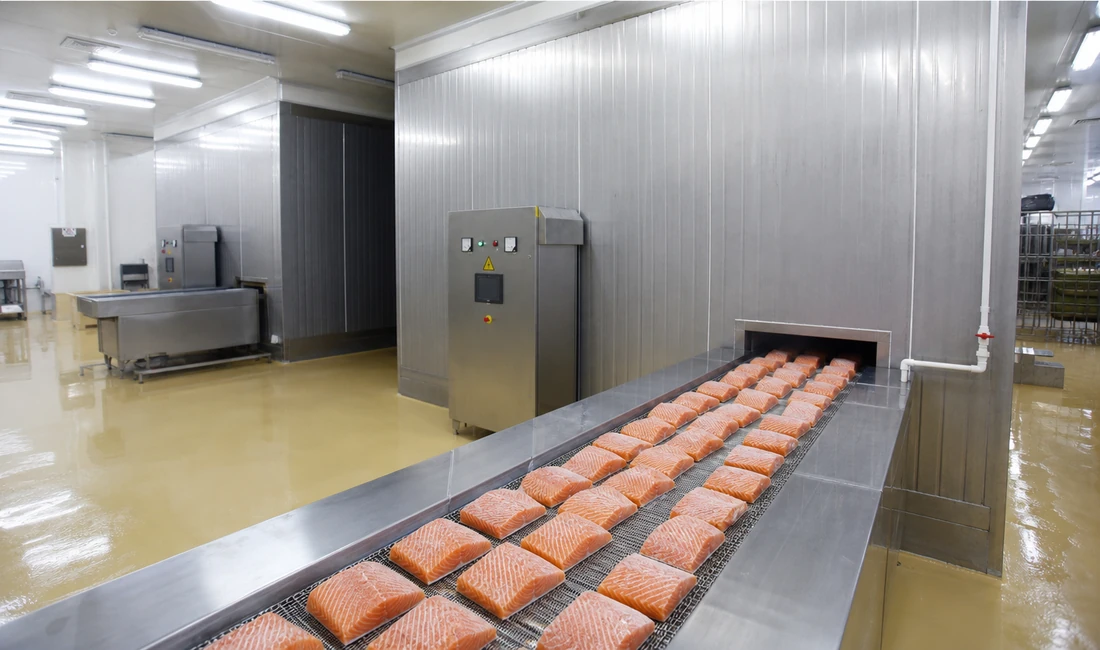
Product dehydration is a common source of yield loss in spiral freezing. It happens when moisture leaves an exposed product during the freezing process. Excess moisture loss can reduce saleable weight and affect the product’s texture, appearance, and production cost.
This article explains why dehydration occurs, how spiral freezer design and operating settings affect it, how processors can reduce moisture loss on an existing line, and how weight loss should be measured before equipment decisions are made.
What Does Dehydration Mean in Spiral Freezing?
Dehydration is often used as a broad term. In practice, processors need to separate direct freezing weight loss from thaw drip loss and freezer burn. These problems are related, but they do not occur in the same way.
Freezing Weight Loss, Thaw Drip Loss, and Freezer Burn Are Different
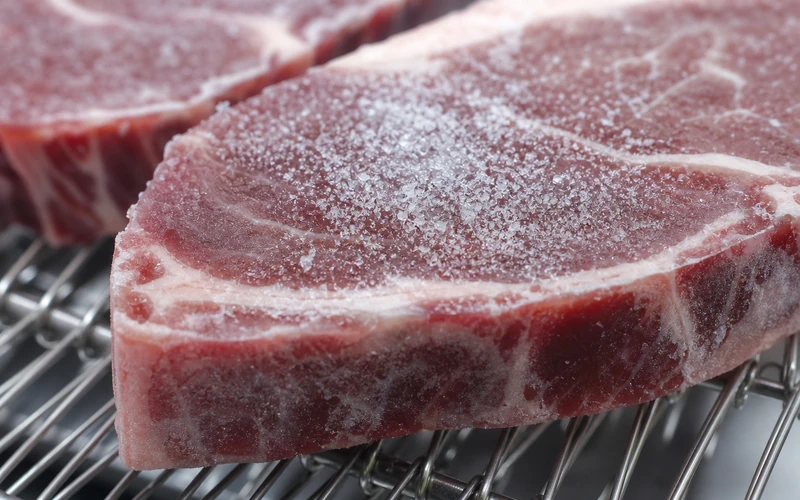
Direct freezing weight loss happens while an unpackaged product is exposed to cold moving air. Before the surface is fully frozen, liquid water may evaporate. After ice forms on the surface, some of that ice may change directly into water vapor. This second process is called sublimation.
Thaw drip loss appears later. It is the liquid released after a frozen product is thawed. Slow freezing and large ice crystals may damage the product structure, but formulation, handling, storage, and thawing conditions can also affect the result.
Freezer burn is mainly a frozen storage problem. It develops when moisture continues to leave an exposed or poorly protected surface. Temperature changes and weak packaging can make it worse. The affected area may become dry, pale, tough, or discolored.
All three can reduce finished product yield and quality. However, they should not be measured or reported as the same loss.
Why Moisture Loss Affects Yield, Quality, and Operating Cost
For products sold by weight, lost water is lost saleable mass. Even a small improvement can have a large annual effect on a high-capacity line.
Dehydration may also change:
- Surface appearance
- Tenderness and juiciness
- Texture after cooking or thawing
- Portion weight
- Product grade
- Customer acceptance
Moisture released inside the freezer may settle as frost on the evaporator, belt, enclosure, or other cold surfaces. This frost can restrict airflow and reduce heat transfer. It may also shorten the time available between defrost cycles.
However, not all frost comes from the food. Warm, humid air can enter through the infeed and outfeed. Water left after cleaning can also freeze inside the enclosure. Frost should therefore be treated as an operating signal, not as a direct measurement of product dehydration.
What Causes Excess Dehydration in a Spiral Freezer?
Moisture loss is controlled by both the product and the freezing environment. These factors interact, so the same freezer settings may produce different results for chicken portions, seafood, dough, or prepared meals.
Product Temperature, Size, Shape, and Surface Condition
A warm product brings more heat into the freezer and normally takes longer to freeze. Its exposed surface also remains unfrozen for longer, giving moisture more time to leave.
Product size and shape matter as well. Small pieces have more exposed surface in relation to their weight. They often freeze faster, but they may also exchange moisture with the air more quickly. Thin edges and irregular surfaces can dry before thicker areas reach the required core temperature.
Other important product variables include:
- Initial product temperature
- Water and fat content
- Product thickness
- Surface roughness
- Coating or marinade
- Skin or natural outer layer
- Water remaining after washing
- Product spacing on the belt
Surface water requires special attention. Water left after washing may evaporate, freeze onto the product, or become frost inside the machine. This can hide the true dehydration result. Upstream draining conditions should therefore remain consistent during testing.
Air Temperature, Velocity, and Exposure Time
Moisture tends to move from the warmer product surface toward the colder surrounding air. The rate depends partly on the difference in water vapor pressure between the product and the air.
Air temperature and air velocity also control heat transfer. Faster air can remove heat more quickly and shorten freezing time. At the same time, it can increase moisture transfer from the surface. This is why maximum fan speed does not always produce the lowest weight loss.
Very low air temperatures create a similar trade-off. They can freeze the product surface faster, which helps limit early moisture loss. However, a colder setpoint does not correct poor airflow, excessive loading, or an unsuitable dwell time.
The goal is to freeze the surface quickly and bring the product core to its target temperature without unnecessary exposure. This requires the air temperature, fan speed, and belt speed to work as one process.
Belt Loading, Product Spacing, Frost, and Air Infiltration
Processors may increase belt loading when production demand rises. If the load exceeds the validated level, products can overlap or form a deep layer. Cold air may no longer reach each surface evenly.
The result is often a mixed batch. Products in high-airflow areas may receive more exposure than needed, while products in blocked areas freeze too slowly. Operators may then reduce the belt speed for the entire load, increasing the exposure time for every product.
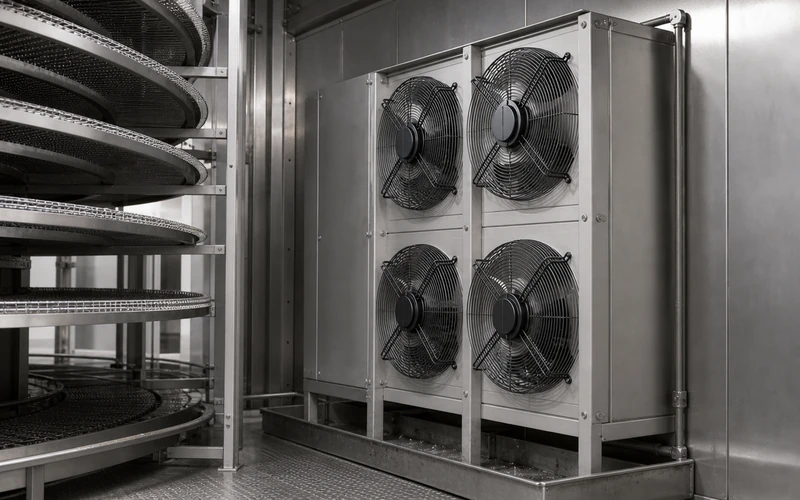
Frost on the evaporator can create a similar problem. As frost builds between the fins, it increases resistance to airflow and reduces effective heat transfer. Fans may continue to run, but the air volume reaching the product can fall.
Air infiltration also adds moisture and heat. Large or poorly positioned infeed and outfeed openings can draw humid room air into the freezer. This increases frost formation and can make freezing conditions less stable over a long production run.
How Does Spiral Freezer Design Help Reduce Dehydration?
A spiral freezer should be designed as a complete thermal system. Belt arrangement, fan position, air ducts, evaporator capacity, product clearance, and enclosure openings all affect the final result.
Uniform Airflow Across the Belt and Every Freezer Tier
Uniform airflow is more important than a high average air velocity. Every belt tier should receive enough cold air to remove heat at a similar rate.
If one area has weak airflow, products in that area need more time to freeze. If another area receives excessive airflow, those products may lose more surface moisture. A good design reduces both conditions.
Horizontal, vertical, and mixed airflow arrangements can all be used in industrial freezers. Their performance depends on how well the air reaches the product, returns to the evaporator, and avoids short circuits or dead zones.
La tecnología Square spiral freezer systems can be configured around the product type, required capacity, belt arrangement, and production line layout. These variables should be reviewed together because a change in one can affect airflow across the full belt.
Evaporator Capacity and Effective Frost Management
The evaporator must handle the product load, fan heat, air infiltration, belt heat, and other thermal loads. If it is too small for actual production conditions, the freezer may struggle to hold a stable air temperature.
Evaporator design also affects frost behavior. Fin spacing, coil depth, air velocity, and defrost design influence how quickly frost blocks the airflow path.
Effective frost management helps the freezer maintain:
- Stable air volume
- Consistent heat transfer
- Longer production runs
- More even product temperatures
- Predictable belt speed
- Lower risk of emergency defrosting
A defrost system does not directly stop product dehydration. Its role is to preserve the airflow and cooling conditions that were used to validate the process.
Coordinated Fan Speed, Belt Speed, and Temperature Control
Fan speed, belt speed, and air temperature should not be adjusted as separate targets.
For example, reducing fan speed may lower surface drying, but it may also increase freezing time. Slowing the belt can correct the exit temperature, but the longer dwell time may cancel the expected moisture benefit.
A control system should allow operators to save validated settings for each product. Useful operating data may include:
- Product infeed temperature
- Freezer air temperature
- Fan speed
- Velocidad de la correa
- Calculated dwell time
- Product loading rate
- Exit core temperature
- Production time since defrost
This information helps operators repeat a stable process instead of adjusting the freezer based only on visual judgment.
Infeed and Outfeed Design That Limits Air Infiltration
Infeed and outfeed openings should be large enough for safe product movement but not larger than necessary. Their position should also match the belt path and nearby production equipment.
Poor pressure balance can pull warm air through these openings. In humid processing rooms, the added moisture may quickly become frost.
Depending on the facility, useful controls may include:
- Properly sized product openings
- Insulated connections between machines
- Air curtains or dry-air barriers
- Controlled pressure around the freezer
- Reduced open space around the conveyor
- Drainage and drying after cleaning
These measures mainly control external moisture. They support stable freezer performance but should not be confused with direct product dehydration control.
How Can Food Processors Reduce Spiral Freezing Dehydration?
An existing spiral freezer may not need to be replaced. In many cases, processors can improve results by controlling the product and restoring the machine to its intended operating condition.
Stabilize Infeed Temperature and Product Surface Condition
Large changes in infeed temperature make a stable freezing process difficult. A belt speed that works for one batch may not work for a warmer batch.
Where the production process allows it, controlled pre-cooling can reduce the heat load on the freezer. The selected temperature must still meet food safety and product quality requirements. A universal pre-cooling temperature should not be applied to every food.
Washing, marinating, coating, and draining also need consistent control. Processors should define how long the product drains and how much surface water is acceptable before it reaches the freezer.
For cooked products, the time between cooking and freezing should be controlled as part of the validated production process. Long, uncontrolled holding may create safety or quality problems even if it lowers the freezer load.
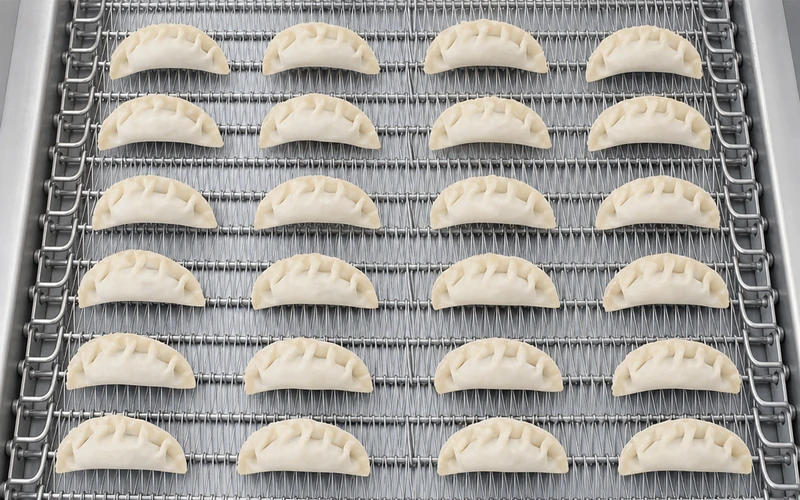
Standardize Belt Loading and Product Spacing
A spiral freezer performs best when the load matches the conditions used during product testing. Operators should control both total throughput and the distribution of food across the belt.
Products should not overlap unless the process has been designed for stacked or packaged loads. Open areas should also be avoided if uneven feeding causes some sections to receive much more airflow than others.
Useful loading controls include:
- A defined mass per square meter of belt
- A stable upstream feed rate
- Consistent product orientation
- Enough space for air to reach exposed surfaces
- A clear response when production exceeds freezer capacity
Increasing belt load without checking the exit core temperature and airflow pattern may raise short-term throughput but lower saleable yield.
Tune Air Temperature, Fan Speed, and Dwell Time Together
Optimization should begin with a stable baseline. The processor should record current settings, product load, infeed temperature, exit temperature, and measured weight loss.
Small controlled trials can then be used to adjust the process. Although the operating variables work together, each trial should change one main setting at a time or follow a planned test matrix. This makes the result easier to explain.
A practical sequence is:
- Confirm that all temperature sensors and scales are accurate.
- Establish a consistent product load and infeed condition.
- Verify airflow and evaporator condition.
- Confirm the required product exit temperature.
- Adjust fan speed, belt speed, or air temperature in controlled steps.
- Repeat the weight test under the same conditions.
The lowest weight loss is not acceptable if the product leaves the freezer above its required core temperature. Product safety and the agreed frozen specification remain the first limits.
Maintain Coils, Fans, Seals, and Air Passages
Dirty coils, damaged fan blades, loose air baffles, worn seals, and blocked return-air paths can change freezer performance. The machine may still reach its air temperature setpoint while products freeze unevenly.
Maintenance should therefore include airflow-related checks, not only mechanical inspections. Pressure drop across the evaporator, motor current, fan speed, frost pattern, and product temperature spread can reveal changes before they become major losses.
Defrost timing should be based on actual performance. Defrosting too late may reduce airflow. Defrosting more often than needed adds downtime, water, and temperature changes.
Protective coatings, packaging, or post-freeze glazing may help certain products. For example, glazing is often used to protect seafood during frozen storage. These methods should be selected for the product and final packaging system. They do not replace a correctly controlled freezing process.
How Should Spiral Freezing Weight Loss Be Measured?
Weight loss data is only useful when the same method can be repeated. A single before-and-after measurement may include surface water, broken pieces, product left on the belt, and differences in product temperature.
Use a Repeatable Infeed-to-Outfeed Weight Test
The basic calculation is:
Gross weight loss (%) = [(Infeed weight − Outfeed weight) ÷ Infeed weight] × 100
Both weights must be taken under defined conditions. The test procedure should state:
- Product lot and formulation
- Number and total weight of samples
- Infeed product temperature
- Draining or surface-drying method
- Time between sampling and weighing
- Belt loading and spacing
- Freezer settings
- Required exit core temperature
- Scale accuracy
- Number of repeated tests
Samples should be collected from different belt positions and at different points in the production run. This helps identify differences between belt tiers, loading zones, or early and late operating conditions.
Separate Dehydration from Surface Water and Physical Product Loss
Gross weight loss does not always equal dehydration. A wet product may lose wash water before the water becomes part of the frozen food. Small pieces may also break off, stick to the belt, or remain in the machine.
The test should record these losses separately where possible. Sample trays or marked batches can help account for every piece.
Frost inside the machine should not be used as the only measurement. Some frost may come from product moisture, but some may come from room air or cleaning water. Frost location and growth rate are useful diagnostic signs, not a complete mass balance.
FAO guidance on freezer weight loss also notes that product type, freezing time, air velocity, equipment type, and operating conditions affect the result. It further warns that surface water and physical damage can distort comparisons between freezing methods. FAO: Weight Loss During Freezing and Cold Storage
Record Core Temperature and Operating Data with Every Test
A lower outfeed weight loss has little meaning if the tested batch is not frozen to the same target temperature.
Every test should include core temperature measurements from the product’s slowest-freezing point. The processor should also record air temperature, fan speed, belt speed, loading rate, and time since the last defrost.
A controlled study of unpackaged model foods found that weight loss changed with freezing conditions and product surface characteristics. The study also found that quickly lowering the product surface temperature was important for limiting loss. International Institute of Refrigeration research record
Once the test is repeatable, the economic value becomes easier to estimate. For example, reducing verified weight loss by 0.5 percentage points on an annual volume of 5,000,000 kilograms would retain 25,000 kilograms of product. The real financial value would depend on the product’s sale price and processing cost.
What Should Buyers Verify in a Low-Dehydration Spiral Freezer?
A supplier may describe a freezer as “low dehydration,” but the term has little value without defined test conditions. Buyers should focus on measurable performance with their own products.
Test the Actual Product, Load Pattern, and Required Throughput
Freezing tests should use a representative product. Size, formulation, coating, infeed temperature, and surface condition should match normal production as closely as possible.
The test should also use the expected:
- Hourly throughput
- Belt loading
- Product spacing
- Target exit temperature
- Production schedule
- Packaging condition
- Refrigeration conditions
A test with a light, evenly spaced load may show good results but fail to represent a full production line. Buyers should ask how performance changes as the load approaches design capacity.
Define Performance Conditions and Acceptance Criteria in Writing
The purchase agreement or performance test plan should define the conditions behind each result. These may include:
- Product description and dimensions
- Infeed temperature range
- Required core exit temperature
- Hourly capacity
- Belt loading
- Temperatura del aire
- Fan operating condition
- Test duration
- Defrost status
- Weight loss test method
- Allowed temperature variation
A fixed dehydration percentage should not be accepted without this context. The same freezer can produce different results when the product or operating conditions change.
Compare Yield, Capacity, Energy, Runtime, and Sanitation Together
Low weight loss is important, but it is not the only measure of a successful freezer.
A complete evaluation should compare:
- Verified product yield
- Required hourly capacity
- Exit temperature consistency
- Energy use per kilogram
- Runtime between defrost cycles
- Cleaning time and access
- Product handling
- Maintenance requirements
- Available floor space
- Integration with upstream and downstream equipment
A freezer that reduces dehydration but limits capacity or requires frequent stops may not provide the best total return. The final selection should balance product quality with stable long-term production.
Conclusion: Better Spiral Freezing Control Protects Yield
Reducing dehydration in spiral freezing requires more than colder air or a slower conveyor. Product temperature, belt loading, airflow, evaporator condition, dwell time, and air infiltration all shape the final result.
The most reliable approach is to establish stable infeed conditions, maintain uniform airflow, and test changes with a repeatable weight-loss method. This allows processors to separate real dehydration improvements from changes in surface water, product temperature, or physical handling.
Equipment selection should follow the same principle. Performance needs to be tested with the actual product and defined operating conditions. Yield, capacity, energy use, runtime, and sanitation should then be evaluated together.
Square Technology develops industrial freezing solutions around specific products, production targets, factory layouts, and hygiene requirements. Food processors planning a new line or investigating unexplained weight loss can contact Square Technology to review the product data and required freezing conditions.