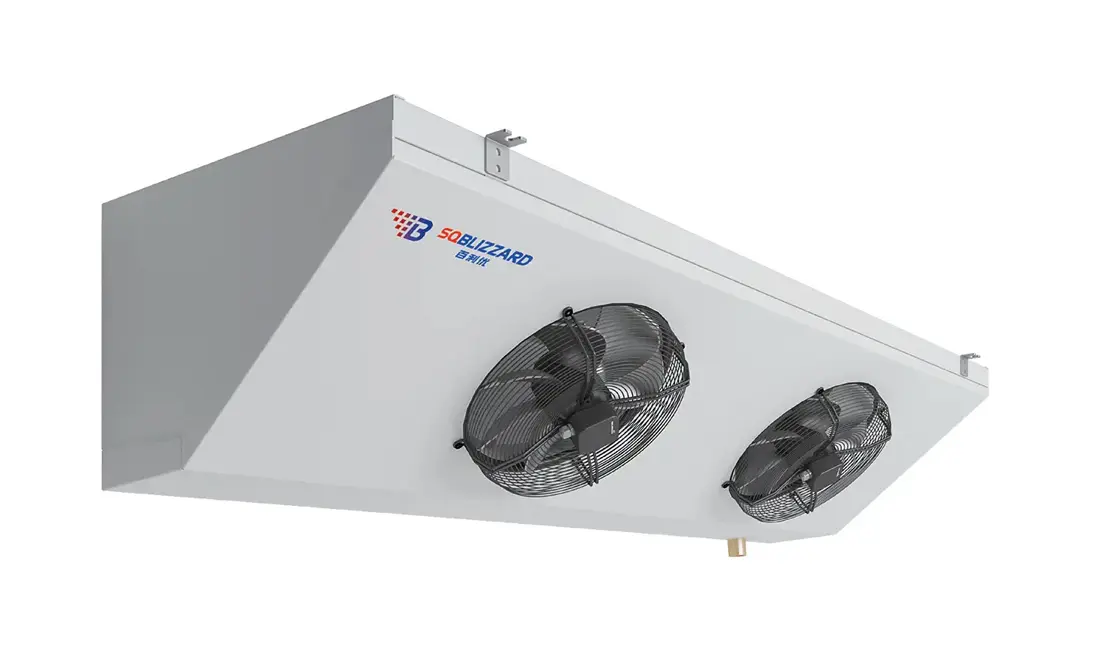
A spiral freezer evaporator removes heat from the air that circulates inside the freezer. It absorbs that heat through the refrigerant or the low-temperature fluid inside its coil tubes. The evaporator cannot be designed on its own. It has to match the product load, the fans, the airflow pattern, the refrigeration system, and the required continuous run time.
This article covers the main design areas in order: design inputs, capacity, coil construction, refrigerant and materials, airflow, frost and defrost, and performance verification. It applies to industrial spiral freezers that run on a mechanical refrigeration system.
What Is a Spiral Freezer Evaporator and How Does It Work?
A spiral freezer evaporator is a finned-tube coil with fans, built into the freezer enclosure. It cools the returning air, and the air then cools the product.
The Spiral Freezer Heat-Removal Path
Heat leaves the product along a fixed path:
Product core → product surface → moving air → evaporator → refrigerant → refrigeration system
Each step depends on the next one. The product gives its heat to the circulating air first. That air then passes across the evaporator coil and gives the heat up to the refrigerant. So the evaporator does not create cold air. It removes heat from air that has already warmed up in the product zone.
In a mechanical spiral freezer, the refrigerant circulates inside a closed circuit. It never touches the food. That separation supports food safety, and it also shapes the material choices covered later.
How the Coil, Fans, and Air Ducts Work Together
Three parts share the job, and each does something the others cannot. The coil transfers heat between the air and the refrigerant. The fans supply the air volume and the static pressure needed to move air through the machine. The ducts and baffles then deliver that cold air to the different spiral belt tiers.
Correct coil capacity alone does not guarantee good freezing. A coil can carry enough nominal capacity and still give uneven results, for three common reasons: undersized fans, poor duct design, or air that bypasses the coil face. Buyers should treat the coil, the fans, and the air path as one package rather than three separate purchases.
What Data Are Needed for Spiral Freezer Evaporator Design?
Evaporator design needs three data groups: product and throughput details, production time and frost conditions, and plant constraints. Missing data forces assumptions, and assumptions show up later as capacity shortfalls.
Product, Throughput, and Temperature Requirements
Design starts with the product, because the product sets most of the heat load. Useful data includes the product name, dimensions, thickness, unit weight, composition, packaging state, and belt loading pattern.
Three production figures follow: hourly throughput, entering product temperature, and target core temperature at the outfeed. A short example shows the format. A line might state 3,000 kg/h of chicken nuggets, entering at +4 °C, leaving with a core at −18 °C or colder.
Packaging changes the answer a great deal. Bare product, product on trays, and product in cartons each present a different surface to the air. A carton adds a layer that slows heat flow, so the same coil freezes the same food more slowly inside a box.
Production Time and Frost Conditions
Run time shapes the coil as much as capacity does. The design team needs the daily operating hours, the number of shifts, the product changeovers, and the available defrost windows.
Frost load then comes from three sources: moisture released by the product, water left in the machine after cleaning, and humid air drawn in through the infeed and outfeed openings. A freezer next to a warm packing hall frosts faster than the same machine in a cool, dry room.
The coil has to suit its late-run condition, not only its clean start-up condition. A coil that performs well only when clean will miss its target near the end of every shift.
Refrigeration, Layout, and Hygiene Conditions
The third group covers the plant around the coil. It has three parts.
First, the refrigeration data: the refrigerant or secondary fluid, the feed method, the design evaporating temperature, and the capacity of the existing system. Second, the physical data: the space available for the evaporator, the fan positions, the pipe connections, and the service access. Third, the sanitation data: the cleaning method, the chemicals used, the drainage available, and the plant hygiene rules.
How Is Spiral Freezer Evaporator Capacity Determined?
Capacity comes from the total heat load, the evaporating condition, and the air volume. Product load is usually the largest single part of the total.
Product and System Heat Loads
Product load is the heat that must be removed to bring the product and its packaging from the entering temperature to the target core temperature. It includes sensible cooling above freezing, the latent heat of the phase change, and sensible cooling below freezing. The latent part is the largest, because most of the water in the food turns to ice.
Total load can also include heat that has nothing to do with the food. Four common items are fan motor heat, drive and transmission heat, heat gain through the enclosure panels, and air infiltration at the openings. Fan heat matters here, because the fans run inside the cold space and their power ends up as heat.
Enclosure volume and hourly throughput are not a sizing basis. Neither figure describes how much heat has to leave the product.
Evaporating, Air, and Product Temperatures
Four temperatures appear in every discussion, and each means something different:
- Температура испарения is the refrigerant condition inside the coil tubes.
- Air-on temperature is the air entering the coil face.
- Air-off temperature is the air leaving the coil.
- Температура в центре продукта is the result at the center of the food.
These values are linked, but none can replace another. Lowering the evaporating temperature widens the temperature difference at the coil, which raises heat transfer. It also lowers compressor efficiency and raises energy use. So the coldest evaporating temperature is not the best one.
Clean-Coil Capacity and Continuous Operating Capacity
Every rated capacity needs its conditions stated, or the number cannot be compared. Suppliers should name the evaporating temperature, the entering air temperature, and the air volume behind any nominal kW figure.
The design should then check the frosted condition. Two questions matter across the planned run time. Does the air volume stay high enough? Does the coil hold enough capacity to meet the throughput?
Design margin belongs in this check. It should reflect real product variation and load swings. Adding margin without a reason only increases cost, footprint, refrigerant charge, and defrost time.
How Is a Spiral Freezer Evaporator Coil Designed?
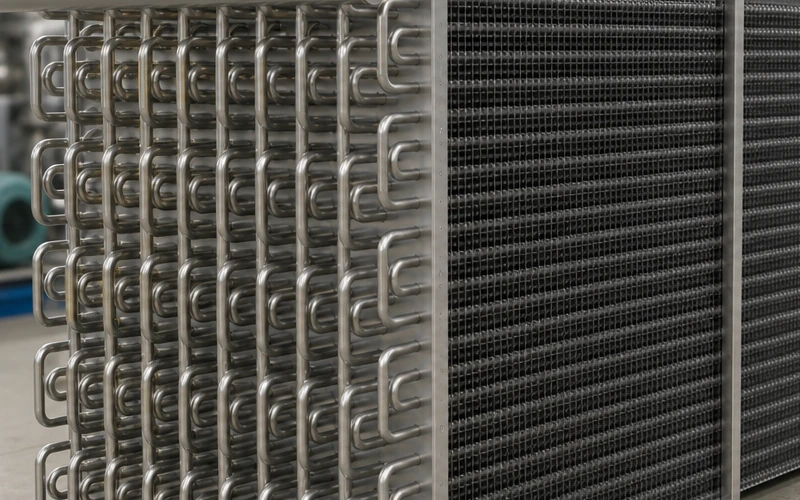
Coil design sets four main variables: face area, tube rows, tube layout, and fin spacing. Each one trades capacity against air pressure drop.
Coil Face Area and Tube Rows
Face area sets the coil face velocity, and face velocity drives three results: heat transfer, air pressure drop, and frost distribution. A small face area raises velocity and pressure drop. It also concentrates frost, because more moist air passes each square meter of fin surface.
Adding tube rows adds heat transfer surface, and it adds air resistance at the same time. Past a certain depth, the last rows meet air that has already given up most of its heat. They contribute little while still charging full pressure drop.
Face area and depth also have practical limits. Both must fit the available space, the fan capability, and the room needed to inspect and clean the coil.
Tube Diameter, Pattern, and Refrigerant Circuiting
Tube diameter and tube pattern affect three things: air-side heat transfer, refrigerant flow, and air pressure drop. Smaller tubes pack more surface into the same volume. Larger tubes carry refrigerant with less pressure loss. Staggered layouts usually improve air-side heat transfer and usually add resistance.
Circuiting decides whether the whole surface does useful work. Refrigerant has to spread evenly between circuits and between coil modules. Poor distribution starves part of the surface, and the air leaving those sections stays warmer than the rest.
Circuit design has to suit the specific refrigerant, the feed method, and the operating load. Rules taken from comfort air-conditioning coils do not transfer to low-temperature food freezing coils.
Fin Spacing and Variable Fin Pitch
Fin spacing controls the balance between surface area and frost capacity. Closer fins add surface area in the clean condition, and they restrict airflow sooner once frost builds. Wider fins hold more frost and run longer between defrosts, but they give less heat transfer area per unit of coil volume.
Variable fin pitch answers a specific problem. Frost does not build evenly. The rows facing the entering air meet the most moisture, so they frost first and fastest. Variable fin pitch places wider gaps in that zone and closer gaps further along the air path.
The purpose of variable fin pitch is to delay airflow restriction. It does not prevent frost, and it does not remove the need for defrost.
Coil Size, Performance, and Cost Trade-Offs
A bigger coil is not automatically a better coil. More surface area, more tube rows, and closer fins all carry costs as well as benefits.
Six factors have to balance: refrigeration capacity, air pressure drop, fan power, frost holding capacity, equipment space, and cost. Pushing one factor to its limit usually damages another.
So no single parameter shows whether an evaporator design is sound. A coil with the largest surface area on paper can still lose to a smaller coil with better airflow and better refrigerant distribution.
How Do Refrigerant and Materials Affect Spiral Freezer Evaporator Design?
Refrigerant choice sets the design pressure, the tube materials, and the feed arrangement. Material choice then has to survive both the refrigerant inside and the washdown outside.
Refrigerant and Supply Arrangements
Industrial spiral freezers run on several system types: ammonia (R717), carbon dioxide (R744), halocarbon refrigerants, and secondary fluid systems using glycol or brine.
Liquid can reach the coil in four ways. Flooded coils stay wetted from a separator by gravity. Pumped coils receive more liquid than they evaporate, from a circulation pump. Direct expansion coils receive metered liquid from an expansion device. Secondary fluid coils circulate a cold liquid that never changes phase, so strictly speaking they do not evaporate anything.
Each system makes different demands on the circuiting, the design pressure, the controls, and the pipe connections. A coil built for one refrigerant cannot be converted by changing its connections.
Tube, Fin, Header, and Casing Materials
Materials have to satisfy four demands at once: refrigerant compatibility, design pressure, food plant conditions, and resistance to cleaning chemicals. Copper, for example, is ruled out with ammonia because ammonia attacks it.
Common choices include aluminum in various grades, stainless steel, and other suitable metals. Casings in food plants often use stainless steel for its washdown resistance.
No material suits every spiral freezer project. A plant using aggressive daily sanitation has different priorities from a plant running dry, packaged product.
Hygienic and Serviceable Construction
Hygienic construction means staff can reach and clean the surfaces that matter. The coil, the fans, and the drain area all need working space around them.
Good detailing removes three problem features: narrow gaps that cannot be reached, flat areas that hold standing water, and ledges that collect product residue.
Durability comes from the same details. Fin thickness, surface treatment, and the internal support structure all have to survive repeated cleaning and the cycle between low-temperature running and defrost warm-up.
How Do Airflow and Fans Affect Spiral Freezer Evaporator Design?
Airflow decides how much of the coil’s capacity reaches the product. Correct capacity with poor airflow still produces uneven freezing.
Airflow, Static Pressure, and Coil Resistance
Fans have two jobs: deliver the air volume, and overcome the resistance in the path. That resistance comes from the coil, the ducts, the baffles, and the loaded product zone.
Free-delivery fan ratings describe a fan blowing into open air, which no spiral freezer does. A fan with an impressive free-delivery figure may move far less air against a real system.
Frost adds resistance during the run, so the design should account for the frosted pressure drop as well as the clean value. A selection checked only in the clean condition will look better than the machine ever performs.
Fan Position, Ducts, Baffles, and Air Bypass
Fan position and ductwork decide whether air passes through both the coil and the product. Air takes the easiest available path, and the easiest path is often the wrong one.
Three faults waste capacity that the plant has already paid for. Bypass lets air slip around the coil block without giving up heat. Short-circuiting returns cold air to the coil before it reaches the product. Local concentration sends too much air through one zone and too little through another.
The design goal is reasonable air distribution across every spiral tier and across the belt width. Average airflow figures hide the problem that operators will actually notice.
Horizontal and Vertical Airflow Arrangements
Spiral freezers use horizontal airflow, vertical airflow, or other engineered patterns. All three appear in working plants.
No direction suits every product and every machine layout. Vertical flow works well when air can pass through the belt openings. Horizontal flow suits other product shapes and other structures.
The arrangement should be verified against four things: the product shape, the belt open area, the loading pattern, and the spiral structure.
Airflow Control at Partial Load
Variable frequency drives let fan speed follow the load, which saves energy because fan power falls sharply as speed drops.
The saving has a condition. Lower air velocity reduces heat transfer at the product surface, so freezing takes longer at reduced fan speed.
Fan control therefore belongs in the same logic as belt speed and refrigerant feed. All three settings should be adjusted together and confirmed by product core temperature, not by air temperature alone.
How Does Spiral Freezer Evaporator Design Manage Frost and Defrost?
Frost management combines coil geometry, defrost method, and drainage. No design prevents frost. Good design decides how long the machine runs before frost limits production.
Why Frost Forms and How It Affects Performance
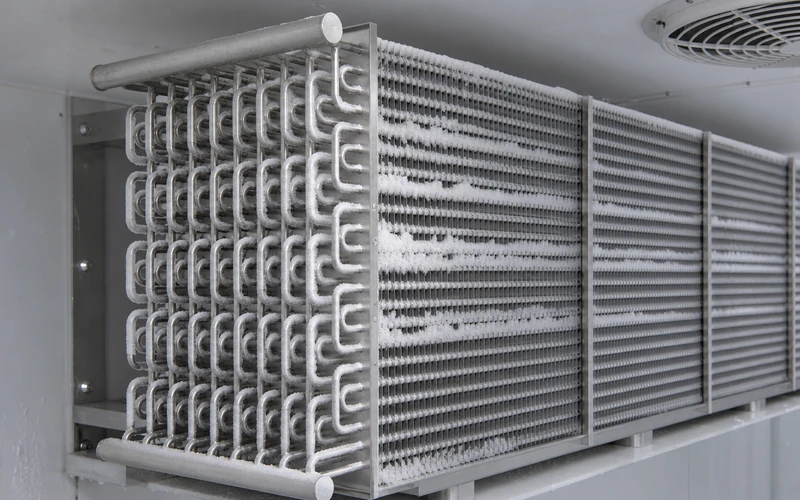
Frost forms because the coil surface sits below the frost point of the surrounding air. Moisture from the product and from infiltrating air deposits as ice on the fins.
Frost then hurts performance in stages. Light frost changes the fin surface and has little effect. Heavier frost narrows the air gaps, cuts the air volume, and reduces the heat the coil can actually move.
The second stage is the one that stops production. Once airflow falls, freezing capacity falls with it, even when the refrigerant is still very cold. Frost is a normal operating variable in low-temperature food freezing, and no coil design removes it permanently.
Fin Spacing and Frost Capacity
Frost capacity depends on three geometry choices: fin spacing, coil depth, and the air direction through the block. Fin spacing sets how much ice the coil can hold before airflow restricts clearly.
Variable fin pitch helps extend the time before that point arrives. It matches the coil geometry to the way frost actually distributes itself.
Geometry alone is not enough. The coil still has to work with a complete defrost plan, including the method, the drainage, and the control sequence.
Spiral Freezer Evaporator Defrost Options
Several defrost methods appear in this equipment: hot gas, water, electric heating, air defrost, and sequential defrost of one coil zone at a time.
Selection depends on five factors: the refrigerant, the coil materials, the available production time, the drainage capacity, and the plant utilities. Hot gas defrost needs a suitable refrigeration system. Water defrost needs generous drainage. Electric defrost needs the electrical supply to carry it.
No single method suits every machine, and no fixed interval suits every product. Both belong in the project discussion, not in a standard specification.
Defrost, Drainage, and Continuous Production
Melt water has to leave the machine quickly. Water left in the coil block, the drain pan, or the enclosure freezes again, and that ice is far harder to remove than frost.
Sequential defrost extends run time, but it has requirements. It needs suitable coil zoning, spare refrigeration capacity, and airflow control that keeps defrost heat away from product still on the belt.
Air defrost and sequential defrost both extend running time. Neither replaces a full defrost, and neither replaces the cleaning and inspection that food safety requires.
How Is Spiral Freezer Evaporator Performance Verified?
Verification runs in stages: engineering calculation, airflow analysis, factory testing, and a site test with real product. Each stage answers a different question.
Engineering Calculations and CFD Analysis
Coil selection calculations must state their inputs. Five items belong on the selection sheet: the refrigerant, the evaporating temperature, the entering air condition, the air volume, and the design heat load.
CFD analysis then examines the air path. It shows three problems that drawings hide: air bypass around the coil, short-circuiting of return air, and differences in airflow between spiral tiers.
CFD is a design tool. It reflects the geometry and fan data entered into it, so it cannot replace a test on the built machine with real product.
Factory and Site Testing
Factory testing checks the equipment before it ships. It can verify the fans, the valves, the control sequences, the alarms, and the defrost logic.
Site testing checks performance. It should run with the agreed product, throughput, entering temperature, and loading pattern, because a lighter load proves nothing about the design duty.
Five records should be kept during that test: product core temperature, belt speed, air conditions, frost condition, and the continuous run time achieved. Without them, a good result cannot be repeated and a poor one cannot be diagnosed.
What Buyers Should Compare
Three figures get compared too often on their own: nominal refrigeration capacity, coil dimensions, and the lowest air temperature the machine can reach. None of them describes what the product will do.
A fair comparison uses one common rating basis for every quotation. It should cover capacity, air volume, static pressure, and the run time the supplier expects between defrosts.
Acceptance should then rest on three measured outcomes: product core temperature, actual throughput, and performance across a full continuous run.
FAQs About Spiral Freezer Evaporator Design
What type of evaporator is used in a spiral freezer?
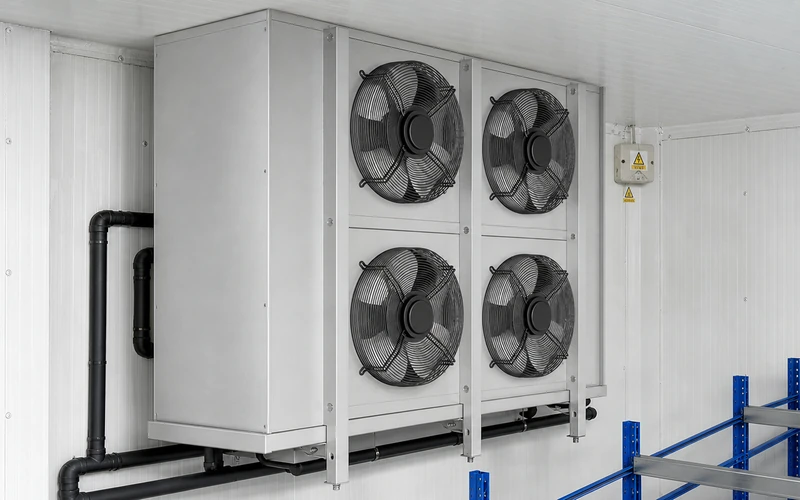
It differs from a cold-store air cooler in one important way: the moisture load. A spiral freezer evaporator meets wet product and infiltrating air all day, so it frosts far faster than a coil holding a storage room at a steady temperature. A coil borrowed from cold-store duty usually blocks up before the shift ends.
Coil position also varies between machines. Some designs place the block beside the spiral drum, and some split the duty between two blocks.
How is a spiral freezer evaporator sized?
Sizing should follow the hardest product on the line rather than the average one. On a line running several products, one will govern: usually the thickest piece, the wettest piece, or the one entering warmest.
Buyers who plan to add products later should say so at the enquiry stage. Adding a thicker product to a machine sized for thin pieces reduces throughput, and no control change recovers it.
What is the best fin spacing for a spiral freezer evaporator?
A better approach is to ask for a result instead of a number. Rather than specifying a fin pitch, buyers can ask the supplier to state the run time the coil will hold before airflow drops below the design value.
That question puts the risk in the right place. The supplier selects the geometry, and the site test measures the outcome.
Is horizontal or vertical airflow better for a spiral freezer?
Rather than debating direction, buyers can ask for evidence. A useful request is the measured core temperature spread between belt positions on a reference machine running a similar product.
That figure says more than any claim about airflow direction, because it reports what the arrangement achieved in a real plant.
How often should a spiral freezer evaporator be defrosted?
Defrost frequency works better as a measured output than a timer setting. Plants that monitor airflow or coil pressure differential can defrost when the coil needs it rather than on a fixed clock.
Many plants also align the main defrost with the daily sanitation stop. That uses downtime already in the schedule, so it costs no extra production.
Discuss Your Spiral Freezer Evaporator Design with Square Technology
Design work moves faster when the data arrives early. A useful enquiry names the product, its size, and its packaging state, together with the hourly throughput, the entering temperature, and the target outfeed core temperature. It should also state the required continuous run time, the refrigerant, the plant layout, the cleaning requirements, and the available defrost conditions.
From that data, the ntsquare engineering team calculates the refrigeration load. It then works through the coil construction, the fin spacing, the airflow, the fan selection, and the defrost plan as one package. Buyers who want to review the equipment scope first can start with the спиральный морозильный шкаф range and the air cooler, evaporator, and condenser product pages, then send the data above to ntsquare for a project-specific proposal.