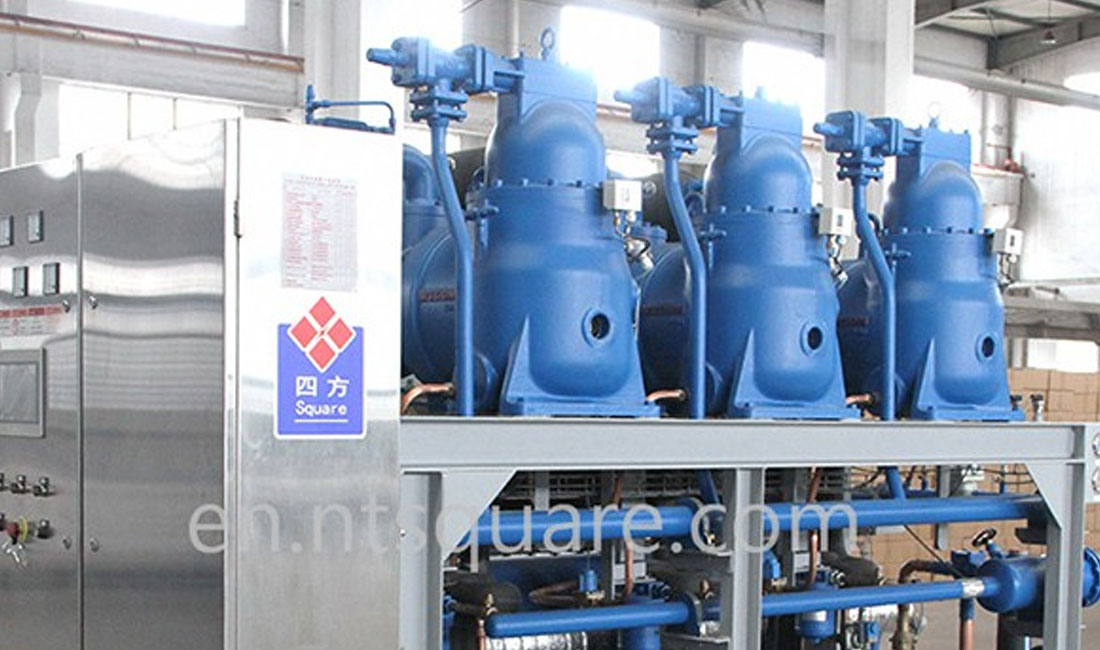
CO₂ refrigeration systems use carbon dioxide, also called R-744, to keep cold storage rooms and food processing lines at stable low temperatures. They are becoming more common because CO₂ has a global warming potential of 1, while many older HFC refrigerants have much higher climate impact. CO₂ can support cold storage, freezing tunnels, spiral freezers, plate freezers, and deep-freezing systems.
Based on industrial refrigeration and cold storage project experience, this guide explains how CO₂ refrigeration works and where it fits best. It covers transcritical systems, subcritical systems, NH₃/CO₂ cascade systems, refrigerant safety, system cost, energy use, heat recovery, regulations, and selection steps for food plants and cold storage facilities.
What Is a CO2 Refrigeration System?
A CO2 refrigeration system uses carbon dioxide as the working fluid in a vapor-compression cycle. The refrigerant is designated R-744. It absorbs heat at the evaporator and rejects it at the condenser or gas cooler. CO2 has a critical point at 31.1 °C and 73.8 bar. ASHRAE Standard 34 classifies CO2 as A1: non-toxic and non-flammable.
What does R-744 mean and why is CO2 called a natural refrigerant?
R-744 is the ASHRAE designation for carbon dioxide. The “7” prefix marks inorganic compounds. CO2 qualifies as a natural refrigerant because it occurs in the atmosphere and the biosphere. Other natural refrigerants include ammonia (R-717) and hydrocarbons such as R-290.
How does the CO2 refrigeration cycle work?
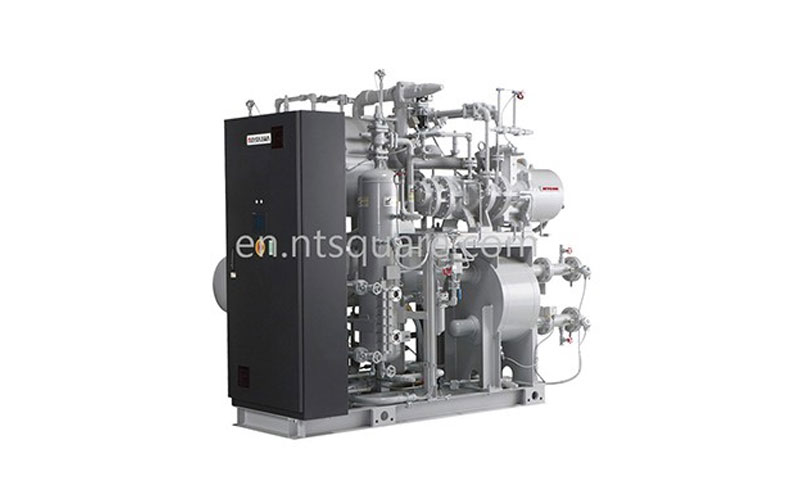
The cycle has four stages. The compressor pressurizes the gas. The gas cooler or condenser releases heat to ambient. The expansion valve drops pressure and temperature. The evaporator absorbs heat from the cold space. Above 31.1 °C ambient, CO2 cannot condense and operates in transcritical mode through a gas cooler.
What are the main pros and challenges?
CO2 systems carry six measurable advantages and four documented challenges (IIR, 2023; ASHRAE).
Advantages:
- GWP of 1 and ODP of 0
- A1 safety rating: non-toxic and non-flammable
- High volumetric capacity, smaller pipe diameters
- Heat recovery up to 90 °C from compressor discharge
- Regulatory stability under Kigali, F-Gas, and AIM Act
- Refrigerant cost of $1–2/kg, abundant and recyclable
Challenges:
- Operating pressures up to 120 bar require reinforced components
- CAPEX runs 15–30% higher than HFC systems
- Dry-ice formation below the triple point of 5.18 bar requires trained service procedures
- Transcritical efficiency drops above 32 °C ambient without parallel compression
Why Is CO2 the Eco-Friendly Future of Cold Storage?
CO2 has the lowest climate impact of any non-flammable refrigerant in commercial use. Its GWP of 1 is 1,000 to 4,000 times lower than common HFCs. Three regulations are forcing the global phase-out of HFCs through 2050.
Which regulations are phasing out HFCs globally?
Three frameworks set the phase-out timeline.
- Kigali Amendment (2016): phased HFC reductions by country group — developed nations cut 85% by 2036, most developing nations cut 80% by 2045, others reach 85% by 2047 (UNEP)
- EU F-Gas Regulation (2024 revision): complete HFC ban by 2050
- US AIM Act (2020): 85% HFC reduction by 2036 (US EPA, 2024)
How does CO2’s GWP compare to synthetic refrigerants?
CO2’s GWP of 1 sets the baseline. The table compares mainstream refrigerants used in cold storage.
| Refrigerante | Type | GWP (AR4, 100-yr) | ODP | Status |
| R-744 (CO2) | Natural | 1 | 0 | Promoted |
| R-717 (Ammonia) | Natural | 0 | 0 | Promoted |
| R-404A | HFC | 3,922 | 0 | Phasing out |
| R-134a | HFC | 1,430 | 0 | Restricted |
| R-22 | HCFC | 1,810 | 0.05 | Banned |
Source: IPCC AR4; ASHRAE 34.
What ESG benefits does CO2 offer food manufacturers?
CO2 reduces Scope 1 emissions on a manufacturer’s GHG inventory. HFC system leakage averages 15–25% per year (US EPA, 2023). Replacing R-404A with R-744 cuts that emissions line by more than 99%. Food brands such as Tyson, Cargill, and Unilever publicly disclose Scope 1 reductions through CDP and SBTi, where refrigerant choice is an increasingly material component.
What Are the Three CO2 System Architectures?
Cold storage facilities select among three CO2 architectures: transcritical, subcritical, and NH3/CO2 cascade. The choice depends on temperature range, capacity, and climate. Cascade systems handle deep freezing below -35 °C.
How do transcritical and subcritical CO2 systems differ?
Transcritical systems reject heat above CO2’s critical point of 31.1 °C using a gas cooler. They suit medium-capacity sites in moderate climates. Subcritical systems condense CO2 below the critical point. Standalone subcritical use is limited to cold-climate sites or cascade configurations where the heat sink stays below 25 °C.
Why is NH3/CO2 cascade the standard for industrial deep freezing?
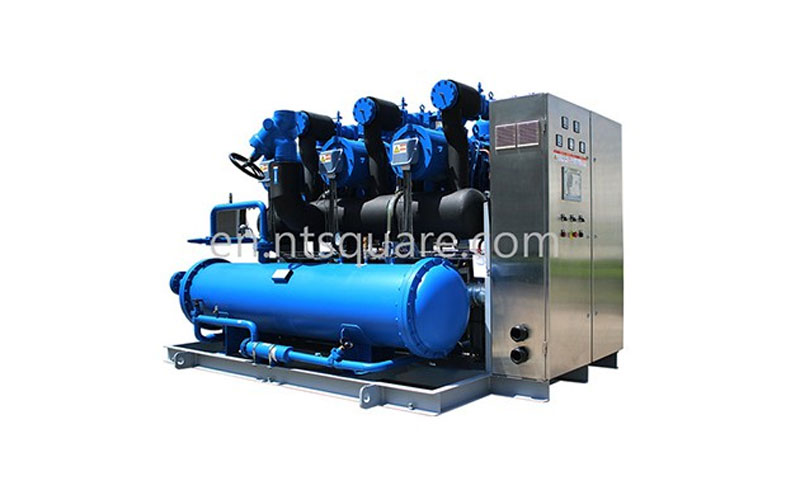
Cascade pairs an ammonia high stage with a CO2 low stage. CO2 evaporates between -35 °C and -50 °C in the freezer coils. Ammonia condenses CO2 through a cascade heat exchanger in an industrial CO2 cascade refrigeration system. The design cuts ammonia charge by 80–90% compared to a full ammonia plant (IIAR, 2022).
Which architecture fits your facility’s climate and capacity?
Three variables determine the fit: ambient design temperature, total capacity, and lowest evaporating temperature.
| Condition | Recommended Architecture |
| Cold-climate sites or systems with a secondary heat sink below 25 °C, evap > -25 °C | Subcritical CO2 (typically configured as part of a cascade) |
| Ambient 25–35 °C, capacity 100–800 kW, evap > -30 °C | Transcritical CO2 with parallel compression |
| Any climate, capacity > 500 kW, evap < -35 °C | NH3/CO2 cascade |
What Are the Differences: CO2 vs Other Refrigerants
CO2 outperforms HFCs on environmental metrics and matches ammonia on efficiency in most cold-storage cases. The table summarizes the practical trade-offs.
| Property | CO2 (R-744) | Ammonia (R-717) | HFC (R-404A) | Hydrocarbon (R-290) |
| GWP | 1 | 0 | 3,922 | 3 |
| Safety class | A1 | B2L | A1 | A3 |
| Flammability | None | Low | None | High |
| Operating pressure | High | Medium | Low | Low |
| Best capacity | 50 kW–5 MW | >500 kW | All | <100 kW |
CO2 is preferred over HFCs for regulatory longevity. CO2 is preferred over ammonia in production halls requiring low toxicity. CO2 is preferred over hydrocarbons where capacity exceeds 100 kW or fire codes restrict flammable refrigerants.
How Is CO2 Refrigeration Used in Industrial Cold Storage and Food Processing?
CO2 refrigeration serves five segments: cold storage warehouses, seafood IQF, meat and poultry, bakery, and prepared meals. Cascade configurations supply evaporating temperatures from -10 °C to -50 °C. The systems integrate with spiral, plate, and tunnel freezers.
How is CO2 used in cold storage warehouses?
Distribution centers use NH3/CO2 cascade for rooms held between -25 °C and -30 °C. The CO2 low side serves docks and storage zones. Ammonia stays in the engine room. This containment meets OSHA PSM thresholds and lowers insurance costs.
Why are seafood, meat, and poultry plants moving to CO2?
These products require evaporating temperatures of -40 °C to -45 °C for congelación rápida individual. NH3/CO2 cascade delivers that range with a higher COP than R-507 systems. CO2’s low toxicity allows the low side to enter food-contact zones.
How does CO2 fit bakery and prepared-meal lines?
Bakery and prepared-meal plants run continuous tunnels at -30 °C to -35 °C. CO2 supplies stable evaporating temperatures with smaller pipe runs. Compressor heat recovery delivers hot water at 70–90 °C for proofing, CIP, and washdown.
How does CO2 integrate with spiral, plate, and tunnel freezers?
CO2 handles the high instantaneous loads of IQF spiral and tunnel freezers. The low-side circuit feeds direct-expansion or pumped CO2 to evaporator coils. CIP-compatible coil designs allow daily wash-down without contamination risk.
Total Cost of Ownership: Is CO2 Worth the Investment?
CO2 systems pay back in 4–7 years for industrial cold-storage operators (IIR, 2023). The TCO calculation breaks down across five line items.
- CAPEX: 15–30% higher than HFC systems due to high-pressure components
- Energy: 10–20% lower OPEX in moderate climates with parallel compression
- Refrigerant cost: $1–2/kg for CO2 vs $40–80/kg for restricted HFCs
- Heat recovery: offsets 20–40% of plant hot-water demand at 70–90 °C
- Compliance: eliminates HFC quota exposure and cuts Scope 1 refrigerant emissions by 99%+
Payback shortens further when retrofitting from R-22 or R-404A systems facing forced phase-out replacement.
How Do You Select a CO2 Refrigeration System for Your Cold Storage Facility?
Selection follows a four-step process tied to facility data.
- Step 1 – Map heat loads and zones: document peak load, average load, and lowest evaporating temperature per room
- Step 2 – Match architecture to climate: use ambient design temperature and capacity to choose subcritical, transcritical, or NH3/CO2 cascade
- Step 3 – Specify components and controls: confirm pressure ratings to 120 bar, parallel compression for hot climates, and PLC-based controls
- Step 4 – Validate safety and training: apply OSHA 1910.147 lockout/tagout, install CO2 leak detection per EN 378 (Europe) or ASHRAE 15 (US), and train staff on high-pressure servicing
Skipping Step 1 is the leading cause of oversized compressors and degraded part-load efficiency.
How Does CO2 Perform in Real Food Plants?
Industry retrofits from R-404A and R-507 to CO2-based systems show consistent energy and emissions gains. Published industry data points the same direction across food segments.
What does a CO2 retrofit deliver on a seafood IQF line?
NH3/CO2 cascade systems replacing R-507 plants typically achieve 15–25% energy reduction in IQF applications. Direct refrigerant emissions drop by more than 99% from the GWP differential alone. Industrial-scale retrofits report 4–7 year paybacks once avoided HFC quota costs are included.
How does CO2 perform in continuous bakery freezing tunnels?
Transcritical CO2 with heat recovery supplies -30 °C to -35 °C to spiral and tunnel freezers in continuous bakery lines. Compressor heat recovery delivers 70–90 °C hot water for CIP, proofing, and washdown. Heat-recovery integration offsets 20–40% of plant hot-water energy demand.
FAQs
Is CO2 refrigeration safe for food plants?
Yes. CO2 is non-toxic, non-flammable, and rated A1 under ASHRAE 34. Leak detection is required because CO2 displaces oxygen above 5% concentration. Standard installations include CO2 sensors and ventilation interlocks per EN 378 (Europe) or ASHRAE 15 (US).
Can CO2 systems reach -40 °C?
Yes. NH3/CO2 cascade systems operate at evaporating temperatures down to -50 °C. The low-stage CO2 is condensed by the high-stage ammonia, enabling deep freezing for IQF and blast applications.
How does CO2 compare to ammonia for industrial freezing?
CO2 is safer indoors due to its A1 rating. Ammonia (B2L) is restricted from production halls under most codes. Ammonia delivers higher efficiency above 500 kW. Cascade designs combine both refrigerants.
Will CO2 refrigeration ever be phased out?
No. CO2 has a GWP of 1 and is not subject to phase-down quotas under Kigali, F-Gas, or AIM Act. It remains compliant long-term.
Does CO2 refrigeration work in tropical climates?
Yes, with parallel compression, ejectors, or adiabatic gas coolers. These additions hold transcritical efficiency at ambient above 35 °C. NH3/CO2 cascade works in any climate because heat rejection runs through the ammonia loop.
What is the lifespan of a CO2 refrigeration system?
15–25 years for industrial installations. High-pressure compressors and gas coolers match the service life of HFC equivalents. Stainless steel piping handles 120 bar without fatigue (IIR, 2023).