
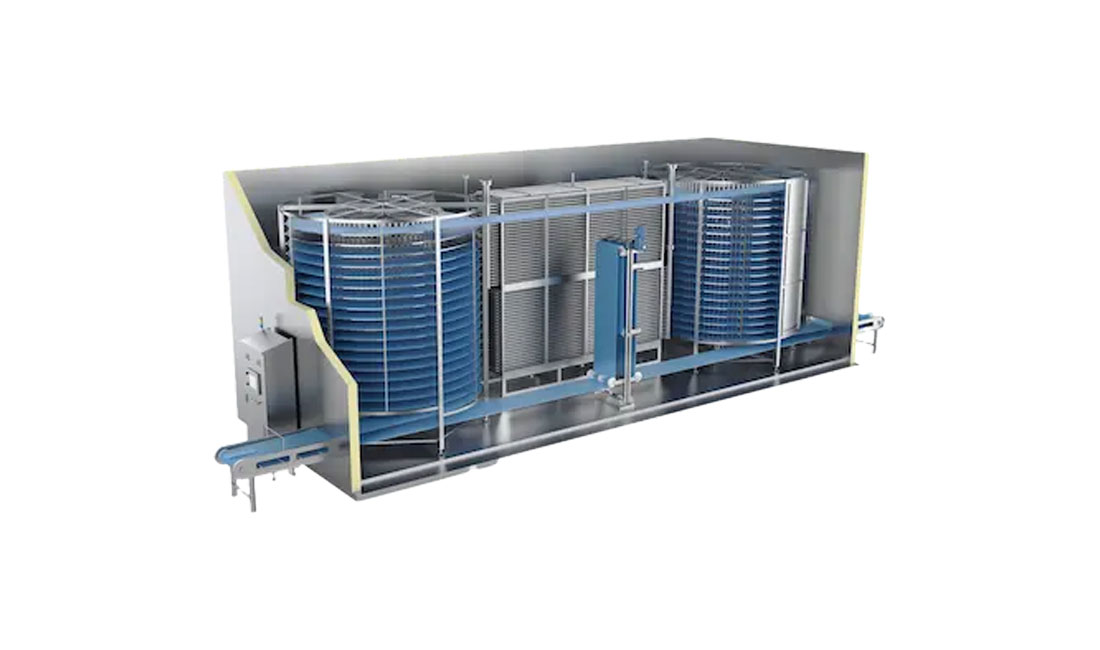
Selecting a spiral freezer manufacturer is one of the most consequential decisions a food processor can make. The wrong choice leads to excessive downtime, inflated energy bills, and inconsistent product quality.
The following ten factors provide a systematic framework for evaluating manufacturers and making a decision that protects both product integrity and long-term profitability.
Factor 1 — Why Does a Manufacturer’s Production Experience Matter?
A manufacturer with decades of continuous production has refined its engineering, resolved recurring failure modes, and built a library of application-specific solutions. Experience directly reduces commissioning risk and shortens the learning curve for new product lines.
Buyers should examine verifiable indicators of experience rather than marketing claims:
| Proof Point | What It Reveals |
| Years in continuous operation | Engineering maturity and financial stability |
| Number of installed systems globally | Scale of real-world validation |
| Range of food applications served | Ability to handle diverse freezing challenges |
| Public listing or audited financials | Long-term viability as a supply partner |
Square Technology, for example, has manufactured freezing systems since 1986 and has been listed on the Shanghai Stock Exchange since 2016, providing both operational track record and financial transparency.
Factor 2 — How Does In-House Component Manufacturing Affect Freezer Quality?
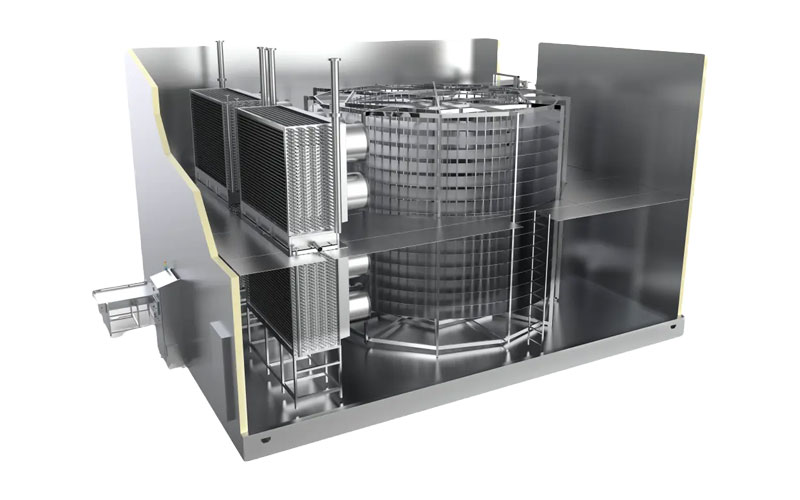
Manufacturers who produce evaporators, insulation panels, conveyor belts, and pressure vessels in-house maintain tighter quality tolerances, shorter lead times, and single-source accountability. Outsourced components introduce variability and complicate warranty claims at component interfaces.
The following core components should ideally be manufactured by the freezer maker itself:
- Evaporator coils — directly determine heat transfer efficiency and defrost behavior
- PIR insulation panels — affect thermal performance and fire safety rating
- Conveyor belts — must match the drive system precisely to avoid tracking issues
- Pressure vessels — require ASME-level fabrication for ammonia systems
- Stainless steel structures — govern corrosion resistance and hygienic cleanability
Square Technology is one of the few IQF manufacturers globally that produces all key components in-house, using a continuous PIR panel line from German and CNC equipment from Italy and Germany.
Factor 3 — What Freezing Performance Metrics Should You Compare?
The three metrics that separate high-performing spiral freezers from average ones are:
- freezing time per kilogram
- product dehydration rate
- energy consumption per kilogram of frozen output
Together they determine product yield, quality retention, and operating cost.
Optimized airflow is the key differentiator. Leading manufacturers use CFD simulation to model air velocity and distribution before building the evaporator. Vertical high-velocity airflow, as used in self-stacking spiral freezers, ensures uniform cooling regardless of product position on the belt. For most protein and bakery products, minimizing dehydration rate is critical — every percentage point of moisture loss translates directly into lost sellable weight.
Mechanical spiral freezers using ammonia or CO₂ compressor systems are preferred for continuous high-volume operations due to lower per-kilogram running costs, while cryogenic systems offer faster speeds but carry significantly higher consumable expenses.
Factor 4 — Which Belt Type Is Right for Your Product?
Belt selection depends on product weight, inlet temperature, and sanitation requirements. The two most common options differ significantly in application profile:
| Tipo de correa | Best For | Temperature Range | Limpieza |
| Stainless steel mesh | Heavy products, high inlet temps (fried items at 60–80°C) | -40°C to 200°C+ | Requires CIP system |
| Modular plastic | Lighter products (frozen vegetables, small pastries) | -40°C to 80°C | Tool-free disassembly |
A self-stacking spiral freezer eliminates the belt-supporting rails found in traditional low-tension designs, delivering up to 50% more freezing output within the same footprint and making the conveyor almost 100% accessible for cleaning. It is particularly well-suited for fried products such as chicken nuggets, fish fingers, and ready meals.
Factor 5 — What Hygienic Design Features Prevent Contamination?
Effective hygienic design combines CIP-integrated wash systems, fully welded stainless steel frames, and open-access structures that eliminate bacterial harborage points. A comprehensive hygienic freezer should include:
- Multi-mode CIP system — covering product zone cleaning (PZC), coil cleaning (PZE), and full-mode cleaning
- Fully welded stainless steel enclosure — no bolt heads, no crevices, no dirt traps
- Sloped floor with corner drains — fast drainage, no standing water
- Air defrosting system (ADF) — pressurized air pulses removing frost during production, extending continuous runtime by 150–200%
Buyers should verify certifications applicable to their region: USDA and FDA (United States), CFIA (Canada), CE (European Union), UL/CSA (electrical safety), and ASME (pressure vessels). Square Technology global project portfolio includes installations certified to North American, European, and Asia-Pacific standards.
Factor 6 — How Do You Match Freezer Footprints to Your Floor Space?
Congeladores espirales save floor space by stacking conveyor length vertically. Single-drum units suit smaller facilities, while double- and triple-drum configurations multiply throughput without proportionally increasing footprint. Key variables include belt width (356–1,372 mm), number of tiers, and belt direction — straight-through, 90-degree turn, or 180-degree turn — all of which affect how a freezer integrates into an existing processing line.
Factor 7 — Why Should the Refrigeration System Come from the Same Manufacturer?
When the freezer body and refrigeration package come from the same manufacturer, system-level optimization — compressor staging, evaporator sizing, and control logic — is engineered as one unit rather than patched together on site. This eliminates integration gaps that cause energy waste and unplanned shutdowns.
Processors should evaluate the following refrigeration-related capabilities:
- Compressor options — single-stage vs. compound two-stage
- Refrigerant flexibility — NH₃, CO₂, or HFC depending on regional regulations and sustainability goals
- Heat exchange components — in-house manufactured condensers and air coolers ensure compatibility and simplified spare parts management
- Integrated control system — PLC touch screen with real-time monitoring, preset freezing programs, and MCC (motor control center) cabinets
Factor 8 — What Smart Features Reduce Long-Term Operating Cost?
Smart features such as PLC-based automated controls, preset freezing programs, and real-time status monitoring reduce operator dependency and energy waste. As production lines become more connected, processors should also consider whether a manufacturer’s control platform can integrate with SCADA and MES systems.
Factor 9 — What Should a Manufacturer’s Warranty and Service Network Cover?
A meaningful warranty differentiates coverage by component lifespan. The table below shows typical benchmarks:
| Component | Expected Warranty(Industry Typical Benchmarks) |
| Stainless steel structures | 3–5 years |
| Evaporator coils (aluminum) | 2 years |
| Conveyor belts | 1 year |
| Electrical / control components | 1–2 years |
Beyond warranty terms, buyers should verify spare parts inventory, regional service centers, and operator training programs.
Factor 10 — How Do You Calculate Total Cost of Ownership Instead of Comparing Quotes?
Total cost of ownership adds energy consumption, dehydration loss, maintenance frequency, downtime hours, and spare parts cost to the purchase price over a ten-year horizon. A freezer that costs 20 percent more upfront but cuts dehydration by one percent often pays back within two years on a high-throughput line.
The following hidden costs are frequently overlooked during procurement:
- Product weight loss from dehydration — often the single largest cost over the equipment’s lifetime
- Defrost downtime — traditional systems require regular production stops for defrosting; ADF-equipped freezers can run continuously
- Water and chemical usage for cleaning — varies dramatically between CIP-equipped and manually cleaned freezers
- Retrofit costs — a freezer that cannot be upgraded with new controls or expanded belt capacity forces early replacement
Processors who model these variables over a ten-year period consistently find that the lowest-priced quotation rarely delivers the lowest total cost.
Conclusion — A Practical Checklist Before You Decide
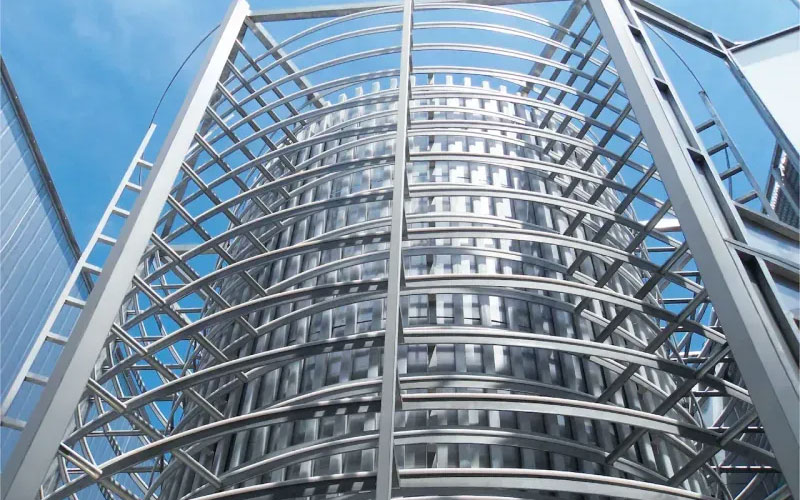
Before issuing a purchase order, food processors should visit the manufacturer’s factory, request reference calls from customers processing similar products, and compare total cost of ownership — not just sticker price.
Manufacturers that score well across all ten factors offer the lowest risk and highest long-term value. To explore how a vertically integrated IQF freezer manufacturer approaches these factors, visit Square Technology’s product portfolio or review their global case studies.
FAQs
What is the typical freezing capacity range of an industrial spiral freezer?
Industrial spiral freezers typically handle 300 kg/hr to 10,000 kg/hr depending on belt width, tier count, and product type. Self-stacking models can achieve up to 3 tons/hr for ready meal packs and up to 5,000 kg/hr for IQF products.
How long does a spiral freezer last?
With proper maintenance, spiral freezers are designed for many years of continuous industrial operation. Longevity depends on maintenance discipline, cleaning frequency, and whether the CIP system is used consistently.
What is the difference between a self-stacking and a low-tension spiral freezer?
A self-stacking spiral freezer uses a chain-driven, self-stacking belt that eliminates the rails and cages required in low-tension designs. This results in up to 50% more freezing output in the same footprint, nearly 100% belt accessibility for cleaning, and reduced motor size and lubricant usage.
How much floor space does a spiral freezer require?
Floor space varies by configuration. A single-drum spiral freezer occupies a fraction of the floor space that a tunnel freezer of equivalent capacity would require. Double- and triple-drum configurations increase capacity with minimal additional footprint.
Can one manufacturer supply both the freezer and the refrigeration system?
Yes. Vertically integrated manufacturers such as Square Technology supply the complete package — freezer body, evaporators, condensers, air coolers, compressor skids, PIR panels, and integrated PLC controls — eliminating the integration risks that arise when multiple vendors are involved.