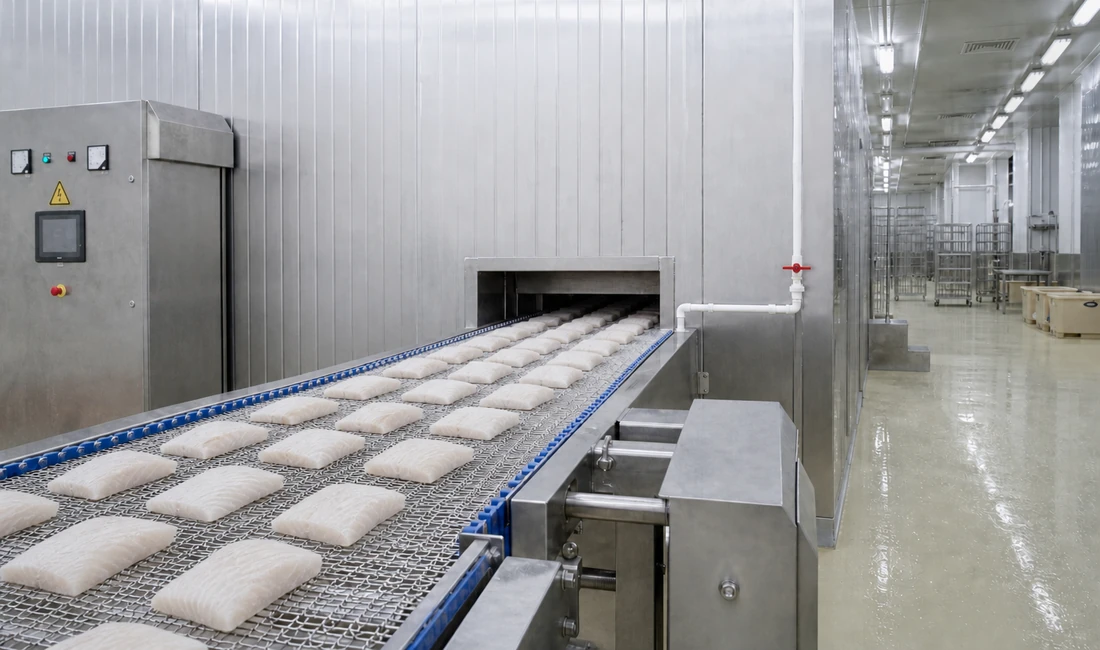
Freezing time is one of the most important values in spiral freezer design and operation. Food manufacturers and suppliers need to know how long each product must stay on the belt to reach a safe and stable frozen core. Getting this number right affects hourly output, energy use, and final product quality.
This article explains what spiral freezer freezing time means, what drives it, and how food processors can calculate and optimize it for their specific products.
How Long Does Food Take to Freeze in a Spiral Freezer?
Food in a spiral freezer can take anywhere from 5 minutes to over 60 minutes to reach a frozen core. The exact time depends on the product type and the conditions inside the freezer.
Define Spiral Freezer Freezing Time
Spiral freezer freezing time is the total time a food product must spend inside the freezer to bring its core temperature down to the required level. For most frozen foods, the target core temperature is −18°C (0°F). This is the standard set by food safety regulations in most markets. Some products require a colder core—such as −20°C or lower—depending on the end use.
The freezing time clock starts the moment the product enters the spiral belt and stops when the product exits. During this window, the cold air inside the cabinet must remove enough heat from the product to freeze it all the way to the center.
Distinguish Freezing Time from Dwell Time
Freezing time and dwell time are closely related but not the same. Dwell time is the total time a product physically spends on the belt, from infeed to exit. Freezing time is the thermal time needed to reach the target core temperature.
For the system to work correctly, the dwell time must be equal to or greater than the required freezing time. If the dwell time is too short, products will leave the freezer with a warm center. If the dwell time is much longer than needed, the belt runs too slowly. This reduces hourly output and can cause excess moisture loss on the product surface.
In short: dwell time is a machine setting. Freezing time is a thermal requirement. Operators set the dwell time to match the freezing time.
Understand Why There Is No Universal Freezing Time
There is no single correct freezing time that applies to all products. A thin vegetable patty freezes much faster than a thick piece of breaded fish. A product entering the freezer at 20°C takes longer than one entering at 4°C. Even the same product can show different freezing times depending on pack weight, belt loading, and airflow conditions.
This is why spiral freezer suppliers and food processors must treat freezing time as a product-specific value. It must be calculated or measured for each individual product under defined operating conditions.
What Factors Determine Spiral Freezer Freezing Time?
Several factors work together to determine how long a product needs in a spiral freezer. Each one affects how fast heat moves out of the product and into the cold air.
Check Product Thickness, Shape, and Composition
The most important single factor is product thickness. Heat must travel from the center of the product to its surface before the cold air can remove it. Thicker products have a longer heat path, so they need more time. For example, a chicken nugget that is 20 mm thick will freeze much faster than a stuffed chicken breast that is 60 mm thick.
Shape also plays a role. Flat, uniform products—such as fish fillets or burger patties—freeze more evenly than irregular shapes like whole chicken pieces or battered shrimp. Irregular shapes can have areas where cold air does not flow well, creating warm spots that extend overall freezing time.
Product composition matters too. Foods with high water content, such as vegetables and seafood, carry a high thermal load because water releases a large amount of heat when it turns to ice. Foods with higher fat content, such as sausages or fried snacks, behave differently because fat transfers heat at a different rate than water.
Confirm Infeed and Target Core Temperatures
The infeed temperature is the product’s core temperature when it enters the freezer. A product entering at 20°C contains far more heat than one entering at 2°C. This difference can add several minutes to the required freezing time.
Food processors should always design around the worst-case infeed temperature. If a production line has delays or if the chilling step is inconsistent, infeed temperatures can vary. Suppliers typically size the freezer for the highest expected infeed temperature to make sure the system always performs reliably.
The target core temperature also defines how long the product must stay in the freezer. Reaching −18°C is standard for most frozen foods. If a product must reach −20°C before packaging or export, the system needs additional dwell time.
Include Packaging, Belt Load, and Product Spacing
Packaging has a direct effect on freezing time. Unwrapped or loosely wrapped products allow direct contact between cold air and the food surface. Tightly sealed vacuum packs or thick film wraps reduce this direct heat exchange and can add 20% to 40% more freezing time, depending on the packaging material and thickness.
Belt load is the weight of product placed on each square meter of belt. Overloading the belt causes two problems: products pile on top of each other, blocking airflow to the lower layers, and the total heat load on the refrigeration system increases. Both effects extend freezing time and create inconsistency across the belt.
Product spacing is equally important. Products placed too close together restrict airflow between them. Even a small gap between pieces lets cold air circulate on all exposed surfaces, which speeds up heat removal. Suppliers recommend a consistent spacing pattern during infeed to maintain even airflow across the full belt width.
Review Air Temperature, Velocity, and Distribution
The air inside a spiral freezer does the work of removing heat. Three air parameters control how well it performs: temperature, velocity, and distribution.
Air temperature is the most direct driver. Standard spiral freezers operate with air temperatures between −30°C and −40°C (−22°F to −40°F). Colder air increases the temperature difference between the air and the product, which drives faster heat transfer. However, very cold air can also increase surface dehydration and frost buildup on the evaporator if not managed properly.
Air velocity determines how quickly cold air contacts the product surface. Higher velocity improves heat removal at the surface, which speeds up the overall freezing process. Most spiral freezers use fans to maintain consistent airflow velocities across the belt.
Air distribution ensures that the same airflow conditions exist across the full width and length of the belt. Poor distribution creates warm zones where products freeze more slowly. Well-designed air ducting and evaporator placement help maintain even conditions throughout the cabinet.
Allow for Refrigeration Capacity and Frost Buildup
The refrigeration system must have enough capacity to hold the design air temperature even at full belt load. If the system is undersized, air temperature rises under heavy production, and actual freezing time increases beyond the design value.
Frost buildup is a natural result of operating a freezer. Moisture from the product and the incoming air collects and freezes on the evaporator fins. As frost builds up, it acts as insulation and reduces the evaporator’s ability to cool the air. This gradually raises air temperature and extends freezing time. Operators must defrost the evaporator on a regular schedule to keep performance consistent.
How Do You Calculate Spiral Freezer Freezing Time?
Calculating spiral freezer freezing time involves a thermal estimate and a machine capacity check. Neither step alone is enough.
Gather the Required Product and Process Data
Before any calculation can begin, food processors need to collect accurate data on the product and the process. The required product data includes: thickness at the thickest point, infeed core temperature, target core temperature, and the thermal properties of the food—density, specific heat, and thermal conductivity. For common foods such as poultry, seafood, and dough products, these thermal properties are available from published food science references.
The process data includes: freezer air temperature, airflow velocity at the belt surface, and total belt length. Suppliers provide these values in their equipment specifications.
Estimate the Product’s Thermal Freezing Time
Once the data is gathered, the thermal freezing time can be estimated using a heat transfer model. A widely used approach for food products is based on Plank’s equation and its modified versions. This method calculates the time needed to freeze a product of a given shape, thickness, and thermal properties under defined air conditions.
For simple shapes such as slabs (flat products) or cylinders (sausages), the calculation is straightforward. For irregular shapes, food technologists often use an equivalent thickness based on the product’s volume and surface area, or they rely on results from similar products tested previously.
As a practical example: a flat chicken nugget with an infeed temperature of 10°C, a target core temperature of −18°C, an average thickness of 22 mm, and a freezer air temperature of −35°C. Using standard thermal properties for cooked chicken, the estimated freezing time falls between 12 and 18 minutes, depending on the surface heat transfer rate. This estimate must then be confirmed by actual product trials.
Calculate Dwell Time from Belt Length and Belt Speed
Dwell time is calculated with a simple formula:
Dwell time (min) = Belt length (m) ÷ Belt speed (m/min)
Every spiral freezer has a fixed belt length. Belt speed is the adjustable variable that operators use to set the dwell time. A longer belt allows a higher belt speed for the same dwell time, which means more product passes through per hour.
Match Required Freezing Time to Available Dwell Time
The dwell time must be at least equal to the required freezing time. If a product needs 15 minutes to freeze and the dwell time is 12 minutes, the product will exit underfrozen. Operators must slow the belt to extend the dwell time, which reduces hourly throughput.
This is where belt length becomes critical. A machine with a longer belt can run at a faster speed to achieve the same dwell time, which keeps throughput high. A machine with a short belt must slow down significantly to provide enough dwell time for products that need longer freezing.
Work Through a Simple Belt-Speed Example
Here is a clear example. A food processor is freezing fish portions that require a dwell time of 20 minutes. The spiral freezer has a total belt length of 200 meters.
Required belt speed = 200 m ÷ 20 min = 10 m/min
If the same processor needs to freeze a thicker product that requires 25 minutes of dwell time:
Required belt speed = 200 m ÷ 25 min = 8 m/min
The slower belt speed reduces the number of meters of product that pass through per minute, which directly reduces hourly throughput. This is the core tradeoff in spiral freezer operation: longer freezing time means lower output for a given machine.
Confirm the Result with Product Trials
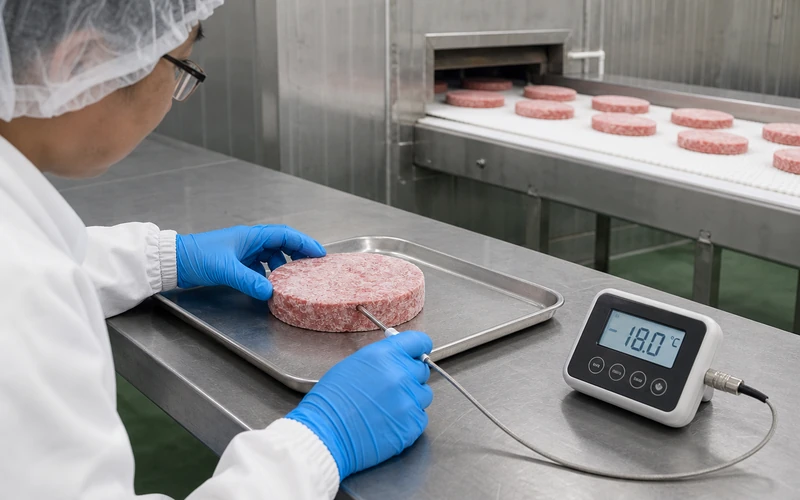
Calculations provide a starting estimate, not a final answer. All freezing time values must be confirmed by running the actual product through the actual machine under production conditions. During a product trial, operators measure the core temperature at the exit point using calibrated probes placed in multiple product samples across the belt width.
If the exit core temperature is not cold enough, the belt speed is reduced until all samples meet the target. The confirmed belt speed then becomes the production setting for that product. This trial-based step is essential for food safety compliance and consistent production.
How Does Freezing Time Affect Spiral Freezer Capacity and Product Quality?
Freezing time is not just a thermal value. It directly controls how much food a line can produce and what the frozen product looks and behaves like.
Balance Belt Speed and Hourly Throughput
Hourly throughput is the amount of product a spiral freezer can process in one hour. It depends on belt speed, belt width, and belt load (kg per meter of belt). When a product requires a longer freezing time, the belt must run more slowly. A slower belt means fewer meters of product pass through per hour.
Food processors must understand this relationship before purchasing or commissioning a spiral freezer. If a product mix includes both fast-freezing items (such as small vegetable pieces) and slow-freezing items (such as thick stuffed products), the machine must be sized for the worst case.
Prevent Underfreezing and Excessive Processing
Underfreezing occurs when the dwell time is not long enough to bring the core to the target temperature. Products that leave the freezer underfrozen can develop quality problems and may not meet food safety standards. If the core is still liquid, the product can warm up quickly during downstream handling.
Excessive processing—running the belt much too slowly—wastes energy and causes surface dehydration. If a product that needs 12 minutes is given 25 minutes due to an incorrect belt speed setting, the surface can dry out. This reduces weight yield and affects texture.
Control Dehydration, Drip Loss, and Texture
Dehydration is a natural side effect of exposing food surfaces to cold, dry air. The faster the product surface temperature drops below freezing, the sooner a protective ice layer forms and slows further moisture loss. Shorter, well-managed freezing times with correct belt loads tend to produce lower dehydration losses.
Drip loss is the moisture that escapes from a frozen product when it is thawed. Products that freeze slowly develop large ice crystals inside the muscle or cell structure. Large crystals cause more physical damage to cell walls, leading to higher drip loss and softer texture after thawing. Faster freezing in a well-optimized spiral freezer produces smaller ice crystals, which improves drip loss performance and protects texture for the end consumer.
Compare Energy Use at Different Operating Settings
Energy consumption in a spiral freezer is linked to belt speed and product load. Running the belt at the correct speed for a given product keeps the refrigeration load stable and avoids unnecessary idle time. When the belt runs too slowly, the heat load drops and the refrigeration system may cycle more, which can reduce overall efficiency.
Operators can track energy use per kilogram of product at different belt speed settings. In most cases, a properly loaded belt running at the correct speed uses less energy per kilogram than an underloaded belt running slowly.
How Can Food Processors Optimize Spiral Freezer Freezing Time?
Optimization does not mean cutting corners. It means finding the belt speed and operating conditions that deliver the required core temperature consistently, at the highest throughput, with the lowest weight loss.
Standardize Product Size and Infeed Temperature
The most effective step a processor can take is to standardize product size and infeed temperature. When products entering the freezer are consistent in thickness and temperature, the required freezing time is stable and predictable. If sizes vary widely—for example, chicken pieces ranging from 30 g to 120 g—the freezing time must be set for the largest, thickest, warmest piece. This forces a slower belt speed for all products on the same run.
Food processors can work with upstream production lines to improve portioning accuracy and to chill products to a consistent 2°C to 4°C before infeed. These two steps alone can add meaningful throughput capacity without any changes to the freezer itself.
Improve Belt Loading and Product Spacing
Correct belt loading makes full use of belt area without overloading the airflow. Most spiral freezer suppliers provide a recommended belt load in kg/m² for each product type. Operating within this range ensures that cold air can reach all product surfaces and that the refrigeration system is not overwhelmed.
Product spacing can be improved by adjusting the infeed conveyor speed and by installing spreading equipment that distributes products evenly across the full belt width. Even distribution means all products receive the same airflow and freeze in the same amount of time. Uneven distribution—with products clumped on one side—creates inconsistent freezing across the belt.
Adjust Belt Speed, Airflow, and Temperature Together
Belt speed, fan speed, and air temperature interact with each other. Changing one without considering the others can produce unexpected results. For example, reducing air temperature to speed up freezing also increases the risk of surface dehydration and faster frost buildup on the evaporator.
An experienced freezer supplier will help processors optimize these three variables together using product trial data and, in some cases, thermal modeling. The goal is to find a set of conditions that meets the freezing time requirement while keeping dehydration, frost buildup, and energy use within acceptable limits.
Monitor Exit Core Temperature Across the Belt
Exit core temperature should be measured regularly on both sides and in the center of the belt. If core temperatures vary across the belt width—for example, −22°C on the left side and −14°C on the right—this points to uneven airflow or uneven product distribution. The problem should be found and fixed before it affects product quality or food safety compliance.
Temperature data loggers placed on belt-width carriers can map the thermal profile across the belt during a production run. This data helps operators find problem zones and target corrective actions precisely.
Maintain the Evaporator and Control Frost Buildup
Frost builds up on the evaporator coils during each production shift. As frost thickness grows, cooling performance drops, air temperature rises, and freezing time increases. Processors should monitor evaporator pressure and air temperature data to detect early signs of performance loss.
Defrost cycles should be scheduled based on production patterns. If a facility runs two long shifts with a break in between, defrost cycles can be scheduled during the break to restore full performance. Processors who push production without adequate defrost cycles often find that products at the end of a long shift are underfrozen compared to those processed at the start.
How Should Buyers Verify Freezing Time in a Spiral Freezer Quote?
When purchasing a spiral freezer, buyers must make sure the supplier’s quoted freezing time is based on realistic and verifiable assumptions.
Provide Complete Product and Production Data
Buyers should give the supplier a complete product data sheet for every product that will run on the machine. This sheet should include: product name, shape, dimensions (length, width, thickness), weight per piece, infeed temperature (worst case), and target core temperature. It should also cover packaging type and weight, since packaging adds to thermal resistance.
Suppliers who quote freezing time without this information are estimating. The more complete the product data, the more accurate the supplier’s design will be.
Request Performance Data Under Defined Conditions
Buyers should ask suppliers to provide their quoted capacity and freezing time under clearly stated conditions, including: air temperature at the evaporator outlet, airflow velocity at the belt, belt length, and belt load in kg/m². This is called the design basis for the machine.
Without a defined design basis, two suppliers may quote the same freezing time under very different conditions, making a fair comparison impossible. A quote that uses very cold air and high airflow to achieve a short freezing time may require a much larger refrigeration system, which affects both upfront cost and operating cost.
Compare Suppliers on the Same Design Basis
To compare two suppliers fairly, buyers should ask each one to quote on exactly the same design basis—the same product, the same infeed temperature, the same target core temperature, and the same operating conditions. This allows a direct comparison of belt length, refrigeration capacity, and energy consumption.
Buyers should also ask how the machine performs when production conditions change—for example, when infeed temperature rises by 5°C or product thickness increases by 5 mm. Suppliers who can clearly show the impact of these changes demonstrate a deeper understanding of their machine’s performance.
Define Product-Trial and Acceptance Criteria
The purchase contract should include a product trial clause. This clause states that the supplier must demonstrate the quoted freezing performance during a factory acceptance test (FAT) or site acceptance test (SAT), using the actual product and agreed measurement methods.
The acceptance criteria should define: the minimum share of product samples that must meet the target core temperature, the measurement method (probe type and placement), and the production conditions during the test. Without clear acceptance criteria, disputes about freezing performance are difficult to resolve.
Frequently Asked Questions About Spiral Freezer Freezing Time
Is Spiral Freezer Freezing Time the Same as Dwell Time?
No. Freezing time is a thermal requirement—the time needed for the product core to reach the target temperature. Dwell time is a machine setting—the time the product actually spends on the belt. For the freezer to work correctly, the dwell time must be set equal to or greater than the required freezing time. If the dwell time is too short, the product will exit underfrozen.
Does Lower Air Temperature Always Shorten Freezing Time?
Lower air temperature increases the temperature difference between the air and the product, which speeds up heat transfer and can shorten freezing time. However, the relationship is not always straightforward. Very cold air can increase dehydration on the product surface and cause faster frost accumulation on the evaporator, which gradually reduces cooling performance. There is usually an optimal air temperature range for each product type that balances freezing speed with product quality and system efficiency.
Can Belt Speed Alone Control the Final Core Temperature?
Belt speed sets the dwell time, which is the time available for freezing. But whether the product actually reaches the target core temperature during that time depends on many other factors: air temperature, airflow, product thickness, and belt load. If belt speed is reduced but air temperature is too warm or airflow is uneven, the product may still not freeze correctly. Belt speed is one of several variables that must all be set correctly together.
Why Must Freezing Time Be Verified with the Actual Product?
Thermal calculations provide estimates based on assumed product properties and ideal conditions. Real products vary in composition, thickness, and infeed temperature. Real machines have airflow variations across the belt and frost accumulation on the evaporator. These real-world factors mean a calculated freezing time may differ from the actual value by several minutes. Only a product trial—with temperature measurements taken inside the actual product under actual production conditions—can confirm the correct belt speed setting. This step is required for food safety and production reliability.
Sonuç
Spiral freezer freezing time is not a fixed value. It is a product-specific parameter that depends on thickness, composition, infeed temperature, air conditions, and machine design. Food processors who understand these factors can calculate a starting estimate, confirm it through product trials, and optimize their operation to maximize throughput while protecting product quality.
For food manufacturers and suppliers specifying or evaluating spiral freezers, the most important steps are to provide complete product data, require a clearly defined design basis, and include product-trial acceptance criteria in every purchase contract.
Square Technology designs and manufactures IQF spiral freezers built for consistent freezing performance across a wide range of food products—from poultry and seafood to ready meals and baked goods. To explore available models and technical specifications, visit the Square Technology spiral freezer product range.