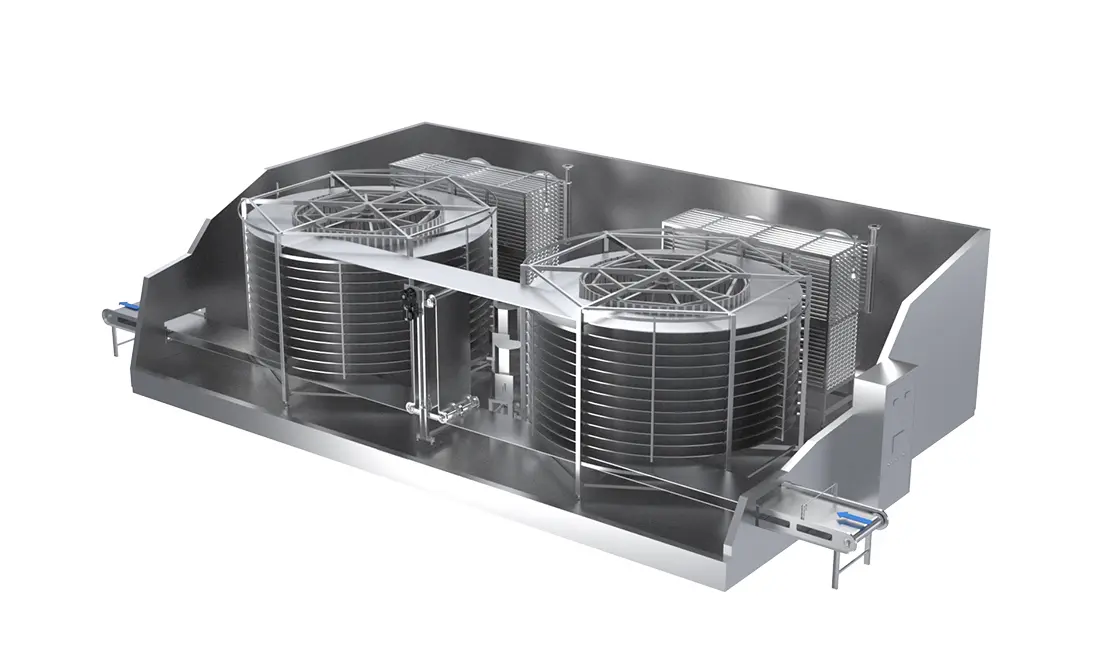
A spiral freezer can only perform as well as the design behind it. Two systems with the same stated capacity may deliver different results when product size, inlet temperature, belt loading, airflow, and production hours are different. For this reason, spiral freezer design should begin with the food and the production line rather than a standard equipment model.
This guide explains the main design decisions, from product data and dwell time to spiral configuration, belt selection, airflow, refrigeration, hygiene, and controls. It also shows food processors how to compare supplier proposals on the same basis.
What Should an Effective Spiral Freezer Design Achieve?
A spiral freezer must remove enough heat to bring the product to its required core temperature within the available production time. However, temperature and capacity are only part of the design target.
An effective system should also:
- Deliver the required hourly output under normal production conditions
- Freeze products evenly across the full belt width
- Limit unnecessary moisture and weight loss
- Handle products without damage, movement, or overlap
- Connect smoothly with upstream and downstream equipment
- Allow practical cleaning, inspection, and maintenance
- Control energy use during full-load and part-load operation
- Maintain stable performance as frost builds on the evaporator
- Meet the safety and hygiene requirements of the production facility
These goals are connected. Increasing belt loading may improve theoretical output, for example, but it can also block airflow and increase freezing time. Higher air velocity may speed up heat removal, but excessive airflow can raise fan energy use or move lightweight products.
Good spiral freezer design balances these factors instead of maximizing one parameter at the cost of the others.
Which Product Data Shapes Spiral Freezer Design?
A supplier needs more than the product name and the required kilograms per hour. The design should be based on the physical condition of the product when it enters the freezer and the result it must reach at discharge.
Product Size, Shape, Weight, and Surface Condition
Product thickness is one of the most important inputs. Heat must travel from the center of the product to its surface before cold air can remove it. A thick meat portion will therefore need more time than a thin patty of the same weight.
The supplier should receive the minimum and maximum product dimensions, not only the average size. Large variations can make it difficult to freeze every piece evenly at one belt speed.
Other relevant details include:
- Weight per piece
- Product density
- Moisture and fat content
- Surface temperature
- Surface stickiness
- Product strength and shape stability
- Coating, breading, glaze, or oil
- Packaged or unpackaged condition
- Tray or container dimensions
Wet, oily, or sticky products may require a different belt surface from dry packaged goods. Delicate products need stable transfers and gentle movement. Lightweight items may also limit the air velocity that can be used without moving them on the belt.

Infeed Temperature and Required Core Temperature
The temperature difference between the product entering and leaving the freezer directly affects the heat load.
A product entering after cooking carries more heat than the same product entering from a chilled room. Variations in the upstream process can also change freezer performance. If some products enter warmer than the design value, the system may need a longer dwell time or a lower belt load.
The required discharge condition should be stated clearly. A surface temperature alone does not confirm that the center is frozen. The design target should normally include:
- Expected infeed temperature
- Maximum possible infeed temperature
- Required discharge core temperature
- Acceptable temperature variation
- Location and method of temperature measurement
These values should be agreed upon before the equipment is sized.
Throughput, Production Hours, and Product Mix
Hourly capacity can be expressed in kilograms per hour, pieces per minute, trays per hour, or another suitable unit. When possible, the supplier should receive both mass flow and piece count.
Piece count helps determine the product pattern on the belt. It shows how many items must fit across the belt and how much space is needed between them. Mass flow is required for the heat-load calculation.
The production schedule is also important. A freezer running one short shift has different frost and cleaning requirements from a system expected to operate continuously for several days.
The design information should include:
- Average and peak hourly output
- Number and length of production shifts
- Required continuous operating time
- Product changeover frequency
- Number of products to be processed
- Seasonal changes in production
- Expected future capacity
A multi-product freezer should be designed around a clear operating range. Designing only for the easiest product may leave the system unable to handle the thickest, warmest, or heaviest item.
How Are Capacity and Dwell Time Built Into Spiral Freezer Design?
Spiral freezer capacity comes from the relationship between heat removal, dwell time, and usable belt area. These elements should be calculated together.
Estimate the Product Heat Load
The product heat load is the amount of heat that must be removed each hour. It depends on product mass, composition, infeed temperature, freezing point, and target discharge temperature.
The calculation should include the heat removed before freezing begins, the heat released as water turns into ice, and the heat removed after the product becomes frozen. Packaging and trays may add further load.
The total freezer load can also include:
- Heat entering through the insulated enclosure
- Warm air entering at the infeed and outfeed
- Heat from fans, motors, lights, and other equipment
- Heat carried by the conveyor belt
- Heat introduced during loading or door opening
- Cooling needed after cleaning or defrosting
A design based only on product weight can therefore underestimate the required refrigeration capacity.
Set Dwell Time and Belt Speed
Dwell time is the period a product remains inside the freezing zone. It is set by the active belt length and belt speed.
The required dwell time can be estimated from reliable product data, freezing calculations, previous production records, or product tests. Testing becomes more important when a product has an unusual shape, uneven thickness, several ingredients, or complex packaging.
Belt speed should provide enough time for the warmest and thickest products to reach the required core temperature. A faster belt raises potential output, but it can cause underfreezing. A slower belt provides more time, but it may reduce capacity and use more energy than necessary.
Variable-speed control allows the freezer to handle different products. However, belt speed cannot correct an undersized evaporator, poor airflow, or excessive product loading.
Select Belt Width, Loading Density, and Number of Tiers
Belt width determines how many products can travel side by side. The number of tiers and the spiral path determine the active belt length.
Not all belt surface should be treated as usable product area. Space may be needed between products and along the belt edges. These gaps protect airflow, product stability, and cleaning access.
Tier spacing must also allow enough room for:
- Maximum product height
- Trays or packaging
- Air to pass over and around the product
- Product guides or edge guards
- Safe movement through the spiral
Adding tiers can increase belt length without greatly increasing the floor footprint. However, more tiers also affect the enclosure height, structure, airflow path, cleaning access, and installation method.
A reasonable design margin can support future changes, but excessive oversizing should be avoided. A larger freezer has more metal, belt, and air to cool. This can raise the purchase price and operating load when production remains low.
Which Spiral Freezer Configuration Fits the Factory?
After capacity and dwell time are known, the equipment must be arranged around the available building space and the surrounding process equipment.
Single or Double Spiral
A single spiral uses one spiral structure and normally follows a simple upward or downward product path. It can be suitable when the required belt length and capacity fit within one spiral.
A double spiral uses two spiral sections within the system. It can provide a longer belt path or support higher production within a compact area. It may also offer more options for matching the infeed and outfeed positions.
The choice should not be based on capacity alone. The supplier should also consider:
- Required dwell time
- Available floor area
- Ceiling height
- Product transfer points
- Cleaning access
- Conveyor direction
- Installation and maintenance space
A well-sized single spiral may be more practical than an unnecessarily complex double spiral. In other cases, a double spiral can fit a long freezing path into a factory where floor space is limited.
Up-Running or Down-Running
In an up-running design, the product enters at a lower level and leaves at a higher level. In a down-running design, the product enters high and moves downward before discharge.
The correct direction depends mainly on the layout of the production line. The freezer may need to receive products from an oven, fryer, forming line, or preparation conveyor and then deliver them to packaging, inspection, or cold storage stalls.
The design should minimize unnecessary elevators and transfers. Each extra transfer adds cost and creates another point where products can move, fall, overlap, or become damaged.
Cleaning flow and separation between raw and ready-to-eat areas should also be considered when deciding the product path.
Infeed, Outfeed, Footprint, and Service Access
Spiral freezers can use straight, 90-degree, or 180-degree conveyor arrangements. The selected layout should match the actual product flow rather than force the factory to make difficult conveyor changes later.
The equipment footprint shown on a proposal is not the same as the total installation space. Additional space is needed for:
- Infeed and outfeed conveyors
- Access doors
- Evaporator and fan maintenance
- Belt inspection and repair
- Cleaning personnel
- Drainage and sanitation equipment
- Electrical panels and control cabinets
- Refrigerant pipes and valves
- Safe walkways and emergency access
Engineers should also check floor loading, foundation requirements, ceiling obstructions, columns, ventilation ducts, and utility routes. These limits are much easier to solve during layout design than after the equipment has been manufactured.
How Do Belt and Drive Choices Affect Spiral Freezer Design?
The belt carries every product through the freezer. Its material, open area, strength, and drive method affect product handling, airflow, hygiene, and long-term maintenance.
Belt Material, Open Area, and Product Support
Stainless steel mesh belts provide high strength and an open structure for air circulation. They are often used for unpackaged foods, heavy loads, and products that benefit from airflow through the belt.
Plastic modular belts can provide a wider support surface and may suit products that need stable contact. Their suitability depends on the product, operating temperature, cleaning method, and required belt strength.
The belt opening should be small enough to support the product but open enough to allow effective airflow and drainage. A belt selected only for maximum open area may mark or damage soft products. A surface that is too closed may restrict airflow and hold water during cleaning.
The belt material should also be compatible with cleaning chemicals, food residues, operating temperature, and the expected mechanical load.
Drive Method and Belt Tension
Traditional spiral systems use a rotating drum or cage to help move the belt. Friction, an auxiliary drive, and the tensioning system work together to control belt movement.
Low-tension designs aim to reduce the pulling force on the belt. Lower belt tension can limit wear and support smoother operation, but correct adjustment and alignment are still required.
Self-stacking designs use belt links that support the tiers above them. This can remove some internal support rails and create a compact structure. The design may improve access in some areas, but the belt, drive, product load, and cleaning system must still be matched carefully.
No drive system is best for every application. The correct choice depends on belt length, product weight, speed, hygiene needs, maintenance skills, and the space available.
Product Stability at Transfers and Turns
Products should enter the spiral in a controlled pattern. Uneven loading can create crowded areas, open spaces, and different freezing conditions across the belt.
The infeed conveyor should match the spiral belt speed. Guides may be needed to control product position, but they should not damage the product or create difficult cleaning points.
Special attention is needed for:
- Round products that can roll
- Oily products that can slide
- Soft products that can deform
- Lightweight products affected by airflow
- Trays that must remain aligned
- Products close to the belt edge
The discharge transfer should also be short and stable. A product that freezes correctly can still be damaged by a poor transfer into the packaging line.
How Does Airflow Design Affect Freezing Uniformity?
Cold air must reach the product before it can remove heat. A low freezer temperature alone cannot provide uniform freezing if the airflow path is blocked or uneven.
Choose an Airflow Pattern for the Product
Common spiral freezer airflow arrangements include horizontal, vertical, and combined patterns.
Horizontal airflow moves across the belt tiers and product surfaces. Vertical airflow moves through the belt stack. Combined arrangements use ducts and baffles to control air movement in more than one direction.
The best pattern depends on:
- Product height and shape
- Product weight
- Belt opening
- Tier spacing
- Product arrangement
- Loading density
- Evaporator and fan position
There is no single airflow pattern that is always more efficient. The useful question is whether cold air reaches each product surface at a suitable and consistent velocity.
Balance Air Velocity, Distribution, and Belt Loading
Higher air velocity can improve heat transfer by removing the warmer air layer around the product. However, increasing fan speed does not solve every freezing problem.
Excessive velocity can increase fan power, move light products, dry exposed surfaces, or send more air through open belt areas instead of through the product load. Poorly placed baffles may also create high-speed zones beside low-flow areas.
Product loading and airflow must therefore be designed together. Items should have enough space for air to move around them. Stacking or crowding products may raise the belt load per square metre but reduce actual freezing capacity.
Airflow analysis can help locate areas with uneven velocity or temperature. Final performance should still be checked under realistic product loading because an empty freezer does not represent normal production.
Control Air Infiltration at the Infeed and Outfeed
Every conveyor opening allows some warm air and moisture to enter the freezer. This adds refrigeration load and can increase frost on the evaporator, enclosure, belt, and nearby floor.
The size and position of the openings should be kept practical for the product. Air shrouds, dry-air systems, vestibules, or other controls may be used when moisture infiltration is a major concern.
The pressure conditions around the freezer also matter. Strong air movement in nearby processing rooms can push humid air through the openings even when the openings appear small.
Controlling infiltration can improve temperature stability, reduce frost, protect worker safety, and extend the operating time between defrost cycles.
How Should Refrigeration and Defrost Support Spiral Freezer Performance?
The spiral conveyor and the refrigeration system cannot be designed separately. The evaporator, fans, refrigerant supply, airflow, and production schedule must support the same heat load.
Match Refrigeration Capacity to the Actual Heat Load
Refrigeration capacity should be stated at the operating conditions required by the freezer. A compressor’s nominal capacity at one temperature may be very different from its available capacity at a lower evaporating temperature.
For a new system, the refrigeration designer should confirm the heat load, evaporating temperature, refrigerant, compressor capacity, pipe sizing, liquid supply, and control method.
When a spiral freezer is connected to an existing refrigeration system, the engineer should also review other loads operating at the same time. Spare capacity during one shift does not always mean that enough capacity is available during peak production.
Refrigerant selection depends on project size, existing factory systems, local rules, energy goals, service resources, and lifecycle cost. The freezer and refrigeration teams should agree on the design conditions before equipment production begins.
Coordinate the Evaporator, Fans, and Air Path
The evaporator cools the circulating air, while the fans move that air through the product zone. Increasing one component without checking the others may not improve performance.
Evaporator design should consider:
- Required heat-transfer area
- Refrigerant circuit arrangement
- Air pressure drop
- Tube and fin materials
- Kanat aralığı
- Frost accumulation
- Cleaning access
- Drainage after defrost
Fin spacing may be varied to manage frost and airflow through the coil. The correct arrangement depends on moisture load and required operating time.
Fan selection should provide the required airflow against the resistance of the evaporator, ducts, baffles, belt stack, and product load. The complete air path should be considered instead of selecting fans by free-air volume alone.
Plan Defrost Around the Production Schedule
Frost acts as insulation on the evaporator and restricts airflow between the fins. As frost builds, freezing conditions may change even if the displayed room temperature appears stable.
The defrost strategy should match the required continuous runtime. Available methods can include water, hot gas, electric, air-based, or sequential systems, depending on the refrigeration and freezer design.
Systems that reduce frost during production may extend runtime, but they do not remove the need for full defrosting, cleaning, and inspection. The design should provide enough drainage and recovery time before food production restarts.
Operators should be able to monitor signs of frost-related performance loss, such as changes in air pressure, coil temperature, fan load, or product discharge temperature.
How Do Hygiene, Controls, and Safety Affect Long-Term Operation?
A freezer may meet its thermal target and still create high operating costs if it is difficult to clean, inspect, or control. These requirements should be included in the mechanical design from the beginning.
Hygienic Materials, Welds, Drainage, and Access
Food-zone materials should resist corrosion and repeated washdown. Smooth surfaces and suitable welds help reduce areas where food residue and water can collect.
The internal floor should allow cleaning water to move toward the drains. Poor drainage can leave standing water, which may freeze during startup and create hygiene or safety problems.
Open access is equally important. Cleaning and maintenance teams should be able to reach the belt, drum, supports, evaporator area, floor, walls, and product transfer points.
A compact footprint should not be achieved by removing the space needed to clean or repair the machine.
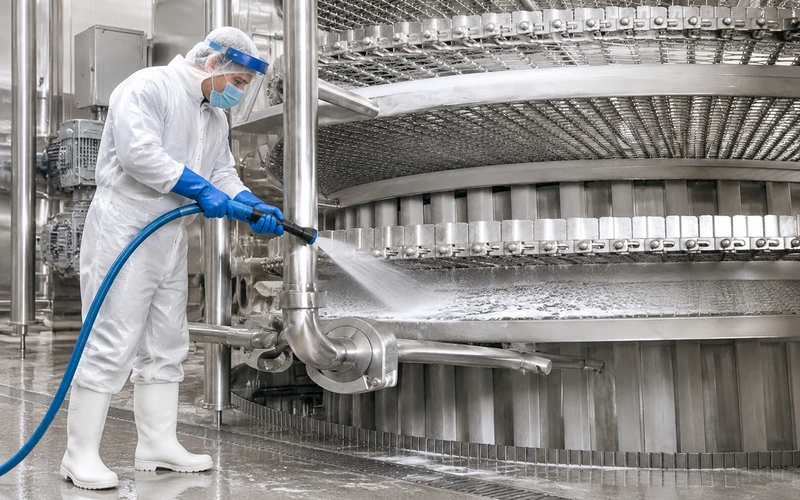
Belt Washing and CIP Options
A belt washer can remove product residue from the returning conveyor. Its design should match the type of soil, belt material, and production schedule.
A Clean-in-Place system can automate parts of the wash and sanitation cycle. However, CIP performance depends on spray coverage, water pressure, chemical concentration, contact time, temperature, and drainage.
CIP should not be treated as a replacement for access and inspection. Areas outside the spray pattern may still require manual cleaning. The cleaning process should be validated for the products and sanitation program used by the factory.
The design should also protect motors, bearings, sensors, and electrical parts from wash water and cleaning chemicals.
PLC Controls, Sensors, Alarms, and Safety Devices
The control system should make the freezer easier to operate without hiding important process information.
Useful control functions may include:
- Adjustable belt speed
- Fan and refrigeration control
- Product-specific operating recipes
- Multi-zone temperature monitoring
- Runtime and defrost tracking
- Product discharge temperature records
- Fault history and alarms
- Remote diagnostic support
Mechanical protection may include belt-flip detection, belt alignment monitoring, torque protection, speed monitoring, and emergency stops. Access doors may require interlocks based on the system design and local safety rules.
Controls can improve stability, but they cannot compensate for poor airflow, incorrect belt loading, or insufficient refrigeration capacity.
How Should Buyers Compare Spiral Freezer Design Proposals?
Two quotations may show the same hourly capacity while using very different assumptions. Buyers should first confirm that every supplier is designing for the same product and operating conditions.
Compare Proposals on the Same Design Basis
The following information should be consistent across all proposals:
| Design Basis | Information to Match |
| Ürün | Type, dimensions, weight, composition and packaging |
| Sıcaklık | Normal and maximum infeed temperature, required core temperature |
| Production | Average and peak throughput, shift length and continuous runtime |
| Belt loading | Product pattern, spacing, pieces across and load per belt area |
| Freezer layout | Single or double spiral, belt direction, infeed and outfeed positions |
| Thermal design | Dwell time, air conditions, refrigeration load and design margin |
| Construction | Belt, structure, enclosure, floor and food-zone materials |
| Project scope | Refrigeration, controls, CIP, installation, testing and training |
Without a common design basis, a lower price may simply represent a smaller belt, shorter dwell time, lighter construction, or narrower supply scope.
Confirm Performance and Supply Scope
A capacity guarantee should state the exact product and operating conditions. A broad statement such as “2,000 kg/h” has limited value without product thickness, infeed temperature, discharge temperature, and belt-loading assumptions.
The buyer should also confirm which items are included:
- Spiral conveyor and enclosure
- Evaporator and fans
- Refrigeration equipment
- Electrical panels and field wiring
- Belt washer or CIP
- Infeed and outfeed conveyors
- Refrigerant piping
- Installation and supervision
- Commissioning and product trials
- Operator and maintenance training
Clear supply limits help prevent unexpected costs during installation.
Evaluate Total Cost of Ownership
Initial equipment price is only one part of the investment. The design also affects:
- Refrigeration and fan energy
- Product weight loss
- Cleaning labour and water use
- Defrost frequency
- Production downtime
- Belt and component life
- Spare-parts requirements
- Maintenance access
- Technical support
Energy figures should be compared under the same production load and temperature conditions. Estimated savings without a clear calculation basis should be treated carefully.
Product yield also deserves attention. A small reduction in moisture loss can have a meaningful financial effect on a high-volume line, but the expected result should be supported by realistic product conditions and testing.
Check Testing, Installation, and Commissioning
Factory testing can confirm belt movement, controls, alarms, motors, sensors, and cleaning functions before shipment. It can also identify alignment or assembly problems while the equipment is still at the manufacturer’s facility.
Final freezing performance normally needs to be confirmed during site commissioning with the actual product and refrigeration system. Testing should check:
- Product feed pattern
- Belt speed and dwell time
- Temperature across the belt width
- Product core temperature at discharge
- Performance during normal production
- Alarm and safety functions
- Cleaning and drainage
- Operation as frost develops
The acceptance method should be agreed upon before the order is placed.
Frequently Asked Questions About Spiral Freezer Design
Can a Spiral Freezer Be Expanded After Installation?
Some operating capacity may be gained through better product loading, airflow adjustment, control changes, or improved refrigeration performance. However, major expansion is often limited by the original belt length, tier count, structure, enclosure, drive load, evaporator, and refrigeration capacity.
If future expansion is expected, it should be discussed during the first design stage. The supplier can then evaluate whether space, controls, refrigeration connections, or conveyor layouts should be prepared in advance.
What Happens If the Product Changes After the Design Is Approved?
A change in product thickness, weight, infeed temperature, moisture, packaging, or belt pattern can change both freezing time and capacity.
Minor changes may be handled with a different operating recipe or belt speed. Larger changes may require a new heat-load calculation, product test, or mechanical modification. The supplier should review the revised product data before confirming performance.
Can an Existing Refrigeration System Support a New Spiral Freezer?
It may be possible, but the answer cannot be based only on compressor motor power or stated system capacity.
An engineer should check the available refrigeration capacity at the freezer’s required evaporating temperature. The review should also cover current factory loads, refrigerant supply, pipe sizing, pumps, valves, control strategy, and peak operating conditions.
A refrigeration system with little reserve capacity may hold the required air temperature when empty but fail to maintain it under full product load.
When Is a Product Freezing Test Needed Before Final Design?
A freezing test is useful when reliable product data is not available or when the food has an unusual shape, uneven thickness, mixed ingredients, a heavy coating, or complex packaging.
Testing can help confirm:
- Required dwell time
- Suitable air conditions
- Product spacing
- Discharge core temperature
- Surface quality
- Nem kaybı
- Expected hourly capacity
The closer the test conditions are to real production, the more useful the results will be for final equipment sizing.
A Spiral Freezer Should Be Designed as One System
Successful spiral freezer design depends on how well the product, belt, airflow, evaporator, refrigeration system, controls, and factory layout work together. Increasing belt area or lowering air temperature cannot correct every design problem. Each change affects other parts of the system.
Food processors should begin with accurate product and production data, then compare proposals using the same design basis. Attention to hygiene, maintenance, frost management, and project scope can also prevent costs that may not appear in the initial equipment price.
Square Technology designs industrial spiral freezer systems around product requirements, target capacity, available space, and production schedules. Food processors planning a new line or an equipment upgrade can provide their product specifications and factory layout for a tailored design review.