Food processors face rising costs, stricter regulations, and higher demand for consistent quality. Small inefficiencies—like uneven line speeds or unplanned downtime—can quickly eat into profits.
Optimizing a line means boosting output and quality by reducing waste, improving equipment uptime, and streamlining every step from raw input to packaging. Modern tools—automation, predictive maintenance, and AI-based quality control—enable quick, data-driven adjustments.
Well-designed layouts and trained operators keep production moving smoothly, while combining technology with skilled teams maximizes productivity and control.
Why Does Efficiency Matter More Than Ever Today?
Efficiency measures how well a processing line converts energy, materials, and labor into finished food. It determines whether you can meet safety standards, maintain product consistency, and stay profitable amid rising costs.
Energy prices have risen over 30% in the past decade, directly impacting production budgets. Food processing consumes significant energy for heating, cooling, and automation, so every wasted kilowatt-hour reduces margins.
Labor shortages add pressure, while safety and traceability regulations keep tightening. Unoptimized manual steps increase errors, waste, and rework. Automating tasks like packaging or seasoning transfer can maintain output even with a smaller workforce.
Around 75% of bottlenecks come from process design, not equipment. Focusing on layout, scheduling, and workflow often yields bigger gains than buying new machines.
Improved efficiency also ensures reliable, safe, and uniform products, making output more predictable and helping meet demand without overspending on energy or labor.
Where Should You Start—Do You Have the Right Baseline & KPIs?
A baseline provides a snapshot of how your production system performs before making changes, showing where you stand and allowing you to track real improvements.
The right KPIs focus on measurable, repeatable data rather than gut feelings. Core efficiency KPIs include:
- Line Throughput (units/hour): Tracks output against targets.
- OEE (Overall Equipment Effectiveness): Combines availability, performance, and quality.
- Waste / Rejection Rate (%): Highlights defects and process consistency.
- Energy Consumption per Unit: Monitors energy efficiency.
- MTBF / MTTR: Shows equipment reliability and repair speed.
- Changeover Time: Measures flexibility and product-switch efficiency.
Collect at least five consistent readings to establish a reliable baseline. Tools like Value Stream Mapping (VSM) help identify bottlenecks and waste in transport, waiting, or excess buffering.
Benchmarking against industry standards—60–70% OEE for typical lines, 85%+ for top performers—provides clear targets for improvement.
Which Equipment Upgrades and Maintenance Actions Deliver the Biggest Impact?
Improving throughput, cutting energy use, and minimizing downtime are the main goals of equipment upgrades and maintenance actions.
- Upgrade: Focus on bottleneck machines like mixers, freezers, and packaging units.
- Техническое обслуживание: Preventive and predictive plans reduce unplanned stoppages.
- Гигиенический дизайн: Easy-clean parts and CIP/SIP systems cut cleaning time and speed product changeovers.
Prioritize High-Impact Equipment Upgrades
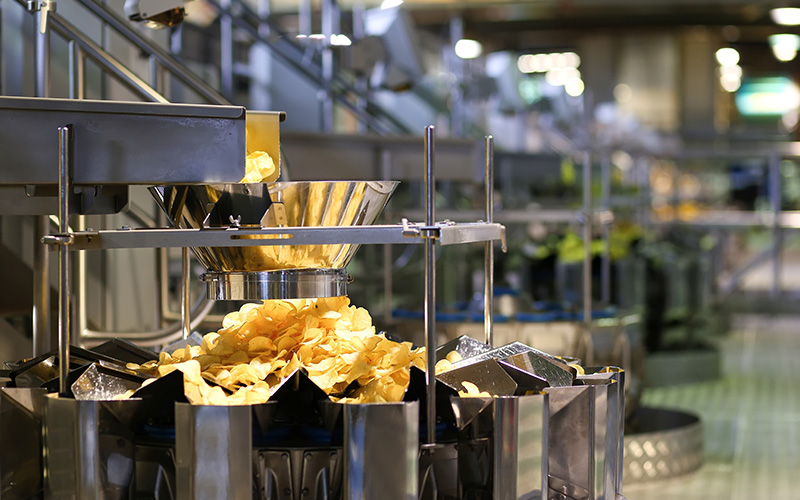
The biggest gains in efficiency come from upgrading bottleneck machines—mixers, freezers, weighers, and packaging units—since delays here slow the entire line.
Swapping old compressors or adding variable-speed drives (VSDs) can cut energy use by 15–25%. For instance, modern ammonia or CO₂ refrigeration systems adjust compressor speed to match demand, maintaining cooling while using less power.
Automated portioning and check-weighing systems with ±0.5% accuracy reduce giveaway and rework, keeping throughput steady and reducing operator intervention.
Focus investment on modules that most affect uptime first, rather than replacing the whole line:
- Freezing/Chilling: 15–25% less power use, lowering utilities.
- Mixing/Batching: Better product uniformity and fewer rejects.
- Packaging: Faster cycles, increasing daily output.
Implement Preventive & Predictive Maintenance
Regular maintenance prevents small issues from causing major stoppages and keeps production reliable.
A preventive maintenance plan includes weekly bearing lubrication, monthly belt inspections, and quarterly probe calibrations. Plants following these schedules often see 30–40% less unplanned downtime.
Predictive maintenance goes further by using IoT sensors to monitor vibration, motor amperage, and temperature, spotting wear before failures occur. For example, if a bearing shows increased vibration, it can be replaced during planned downtime, avoiding emergency repairs.
Improve Hygienic Design to Reduce Cleaning Downtime
Designing equipment for easy cleaning significantly cuts downtime and keeps production flowing.
Quick-release parts, sloped surfaces, and 316L stainless steel enclosures prevent debris buildup and withstand harsh cleaners, extending equipment life.
Clean-in-Place (CIP) or Steam-in-Place (SIP) systems allow tanks, pipes, and conveyors to be sanitized without disassembly. Plants using these systems report 20–50% shorter cleaning cycles, freeing hours for production each day.
Slot drains and continuous weld seams reduce manual scrubbing, enabling faster product changes while maintaining hygiene and food safety.
How Can You Improve Line Layout and Material Flow?
Optimizing line layout and material flow helps reduce wasted steps, prevent bottlenecks, and minimize downtime.
- Mapping: Track actual material and operator movement to identify inefficiencies.
- Redesign: Arrange workstations in process order and use straight-line or U-shaped layouts to cut walking distance.
- Automation: Introduce machines like checkweighers, sorters, and palletizers where ROI is proven to reduce errors and free labor.
Map the Current Material and People Flow
Track how materials and operators move during a full cycle. Spaghetti diagrams reveal crisscrossing paths, bottlenecks, and dead zones. Measure travel distance, handling time, and waiting points to spot inefficiencies and cross-contamination risks.
Redesign for Fewer Steps, Less Movement, Faster Changeovers
Arrange tasks in process order—raw materials → prep → processing → thermal steps → packaging—to reduce extra movement. Straight-line or U-shaped layouts cut walking distance by up to half. Applying SMED principles moves prep outside active changeover time, reducing downtime from 40 minutes to under 10.
Introduce Automation Where ROI Is Proven
Automate only where ROI is clear, such as weighers, optical sorters, vision inspection units, and robotic palletizers. Automation improves accuracy, reduces errors, and frees staff for inspection or quality checks. Examples:
- Checkweighers: Cut weighing errors by up to 90%
- Optical sorters: Detect foreign objects, lowering recall risks
- Palletizing robots: Pay for themselves in 2–3 years on a three-shift schedule
How Do You Strengthen Quality Control Without Slowing the Line?
Effective quality control ensures safe, consistent products while keeping the production line running smoothly.
- Critical Control Points: Focus checks on the riskiest stages like heating, cooling, and packaging using HACCP thresholds.
- Smart Detection: Use X-ray, metal detectors, and vision systems to catch defects instantly without delaying production.
- Traceability: Assign batch codes or digital tracking to every product for fast audits, recalls, and decision-making.
Set Up Critical Control Points (HACCP)
HACCP plans identify stages where contamination or variation may occur, such as heating, cooling, or packaging, ensuring food safety.
Each critical point has defined thresholds for temperature, pressure, and contamination risk—for example, logging pasteurization temperature to kill pathogens without affecting texture.
Focusing on key control points rather than inspecting every product saves time while covering the riskiest stages. Automated sensors continuously record data, allowing operators to respond quickly if something is off, minimizing manual sampling delays and maintaining batch-to-batch consistency.
Use Smart Detection Tools
Modern production lines employ X-ray systems, metal detectors, and machine vision cameras to inspect products directly on the conveyor, each detecting different issues.
- X-ray systems: catch dense foreign objects like bones or stones.
- Metal detectors: identify small ferrous and nonferrous particles.
- Vision systems: monitor shape and color for consistent appearance.
Automated inspection replaces random checks with continuous scanning, helping plants reduce rework or scrap by 20–30%. Detection occurs in milliseconds, improving safety without slowing the line or adding labor.
Improve Traceability Across the Entire Line
Traceability links each product to its origin, ingredients, and processing history, ensuring faster problem resolution and compliance.
Batch coding, barcodes or QR codes, and digital production logs give each unit a unique identifier, so quality issues can be traced in minutes instead of hours.
Real-time tracking software compiles this data for audits, recalls, and reporting, speeding up decision-making and reducing waste during hold-and-release events.
How Can Your Workforce Become a Driver of Efficiency?
A well-trained and engaged workforce directly reduces downtime, waste, and rework, boosting overall line performance.
- Continuous Training: Keep operators and supervisors updated on standards, sanitation, and troubleshooting. Cross-training allows staff to cover multiple stations, maintaining flow during absences or demand changes.
- Lean Tools: Implement 5S, visual boards, and Kanban systems to make workflow problems visible and easy to fix, creating safer and more organized workspaces.
- Continuous Improvement Culture: Engage employees in daily Gemba walks and suggestion programs. Lean adoption can yield 10–25% efficiency gains through local problem-solving and peer accountability, leading to more consistent output and fewer defects.
What Digital Tools Can Help You See and Solve Problems Faster?
Digital tools collect and analyze production data so teams can spot issues early. In food processing, they give managers a real view of line performance, helping prevent downtime or waste.
Real-time monitoring systems like IoT sensors and MES track temperature, humidity, and equipment speed. Operators can see abnormal readings—like a temperature spike—before it affects product safety, enabling faster fixes and fewer ruined batches.
Analytics platforms use statistics and machine learning to find hidden patterns, identifying short interruptions, energy spikes, or slowdowns tied to machines. Maintenance decisions are based on evidence, not guesswork.
Supply chain tools integrate inventory, supplier, and scheduling data. If ingredient stock falls below a threshold, the system can trigger an automatic restock, helping avoid unplanned stops and keeping deliveries on track.
What Is the Best Way to Start Your Optimization Journey Today?
Optimization improves every step in a production line to boost performance and cut waste. In food processing, use real data, clear benchmarks, and proven methods for measurable results.
Start by setting a performance baseline: record cycle times, downtime causes, and energy use for each workstation. Data from sensors or manual logs helps identify where the biggest delays or losses occur.
Next, check equipment and line design—conveyor speeds, filler precision, and cleaning cycles—to see if slowdowns come from worn-out machines, poor layouts, or wrong step sequences. Then focus on quality control and workforce performance. A good QC checklist ensures safety and consistency, while training operators reduces variation and improves efficiency.
Digital tools like process mapping and low-code automation make it easier to track changes over time. Real-time dashboards flag bottlenecks before they disrupt production. Start with a pilot area, usually the worst bottleneck, to build experience and momentum.
Initial action checklist:
- Record baseline process data
- Identify biggest delays or losses
- Check key equipment and layout
- Review QC steps and operator training
- Test digital monitoring or automation in a pilot area
Часто задаваемые вопросы
How to improve the efficiency of a production line?
A production line runs better when downtime is low and workflows are standardized. Installing IoT sensors gives real-time data on equipment temperature, speed, and performance.
When operators see early warnings for wear or imbalance, they can plan maintenance before things break down. Adding automated conveyors and robotic handling keeps cycle times short and cuts manual mistakes.
This leads to more output per shift and fewer defective products at the next stage.
How to improve the efficiency of a process?
Efficiency comes from finding process bottlenecks and digitizing repetitive tasks. Process-mapping tools show where delays pop up between steps so managers can redesign workflows that actually move faster.
Predictive analytics uses past data to predict when machines need care. Maintenance happens before failure, so there’s less unplanned downtime.
For workers, that means fewer interruptions and a steadier production flow.
How can the efficiency of food production be improved?
Food production gets better when waste and rework drop. AI-based quality control systems inspect ingredients and finished products all the time.
These systems catch small issues early, so less material gets rejected or reprocessed. Installing energy-efficient refrigeration and variable-speed drives cuts power use without hurting safety or quality.
That way, the plant makes more sellable food for less cost per unit. Not perfect, but it’s a real step forward.
How to make an assembly line more efficient?
If you want a more efficient assembly line, try blending automation with human oversight. Digital standard operating procedures (SOPs) walk workers through each step in the right order.
This approach helps keep things consistent, even for folks who are new on the job.
Modular equipment design can make product changeovers a lot faster. With quick-release fittings or programmable settings, operators switch from one product batch to another in just minutes.
For places making more than one item, that kind of flexibility really boosts the total output.