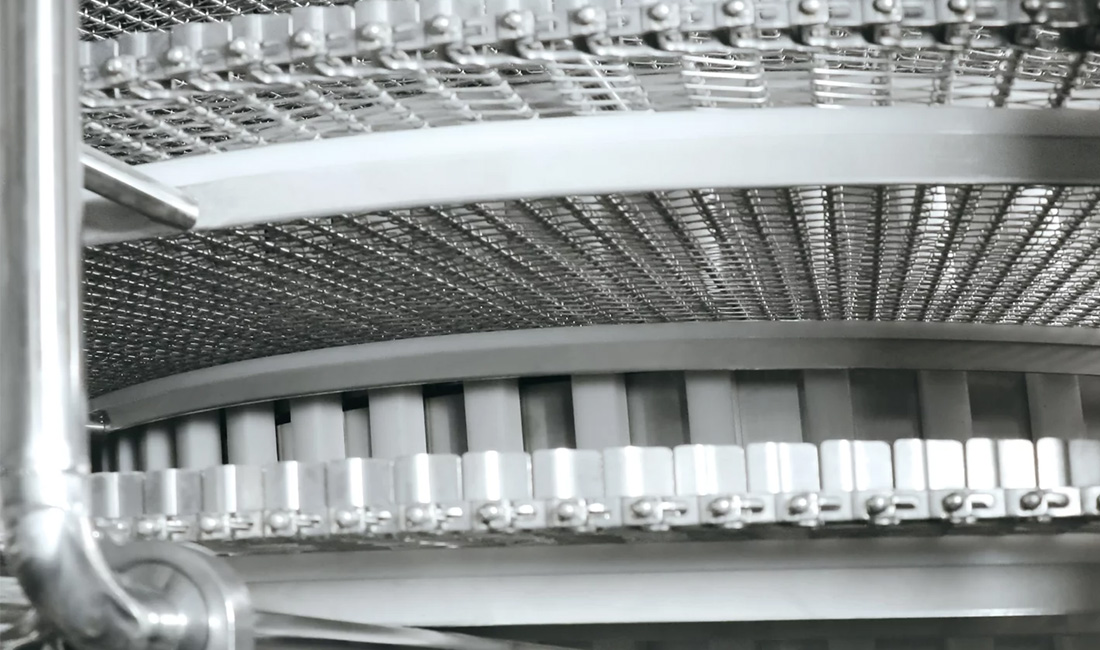
Clean-in-Place (CIP) is an automated cleaning method that lets food processing equipment, like congeladores en espiral, get sanitized without being taken apart. It works by spraying water and cleaning solutions in a controlled way to wash away residues and microorganisms from inside the freezer. When CIP works well, you get steady hygiene, smoother operations, and it’s a lot easier to meet tough food safety standards.
Effective cleaning in spiral freezers depends on full spray coverage, the right chemistry, and proper validation. Well-designed nozzles and pressure help the solution reach every surface, while neutral detergents and controlled disinfectants remove buildup without harming stainless steel. With data checks, temperature readings, and visual inspections to verify results, processors can keep the system clean, consistent, and food-safe.
Why CIP Is Essential in Food Processing Operations
CIP is essential because spiral freezers quickly accumulate food residues, moisture, and microbes that must be removed to protect product safety.
Spiral freezers process high volumes of food, and residues, fat, and ice build up fast. Without regular, validated cleaning, microbial risks rise and freezing efficiency drops. CIP provides controlled, repeatable cleaning without disassembly, supporting HACCP requirements and helping facilities meet FDA and USDA hygiene standards. Automated cycles also record key parameters—time, temperature, pressure, and chemical levels—ensuring reliable results for audits and continuous improvement.
Why CIP Outperforms Manual or Traditional Cleaning Methods
CIP outperforms manual cleaning because it reaches enclosed, complex areas that are difficult or unsafe for workers to clean thoroughly.
A typical CIP cycle uses pre-rinse, wash, rinse, and sanitize steps to remove soils, detergents, and microbes. Spiral freezers rely on rotating nozzles to reach tight, hard-to-access spaces inside the enclosure—areas manual cleaning often misses. While small sections like belt returns or support frames may need quick manual checks, most internal surfaces are cleaned more consistently and efficiently by CIP than by manual methods.
Why Automation Makes CIP the Preferred Solution for Spiral Freezers
Automated CIP is preferred because it guarantees consistent cleaning performance while reducing labor, downtime, and operational risks.
CIP automation controls flow, concentration, pressure, and spray duration from a central panel. Sensors track conditions in real time, and data logs document each cleaning run. Some systems can recover water or chemicals to save resources. By delivering precise detergent dosing and even spray coverage, automated CIP protects equipment reliability, extends asset life, and minimizes human error during cleaning.
How to Optimize Spray Coverage in a Spiral Freezer?
Spray coverage in a spiral freezer can be optimized by strategically placing nozzles, ensuring even distribution of cleaning solution, and controlling water flow and pressure to clean thoroughly without wasting resources.
Getting spray coverage right in a spiral freezer’s Clean-in-Place (CIP) system comes down to where you put the spray devices, how evenly the cleaning solution spreads, and how well you control water flow and pressure. Dialing these in means you clean thoroughly but don’t waste chemicals or water.
How to Place and Design Nozzles?
Nozzles should be selected and positioned based on type, spray angle, and mounting location so that all surfaces are reached efficiently, minimizing the need for manual cleaning.
A nozzle’s design and location determine whether the cleaning solution hits all surfaces. Static spray balls release fluid through fixed holes, while rotating nozzles create moving patterns and reach more areas in large chambers. Engineers size and place nozzles based on freezer dimensions; one nozzle often covers about 2.5 meters. Overlapping spray patterns prevent missed spots. Key factors include nozzle type, spray angle, and mounting position. Good setup reduces the need for manual cleaning.
When setting up nozzles, think about:
- Nozzle type: static or rotating
- Spray angle: shapes the coverage
- Mounting location: top, side, or bottom
If you set things up well, detergents and rinse water move over all surfaces, so you don’t need much manual cleaning.
How to Ensure Complete Coverage?
Complete coverage can be ensured by arranging nozzles to create overlapping zones, using tracers or markers to check for blind spots, and making adjustments as needed.
If spray doesn’t reach every area, residues build up in corners and joints. Operators use tracers or fluorescent markers to check coverage. In spiral freezers, rotating nozzles arranged vertically create overlapping zones to avoid gaps. Regular checks of nozzle direction and rotation help maintain even coverage. If blind spots appear, you can add nozzles, adjust angles, or extend movement.
How to Control Flow and Pressure?
Effective flow and pressure control is achieved by maintaining stable pump operation, using appropriate pressure and flow rates, and monitoring with sensors to ensure consistent cleaning without wasting water or damaging equipment.
Flow and pressure determine cleaning strength. Low flow weakens washing; excessive pressure wastes water or risks damage. Static nozzles typically use 20–30 gpm at 20–30 psi, while rotating systems may use less flow but cover more area. Pumps must keep flow stable across circuits for consistent chemical distribution. Using uniform hose sizes and avoiding sharp bends maintains smooth operation. Sensors that track flow and pressure help detect clogs or pump wear early, keeping cleaning efficient.
How Does the Chemistry of CIP Systems Work?
CIP systems clean spiral freezers by using appropriate chemicals at controlled concentrations to remove soils, residues, and microbes effectively while following HACCP and cGMP safety practices.
CIP systems rely on chemical action to remove soils, residues, and microbes without scrubbing. Choosing suitable chemicals, keeping concentrations accurate, and following HACCP/cGMP safety practices are all essential.
Selection of Detergents and Sanitizers
CIP uses alkaline, acidic, or neutral detergents based on the type of residue. Alkaline cleaners like sodium hydroxide break down fats and proteins, while acids such as nitric or phosphoric acid remove mineral scale. Surfactants help solutions spread, and emulsifiers or dispersants keep soils suspended. Enzymes target biofilms by breaking down proteins and carbs. After cleaning, sanitizers like peracetic acid or chlorine-based agents kill remaining microbes without damaging surfaces or leaving excessive residues.
Managing Chemical Concentration and Compatibility
Effective CIP depends on the right detergent strength, time, and temperature. Too weak leaves residues; too strong risks corrosion or foaming. Modern systems use sensors and controlled dosing to stay precise. Chemicals must match equipment materials—stainless steel tolerates most, but plastics and seals may not. Operators confirm compatibility with data sheets. Routine validation and records ensure each cycle meets HACCP and cGMP requirements.
Safety Measures for Chemical Handling
CIP chemistry—acids, bases, oxidizers—require strict safety controls. Workers need PPE like gloves, goggles, and face shields. Clear labels and color-coded lines reduce mistakes. Good ventilation removes vapors from tanks and enclosed areas. Emergency showers and eye-wash stations must be accessible and tested. Automated dosing reduces manual contact, and regular training on spills, first aid, and PPE keeps operations safe and compliant.
How to Validate Cleaning in Spiral Freezers?
Cleaning in spiral freezers can be validated by confirming that the CIP process effectively removes product residues, soils, and microbes while ensuring chemicals are fully rinsed and regulatory standards are met.
Cleaning validation checks if the clean-in-place (CIP) process for spiral freezers actually removes product residues, soils, and microbes so you meet safety and regulatory standards. It’s all about confirming cleaning coverage, making sure chemicals are rinsed off, and staying in line with cGMP and HACCP requirements for hygienic design and operation.
Methods for Verifying Cleaning Effectiveness
Validation combines visual checks, test markers, and analytical methods. Operators often start with visual inspection—looking for dirt, foam, or puddles. For multi-use systems, objective checks are needed. Acceptance criteria depend on product risk, including residue thresholds, microbial counts, or detergent levels. Common approaches include:
- Visual inspection for quick feedback.
- Rinse sampling to check for soluble residue in the last wash water.
- Swab sampling for those annoying, hard-to-reach spots.
- Analytical testing to make sure trace contaminants stay below safety limits.
Riboflavin and Visual Coverage Tests
Riboflavin tests verify that spray nozzles cover all surfaces. A fluorescent solution is applied, the wash run, then inspected under UV light. Glowing spots indicate missed areas. Technicians adjust nozzle angles, pressure, or detergent as needed. Riboflavin is safe, rinses easily, and can be repeated. Visual coverage checks complement this, highlighting shadow zones or gaps, especially on belt edges, drum interiors, and evaporator coils.
Sampling and Analytical Procedures
Sampling confirms that contaminants are removed from surfaces and rinse water. Design targets both typical and worst-case locations, like under conveyors or tight fittings. Common methods:
| Method | Description | Use Case |
| Swab Sampling | Wipes a measured area with a sterile pad to pick up residues | Flat or uneven surfaces |
| Rinse Sampling | Collects final rinse water for chemical or microbial checks | Internal piping and tanks |
| Direct Observation | Just looks for visible cleanliness | Single‑product equipment |
| Placebo Testing | Runs a fake product batch to test for carryover | Complex or multi‑product systems |
Samples are analyzed using validated methods (HPLC, GC/MS, LC/MS) that detect at least 25% of the target residue with accuracy and precision. These steps keep spiral freezer cleaning validation compliant and well-documented.
Frequently Asked Questions
Clean-in-place (CIP) systems keep spiral freezers and other food equipment clean without having to take them apart. They rely on good spray coverage, effective cleaning chemistry, and solid validation records to hit hygiene and regulatory marks.
What are the 5 steps of CIP?
CIP usually goes through five steps: pre-rinse, detergent wash, intermediate rinse, sanitizing rinse, and final rinse.
The pre-rinse knocks out loose soil. The detergent wash breaks down fats, proteins, and other gunk. After an intermediate rinse, a sanitizing rinse takes care of any leftover microorganisms. The final rinse clears out any lingering chemicals before food touches the equipment again.
What is CIP in cleaning validation?
CIP validation checks that cleaning procedures reliably remove product residues and contaminants from equipment.
It often uses riboflavin testing, where a fluorescent tracer shows if the spray coverage missed any spots. Proper validation means you can actually trust your cleaning results and meet regulatory demands for cleanliness and cross-contamination control.
What chemicals are used in the CIP process?
The CIP process typically uses alkaline detergents, acid cleaners, and sanitizers.
Alkaline solutions cut through organic stuff like grease or protein. Acid cleaners dissolve mineral deposits—think scale or rust. Sanitizers, usually based on chlorine, peracetic acid, or quaternary ammonium compounds, keep microbes in check and help maintain sanitary conditions.
What are the four principles of CIP?
Effective CIP leans on four main principles: time, temperature, chemical concentration, and mechanical action.
Each one plays a part in cleaning. Enough time lets cleaners work on soil. The right temperature helps chemicals do their job. Using the proper concentration makes soil removal easier, and mechanical action—think spray or flow—boosts how well surfaces get cleaned. Getting these just right? That’s the sweet spot for a reliable cleaning cycle.
