A lower set temperature does not always mean faster freezing. A higher fan speed does not always mean a better result. What matters most is how the cold air moves inside the freezer. Good airflow design sends the right amount of cold air to every product. The air must arrive in a steady and even way. At the same time, the design must control product movement, fan power, and frost buildup. Manufacturers treat airflow as a system, not a single number.
This article explains how they design that system, and how good design shapes freezing speed, product quality, and running cost.
How Does Spiral Freezer Airflow Design Control Heat Transfer?
Airflow controls heat transfer by carrying cold air across the product surface. The moving air pulls heat out of the food and sends it to the evaporator. So the design of the airflow decides how fast and how evenly the food freezes. A spiral freezer holds a long conveyor belt that winds up in a spiral. Fans push cold air through the coil and over the products on each belt tier. The path of that air is the core of the whole design.
How Airflow Removes Heat from the Product Surface
Heat leaves the product mostly through convection. When warm food enters the freezer, a thin layer of still air forms around it. This layer acts like a blanket and slows heat loss. Moving air breaks up that layer. The faster the air moves, the thinner the layer becomes, and the faster heat escapes.
The air takes the heat and carries it to the evaporator. The evaporator is the cold coil inside the freezer. It cools the air back down, and fans push that cold air over the food again. This loop runs without stopping while the belt turns. Air speed in a spiral freezer often sits between 1 and 6 meters per second, based on the product and the target freezing time. Higher speed raises the heat transfer rate, but only up to a point. Past that point, more speed adds fan power and cost without much freezing gain.
Why Uniform Air Distribution Matters More Than Peak Velocity
A freezer can hit a high peak air speed in one spot and still freeze poorly. The reason is simple. Freezing time is set by the slowest product, not the fastest. If some products sit in fast air and others sit in slow air, the batch will not freeze at the same rate. The slow ones leave the belt with a warm core.
Uniform air distribution fixes this. It means every product on every tier meets a similar air speed. A design like this brings the whole batch to the target core temperature at the same time. It also protects product quality, since even freezing gives even texture and better weight retention. Manufacturers such as Square Technology use a symmetrical and smooth circular air duct design for this goal. The shape guides the air so it spreads across each tier instead of rushing through one gap. The result is steady coverage, not just a high number on a meter.
Horizontal vs. Vertical Airflow in a Spiral Freezer
Spiral freezers use two main airflow patterns: horizontal airflow and vertical airflow. Each pattern sends the cold air across the belt in a different direction. Neither one is best for every job. The right choice depends on the product, the belt loading, and the freezing target.
How Horizontal Airflow Reaches Each Belt Tier
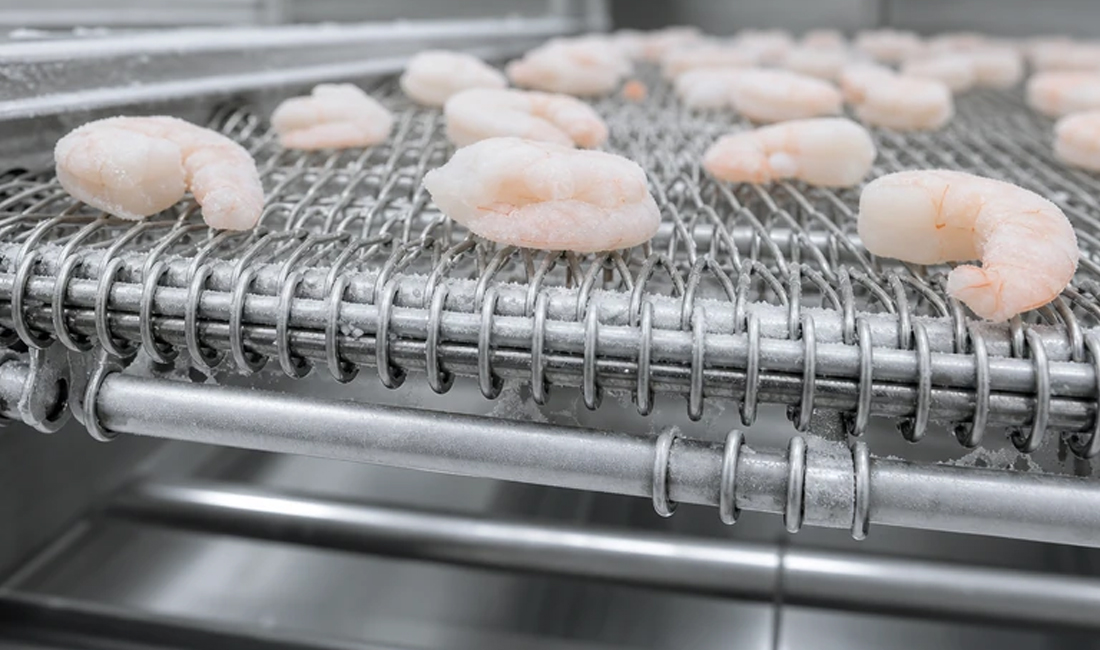
Horizontal airflow moves the cold air sideways across the belt. The air enters from one side of the spiral drum and sweeps over the products, then returns to the evaporator. This pattern works well for products spread out in a single layer, such as fillets, patties, and shrimp. The flat, open path lets the air touch the top and sides of each piece.
Horizontal airflow gives good control over air speed on each tier. Baffles and ducts guide the air so it does not skip a level. This helps the freezer treat the top tiers and the bottom tiers in a similar way. Even so, the design must manage the pressure drop across the drum. If the air loses too much pressure on its way through, the far side of the belt gets weaker flow.
How Vertical and Counter-Current Airflow Work
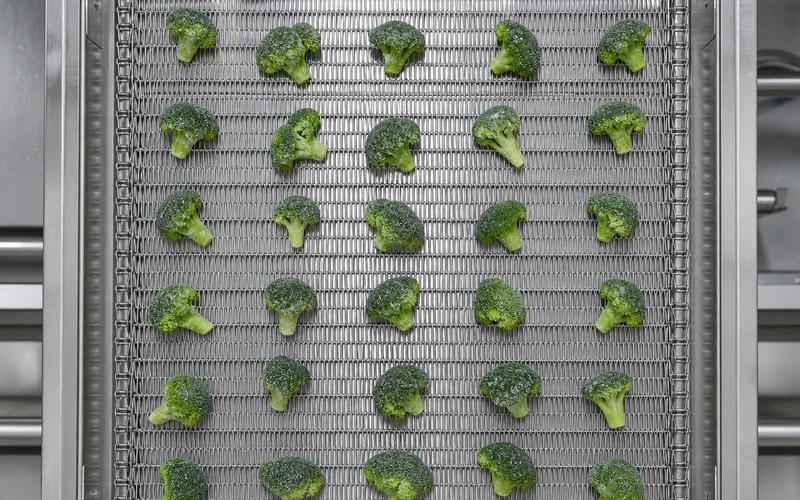
Vertical airflow moves the cold air up or down through the belt tiers instead of across them. The air passes through the mesh of the belt and reaches products from below and above. This pattern suits products that need airflow on all sides, such as diced vegetables, berries, and small dumplings. It works best with an open belt that lets air pass through freely.
Many designs use a counter-current setup. Here the coldest air meets the coldest, nearly finished product near the exit. The warmer incoming product meets slightly warmer air near the entry. This match keeps the temperature gap steady along the whole path. A steady gap makes better use of the coil and helps hold a uniform freezing rate from start to finish.
Why Neither Airflow Pattern Fits Every Application
No single airflow pattern wins every time. Horizontal airflow shines with flat, single-layer products, but it can struggle to reach the underside of thick or stacked items. Vertical airflow reaches all sides of small pieces, but it needs an open belt and can lift very light products if the speed is too high.
This is why a serious manufacturer studies the product first, then picks the pattern. Some freezers even blend both ideas across different zones. The lesson for buyers is clear: the airflow pattern should match the food, the packaging, and the plant goal. A pattern chosen for the wrong product will waste energy and leave warm cores.
What Determines Spiral Freezer Airflow Performance?
Airflow performance depends on the balance between air velocity, air volume, and static pressure, and on how well the parts around the coil work together. A strong number in one area cannot cover a weak one in another. Good performance comes from the whole system, not from a single spec.
Balance Air Velocity, Air Volume, and Static Pressure
Three values shape airflow performance. Air velocity is how fast the air moves, often 1 to 6 meters per second. Air volume is how much air moves per hour, measured in cubic meters per hour. Static pressure is the force the fan must supply to push air through the coil, belt, and product load.
These three values pull against each other. Push for more volume and the static pressure rises. Chase a very high velocity and the fan power climbs fast. A good design finds the balance that meets the freezing target with the least energy. It sizes the fans to deliver the needed volume at the real static pressure of a loaded belt, not an empty one.
Coordinate Fans, Evaporators, Baffles, and Ducting
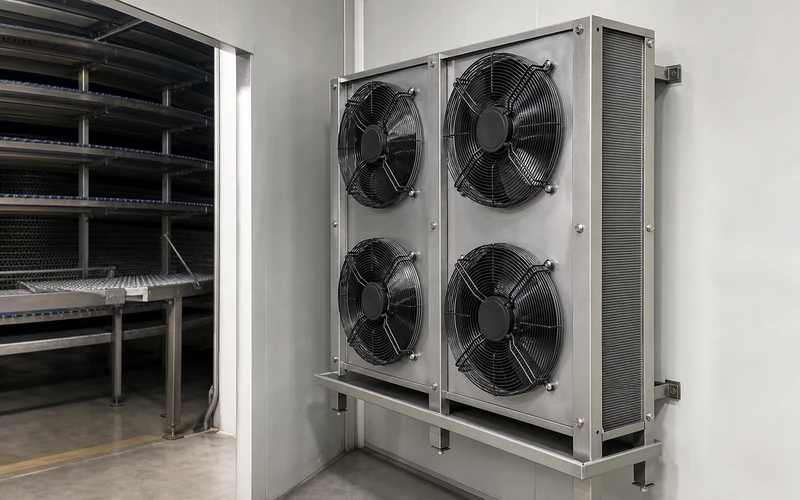
Airflow is shaped by several parts working as a team: fans, evaporators, baffles, and ducting. The fans supply the flow. The evaporator cools the air and also adds resistance. Baffles block short paths and steer the air where it is needed. Ducting carries the air to and from each tier.
If one part is off, the whole flow suffers. An oversized fan against a blocked duct just wastes power. A strong coil with poor baffles lets air short-circuit back before it reaches the food. Square Technology builds many of these parts in house, including the evaporator, the panels, and the belt. In-house parts let the design team match the fan, coil, and duct as one unit, which keeps the airflow steady and the losses low.
Account for Belt Openness, Tier Spacing, and Product Loading
The belt and the load also change how air flows. Belt openness is the share of open area in the mesh. An open belt lets vertical air pass through, while a tight belt blocks it. Tier spacing is the gap between belt levels. Wider gaps ease airflow but lower the product density. Product loading is how much food sits on the belt.
Heavy loading fills the gaps and raises resistance, so the fan must work harder to keep the same flow. A smart design plans for a full belt, not a light test run. It sets belt openness, tier spacing, and loading together so the air still reaches every piece when the line runs at full rate.
How Should Airflow Design Match the Product?
Airflow design should match the product because the food sets the limits, not the machine. The size, shape, weight, and packaging of the product decide the safe air speed and the best airflow pattern. A design tuned to the product freezes faster, protects quality, and avoids waste.
Consider Product Size, Shape, Weight, and Packaging
Every product has traits that guide the design: size, shape, weight, and packaging. A thick chicken breast holds heat deep in the core and needs more time and steady air. A thin fillet freezes fast and needs even flow to avoid over-drying the surface. Packaging matters too. A boxed cake blocks direct airflow, so the air must cool the box, which then cools the food. An unwrapped berry meets the air face to face and freezes much faster.
The design reads these traits and sets the plan. It chooses the air speed, the pattern, and the belt time to fit the exact product. This is why a freezer built for seafood may not suit boxed pastry without changes.
Protect Lightweight and Delicate Products from Movement
Light and delicate products need special care. High air speed can push, roll, or blow small items off the belt. Products such as shrimp, green peas, and sliced fruit are easy to move. If the air lifts them, the batch loses weight and the belt gets messy.
A matched design keeps the air speed below the point where products start to move. It may use a gentler vertical flow or a plastic modular belt that holds pieces in place. The goal is firm freezing without loss. On an IQF line, this care also keeps each piece separate, so the food does not clump into a frozen block.
Allow for Product Moisture and Frost Load
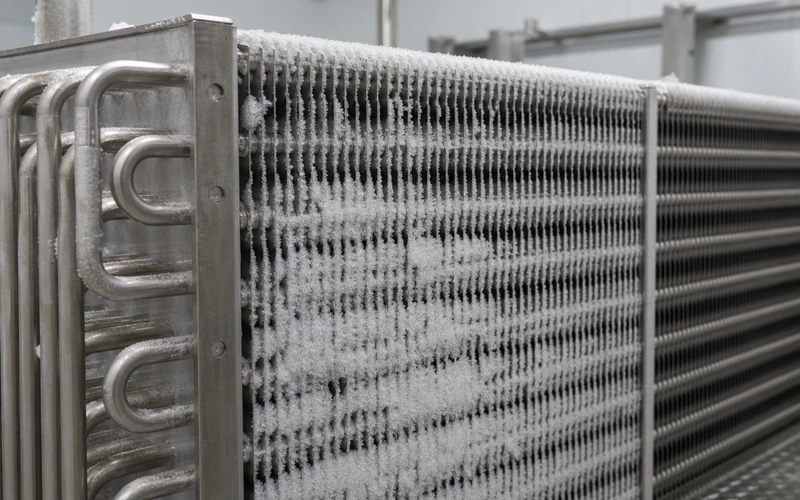
Wet products add water to the air, and that water turns to frost on the coil. Products such as marinated meat, washed vegetables, and glazed seafood carry a lot of surface moisture. As they freeze, this moisture leaves the food and lands on the cold evaporator fins as frost.
Frost is the enemy of steady airflow. It blocks the coil and cuts the air volume over time. A good design plans for this frost load from the start. It leaves room in the coil and gives the fans enough reserve to hold flow as frost builds. It also pairs the airflow with a defrost plan, which the next sections cover in more detail.
How Does Airflow Design Affect Freezing Results and Operating Cost?
Airflow design affects both the freezing result and the running cost at the same time. Good airflow cuts freezing time, lifts capacity, and improves quality, while it also holds fan power and refrigeration load in check. Poor airflow does the reverse. It leaves warm cores, lowers yield, and burns extra energy.
Control Freezing Time and Production Capacity
Airflow sets the freezing time, and freezing time sets the capacity. Faster, more even air pulls heat out sooner, so the product reaches its target core temperature in less belt time. A common IQF target is a core of -18°C, reached in about 8 to 15 minutes for small pieces at an air temperature near -35°C.
Shorter freezing time means the belt can move faster or hold more product. Both raise the output in kilograms per hour. Spiral freezers from Square Technology often run between 500 kilograms and several tons per hour, based on the product and the design. Better airflow lets a plant reach the high end of that range without a bigger machine.
Improve Core Temperature Uniformity, Yield, and Product Quality
Even airflow gives even results: uniform core temperature, higher yield, and better quality. When every piece meets similar air, the whole batch reaches the same core temperature. There are no warm centers and no over-frozen edges.
Uniform freezing also protects yield. Fast, even freezing forms small ice crystals inside the food. Small crystals do less harm to the cell walls, so the product keeps more of its water when it thaws. This means less drip loss and better texture. For an IQF product, even airflow also keeps each piece loose and free-flowing. These quality gains link straight back to the airflow map, not just the set temperature.
Manage Fan Power and Refrigeration Load
Airflow drives two big energy costs: fan power and refrigeration load. Fans run all day, so their power use adds up fast. Fan power rises sharply with air speed, so a small jump in speed can bring a large jump in energy. A smart design uses only the speed the product needs, and no more.
The refrigeration load is the heat the system must remove. It includes the heat from the product, the fans, and any air leaks. Fan heat is often larger than people expect, since fan motors add their own heat to the room. A high-efficiency evaporator helps here. Square Technology reports a heat exchange rate more than 20% higher than older coils, which lets the system move the same heat with less energy. Lower fan speed and a strong coil work together to cut the total power bill.
How Is Spiral Freezer Airflow Design Validated?
Airflow design is validated with a mix of simulation, product trials, and direct measurement. A design is not proven by a drawing alone. It is proven when the airflow, the air temperature, and the product core temperature all meet the target under real running conditions.
Use CFD to Identify Dead Zones and Air Short-Circuiting
Engineers use CFD to check the airflow before they build. CFD stands for Computational Fluid Dynamics. It is a computer model that shows how air moves through the freezer. The model reveals problems that are hard to see in a drawing.
Two problems matter most: dead zones and air short-circuiting. A dead zone is a spot where the air barely moves, so products there freeze slowly. Air short-circuiting is when the air rushes straight back to the coil without passing over the food. CFD maps both. The team then adjusts the baffles, ducts, and fan layout on the model until the flow is even, all before any steel is cut.
Run Product Trials Under Actual Belt Loading
A model is a start, but real food is the true test. Manufacturers run product trials with the actual product on the belt. They load the belt at the real production rate, not a light sample. Full loading changes the airflow, since the product itself adds resistance.
These trials show how the design behaves under stress. They reveal if the air still reaches every piece when the belt is packed. They also check the freezing time against the plan. A trial under true loading gives a result the plant can trust, since it matches the way the line will run each day.
Measure Air Velocity, Air Temperature, and Product Core Temperature
Trials only count if the team measures the right things: air velocity, air temperature, and product core temperature. Air velocity meters check the speed at many points across the tiers. This confirms the flow is even and not just strong in one spot. Sensors track the air temperature around the coil and the belt.
The core temperature is the final proof. The team places probes in the center of the product and follows the reading as the food moves through the freezer. The product passes only when the core hits the target, such as -18°C, within the planned belt time. Numbers, not guesses, decide if the design works.
Confirm Performance as Frost Builds During Production
A freezer that works clean must also work with frost. As production runs, frost builds on the evaporator and slowly blocks the airflow. A good validation checks performance across a full run, not just the first hour. The design must still hit the core temperature target near the end of a production cycle.
This is where frost control earns its keep. Systems such as sequential defrost and real-time air defrost help hold the airflow steady. Square Technology’s air defrost method sends pulses of high-speed air over the coil fins while the products keep running. With frost held back, some designs can run for up to 14 days before a full defrost is needed. A design proven across the whole cycle gives the plant a result it can count on shift after shift.
What Should Buyers Verify Before Approving the Design?
Buyers should verify the data, the test conditions, and the true overall performance before they sign off. A single headline number, such as a peak air speed, does not prove a freezer will work for a given product. The safe path is to check the full picture and ask for proof.
Provide Complete Product and Process Data
Good design starts with good input, so buyers should provide complete product and process data. This includes the product type, the size, the weight, the entry temperature, and the target core temperature. It also includes the required output in kilograms per hour and the plant’s refrigeration setup.
Missing data leads to a poor match. If a supplier does not know the real entry temperature or the true output goal, the airflow design can only be a guess. Buyers who share full and honest data give the manufacturer what it needs to size the fans, the coil, and the belt for the actual job.
Request Airflow Maps, Test Conditions, and Acceptance Criteria
Buyers should ask for proof in writing: airflow maps, test conditions, and acceptance criteria. An airflow map shows how the air spreads across the tiers and where any weak spots sit. Test conditions state the load, the air temperature, and the product used in the trial. Acceptance criteria set the pass mark, such as a core temperature of -18°C within a set belt time.
These documents turn promises into checks. They let the buyer confirm the freezer was tested in a way that matches the real plant. They also give a clear standard for factory tests and site startup. With them in hand, a buyer can hold the design to a fair and measurable bar.
Compare Overall Performance, Not Just Maximum Air Velocity
The last step is to compare overall performance, not just the maximum air velocity. A high peak air speed looks good on paper, but it says little about even freezing or energy use. A freezer with a lower peak speed and better air distribution can freeze the same product faster and cheaper.
So buyers should weigh several factors together: freezing uniformity, energy use, frost control, and belt loading. The best value comes from the whole package, not from one bold number. This wider view protects the plant from a machine that wins a spec sheet but loses on the floor.
Conclusion: Choose a Verified Airflow System, Not a Single Airflow Number
Spiral freezer airflow design is a balance, not a race for the coldest air or the fastest fan. The goal is to send the right amount of cold air to every product in a steady, even way, while holding down product movement, fan power, and frost. Uniform air distribution, a matched airflow pattern, and a coil and fan set sized as one system are what deliver fast, even freezing at a fair cost.
The smart choice is a verified system, not a single airflow number. A trusted spiral freezer design is proven with CFD, product trials, and core temperature checks under full loading and real frost. For products that must stay loose and separate, an IQF freezer built on the same airflow rules keeps each piece free-flowing and high in quality. Buyers who share full data, ask for airflow maps and clear acceptance criteria, and judge the whole package will get a freezer that performs day after day, and not just on paper.