A smart refrigeration monitoring and control system helps food plants protect product quality, reduce energy waste, and find equipment problems before they stop production. It uses sensors, PLC controls, alarms, and software dashboards to track temperature, pressure, energy use, and machine health in real time.
Based on industrial refrigeration and food processing project experience, this guide explains why smart monitoring matters and when it can pay back. It covers manual logs, electronic records, energy-saving controls, predictive maintenance, spiral freezer and IQF monitoring, installation timing, system integration, sensor accuracy, cloud security, and common questions for existing plants.
What Is a Smart Refrigeration Monitoring and Control System?
A smart refrigeration monitoring and control system combines sensors, controllers, and cloud-connected software to track temperature, pressure, energy use, and equipment health in real time. It triggers automatic responses, sends alarms when readings drift, and creates digital records for food safety audits.
The system has three working layers:
- Sensor Layer. Temperature probes, pressure transmitters, vibration sensors, and energy meters installed across compressors, condensers, evaporators, and storage rooms.
- Control Layer. PLC controllers process sensor data and adjust valves, fans, and compressor speeds based on programmed rules.
- Software Layer. SCADA dashboards display live readings. Cloud platforms store historical data for analysis and audit access.
The control function is what separates a smart system from a basic data logger. A logger records readings. A control system acts on them.
How Much Does an Unmonitored Refrigeration Failure Cost a Food Plant?
An unmonitored refrigeration failure costs a food plant $50,000 to $500,000 per event. The cost comes from product spoilage, production downtime, recall scope, and equipment damage. Industry estimates put unplanned cold storage downtime at $2,500 per hour for medium-sized facilities.
The four cost categories from a single failure event are listed below:
- Inventory Loss. Frozen product warming above -18°C falls outside cold storage specifications. According to USDA guidance, frozen inventory should not rise above -12°C for any extended period. A single chamber in a large-scale cold storage facility may hold 200,000to200,000 to 200,000to1 million in product.
- Production Downtime. Idle workers, missed shipping deadlines, and contract penalties accumulate at $2,500 per hour or more.
- Recall Exposure. Missing temperature records during a deviation period trigger precautionary recall of all products made in that window.
- Equipment Damage. A failed compressor often damages downstream components. Replacement costs range from $30,000 to $150,000.
These costs are largely preventable through monitoring alerts that trigger before temperatures cross safety thresholds.
Why Do Manual Temperature Logs No Longer Meet Modern Food Safety Requirements?
Manual temperature logs no longer meet modern food safety requirements because they leave gaps between readings and cannot prove temperatures stayed within range between checks. FSMA, BRC, and SQF audits now require continuous electronic records with timestamp verification and automated alert documentation.
The table below compares manual logs against continuous electronic monitoring across four audit criteria:
| Criteria | Manual Logs | Electronic Monitoring |
| Recording frequency | Every 2–4 hours | Every 1–5 minutes |
| Tamper resistance | Low | High (timestamped data) |
| Deviation detection | At next check | At the moment it occurs |
| Audit retrieval time | Hours to days | Minutes |
A 4-hour gap in manual logging means a deviation can last nearly 4 hours before any operator notices. According to FDA FSMA Preventive Controls rule (21 CFR Part 117), records must show that critical control points were monitored at adequate frequency with documented verification. Industry best practice now treats continuous electronic monitoring as the default standard.
How Does Real-Time Monitoring Lower Industrial Refrigeration Energy Bills?
Real-time monitoring lowers industrial refrigeration energy bills through floating head pressure control, demand-based defrost scheduling, and compressor load matching. According to U.S. Department of Energy data (2020), these strategies cut refrigeration energy use by 15–30%, and refrigeration accounts for 50–70% of total plant electricity consumption.
The three main energy-saving controls are described below:
- Floating Head Pressure Control. The system lowers condensing pressure when outdoor temperature drops, instead of holding a fixed setpoint. This alone improves seasonal efficiency by 8–15%.
- Demand-Based Defrost. Defrost cycles trigger when sensors detect actual frost buildup, not on a fixed timer. Plants typically eliminate 30–50% of unnecessary defrost cycles.
- Compressor Load Matching. Variable-speed drives adjust compressor output to match real cooling demand. Part-load operation accounts for 60–70% of annual run hours in most food plants.
A plant with $300,000 annual refrigeration energy cost can save $45,000 to $90,000 per year when these three controls work together. The 15–30% range reflects combined effect, not the sum of individual measures, since the strategies overlap in their impact.
Which Equipment Failures Can Be Caught Before They Cause Production Loss?
Smart monitoring catches five common refrigeration failures before they stop production: compressor short-cycling, refrigerant charge loss, evaporator fan motor wear, condenser fouling, and oil pressure drop. Pattern detection in continuous data streams identifies abnormal trends 24 to 72 hours before equipment alarms trigger.
The table below shows the early warning signal for each failure type:
| Failure Type | Early Warning Signal | Lead Time Before Failure |
| Compressor short-cycling | Run cycles shorter than 5 minutes | 1–2 weeks |
| Refrigerant charge loss | Gradual suction pressure decline | 3–7 days |
| Evaporator fan motor wear | Rising motor current draw | 1–4 weeks |
| Condenser fouling | Widening approach temperature | 2–8 weeks |
| Oil pressure drop | Pressure trend below baseline | 24–72 hours |
Each signal triggers a maintenance alert before the failure reaches critical level. Industry maintenance studies show that predictive maintenance based on continuous monitoring cuts unplanned downtime by 25–40% compared to fixed-schedule maintenance.
What Does Continuous Monitoring Add to Spiral Freezer and IQF Operations?
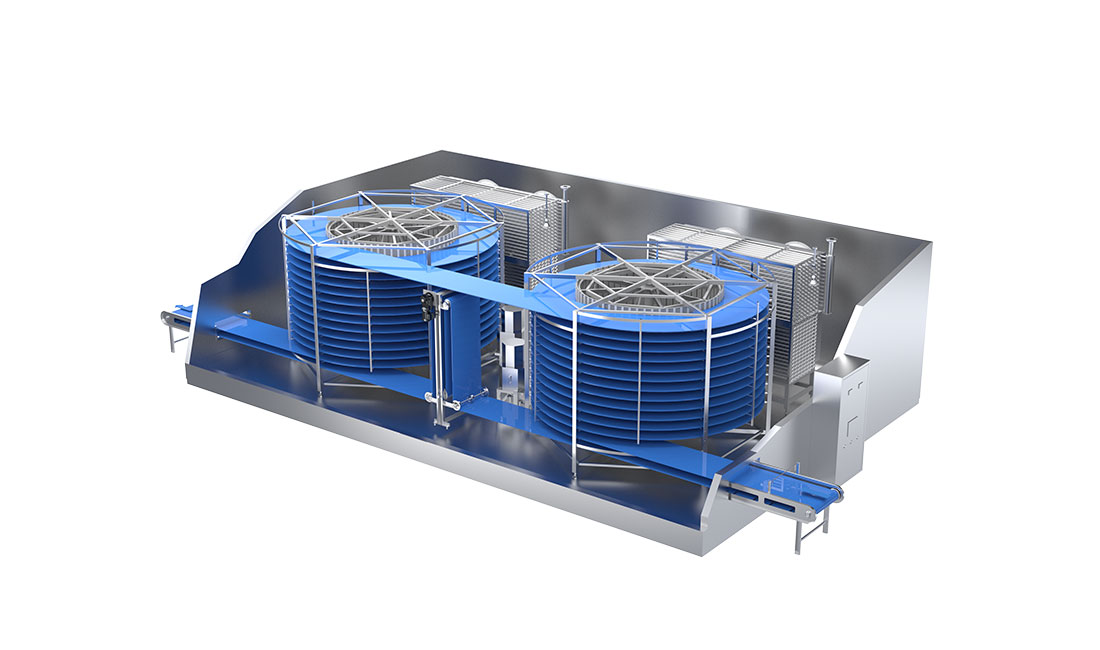
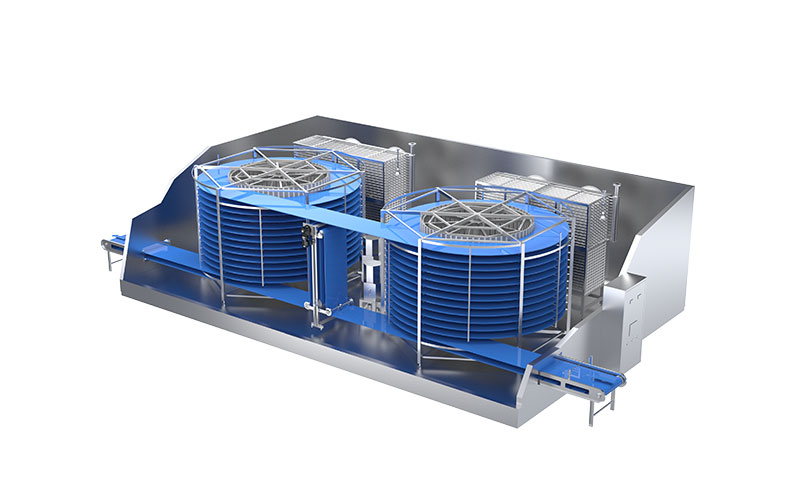
Continuous monitoring adds three capabilities to spiral freezer and IQF operations: evaporating temperature stability maintained within design tolerance, belt speed coordination with freezing load, and product core temperature verification at the belt exit.
The three monitoring functions specific to IQF and spiral freezers are described below:
- Evaporating Temperature Stability. Sensors track refrigerant-side temperature continuously. Variations approaching ±1°C trigger control valve adjustments before product quality is affected. This prevents the ice-crystal damage caused by unstable freezing rates.
- Belt Speed and Load Matching. Belt speed adjusts to incoming product mass and infeed temperature. Faster belts during light loads save energy. Slower belts during heavy loads protect product core temperature.
- Core Temperature Verification. Infrared sensors at the belt exit confirm finished product temperature against the target setpoint. Out-of-spec product is flagged before packaging.
These controls reduce drip loss after thawing and maintain the freezing curves required for HACCP records on raw seafood, poultry, and meat lines.
When Is the Right Time to Install a Refrigeration Monitoring System?
The right time to install a refrigeration monitoring system is during plant expansion, equipment replacement, or after the first unplanned downtime event. Plants with annual refrigeration energy costs above $100,000 typically recover the system cost within 18 to 36 months.
Four common trigger points justify installation:
- Plant Expansion. New equipment integrates more easily during commissioning than during retrofit.
- Major Equipment Replacement. Sensor and controller installation happens alongside compressor or condenser replacement — the natural time to evaluate CO2 cascade refrigeration systems alongside other modernization upgrades.
- First Unplanned Downtime Event. A single avoided failure pays back 30–60% of the system cost.
- Pre-Audit Preparation. Plants seeking BRC, SQF, or FSSC 22000 certification require continuous electronic records.
Waiting carries hidden cost. Each month without monitoring extends exposure to spoilage, downtime, and audit findings. The cost of one major failure exceeds the cost of installing a system across the entire plant.
How Does a Monitoring System Integrate With Existing Refrigeration Equipment?
Modern monitoring systems integrate with existing refrigeration equipment through standard industrial protocols including Modbus, BACnet, and OPC UA. Most plants complete installation within 2 to 4 weeks. There is no need to replace functioning compressors, condensers, or evaporators.
Four integration steps make up a typical installation:
- Equipment Audit. Engineers identify existing PLC controllers, sensor locations, and protocol versions.
- Sensor Placement. New probes install at critical points: compressor discharge, condenser water lines, evaporator outlets, and storage rooms.
- Controller Connection. Existing PLCs link to the monitoring platform through approved gateways. Legacy controllers may need a protocol converter.
- Operator Training. Plant staff learn dashboard navigation, alarm response, and report generation. Training takes 4 to 8 hours per operator.
Cloud-based platforms include role-based access, encrypted data transfer, and on-site backup storage. Plants concerned about network security can run the system on a private network with no internet exposure.
FAQs
How Long Does It Take to Install a Refrigeration Monitoring System in an Existing Plant?
Most installations take 2 to 4 weeks from equipment audit to operator handover. Large multi-zone plants may take 6 to 8 weeks. Installation usually occurs during scheduled maintenance windows to avoid production interruption.
What Is the Typical Payback Period for a Smart Refrigeration Monitoring System?
Payback ranges from 18 to 36 months for plants with annual refrigeration energy costs above $100,000. Energy savings of 15–30% combined with avoided downtime drive the return. Plants with frequent failure history see faster payback.
Can a Monitoring System Work With Refrigeration Equipment From Different Manufacturers?
Yes. Industrial protocols like Modbus, BACnet, and OPC UA allow integration across compressor, condenser, and evaporator brands. Legacy equipment without these protocols needs a gateway device, which adds $1,000 to $3,000 per controller.
What Temperature Accuracy Do Industrial Refrigeration Sensors Provide?
Industrial RTD and thermocouple sensors provide accuracy of ±0.2°C across the range from -50°C to +50°C. This meets the precision required for IQF freezing curves, cold storage compliance, and HACCP record-keeping.
Is Cloud-Based Refrigeration Monitoring Secure for Food Production Data?
Cloud-based platforms use encrypted data transfer, role-based access, and ISO 27001-certified hosting. Plants requiring full network isolation can deploy on-premise versions with the same software. Both options meet food safety data retention requirements.
How Many Sensors Does a Typical Industrial Refrigeration Plant Require?
A typical food plant requires 30 to 150 sensors depending on plant size and zone count. A single spiral freezer needs 8 to 12 sensors for evaporator, belt, and product monitoring. A cold storage room needs 4 to 6 sensors.